SEO Workflow Use Cases by Funnel Stage
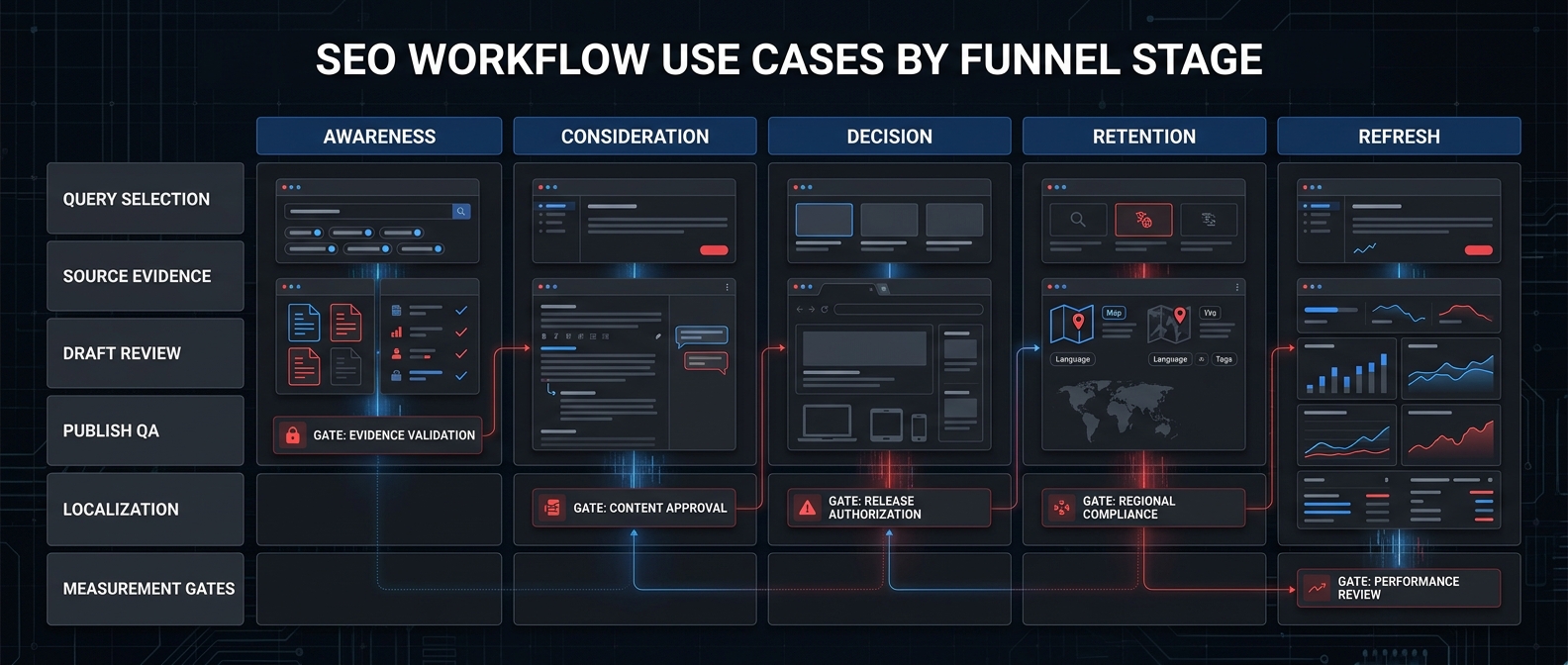
SEO workflow is not one thing. The useful workflow depends on where the reader is in the funnel and what the page needs to do next.
If the page is for awareness, the workflow should discover and qualify demand. If it is for consideration, the workflow should help readers compare options. If it is for decision, the workflow should prove the page can support a purchase or implementation choice. If it is for retention, the workflow should help existing users succeed. If it is for refresh, the workflow should recover or protect a URL that already has traction.
That is why "SEO workflow use cases by funnel stage" is a better question than "what is the one best SEO workflow?" Different stages need different inputs, different review gates, and different metrics.
The stage map
| Funnel stage | Primary use case | Workflow output | Main gate | Main metric |
|---|---|---|---|---|
| Awareness | Topic discovery, query clustering, problem framing | Brief, outline, first draft | Intent fit and source quality | Impressions and CTR |
| Consideration | Comparison pages, checklists, evaluation content | Matrix, FAQ, conversion path | Clear differentiation | Clicks and assisted signups |
| Decision | Product pages, implementation guides, integration pages | Release-ready page with proof | Claim accuracy and route checks | Qualified signups and demo intent |
| Retention | Onboarding docs, advanced guides, lifecycle content | Supportive content that reduces friction | Freshness and route parity | Activation, return usage, expansion |
| Refresh | Content decay fixes, merge plans, update work | Updated URL or canonical replacement | Canonical ownership and evidence update | Recovered clicks and indexed URLs |
The practical job is not to automate everything. It is to match the workflow to the stage.
Awareness: discover the demand first
At the awareness stage, the workflow should find the problem before it tries to solve it.
Good awareness work usually starts with:
- query clusters
- related questions
- support tickets
- sales objections
- competitor snippets
- internal search terms
The output is not a pitch. It is a clean problem statement with enough evidence to justify a page.
For TokenTest, that means using the workflow to separate broad topics like "SEO workflow" from narrower problems like "how to choose the right workflow for a funnel stage." The second version is usually easier to own because it creates a more specific page decision.
The main gate here is intent fit. If the page does not answer a real search problem, the workflow is too loose.
Consideration: help readers compare
At the consideration stage, the reader already knows the problem. Now they want a framework for choosing between options.
This is where SEO workflow content should become more concrete:
- comparison pages
- checklist articles
- evaluation frameworks
- workflow diagrams
- buyer questions
- decision matrices
The workflow should surface tradeoffs, not just definitions. A reader in consideration wants to know what to automate, what to keep manual, what proof to ask for, and what the exit criteria should be.
This stage is also where internal links matter most. A comparison-style page should point readers toward adjacent workflow content, not leave them stranded on a single page.
For this topic, useful internal anchors include SEO Automation Strategy for Growth Teams, Keyword Research Automation Strategy for Growth Teams, and Technical SEO Automation Tools: Evaluation Framework.
The main gate here is differentiation. If the page does not explain why one workflow is better for a specific use case, it is not helping a buyer compare.
Decision: prove the page can support action
At the decision stage, the workflow should make it easy to say yes.
That usually means pages like:
- implementation guides
- integration pages
- product evaluations
- pricing-adjacent explainers
- migration guides
- setup checklists
Decision-stage pages should reduce uncertainty. They need clearer proof, stronger claims discipline, and more exact route checks than awareness or consideration pages.
This is also where product evidence matters. TokenTest's homepage and manual describe a production-reference evaluation console that checks model identity, token behavior, safety, and route integrity without storing the API key. That kind of current product proof is useful before the CMS boundary when draft content or translation is AI-assisted.
The main gate here is claim accuracy. If the page makes a promise the product cannot support, the workflow fails.
Retention: keep the workflow useful after signup
Retention content is often ignored, but it is one of the most practical SEO workflow use cases.
This stage includes onboarding guides, advanced how-tos, lifecycle content, troubleshooting pages, release notes, and adoption playbooks. The goal is not just traffic. It is helping existing users adopt the product faster, return to the product more often, and expand usage with less friction.
For a product like TokenTest, retention content should map to the same release discipline as the public blog: source evidence, route checks, and a clear measurement plan. The difference is that the metric is less about first click and more about activation and repeat use.
The main gate here is freshness. Retention content becomes stale quickly if it does not track the current product and workflow.
Refresh: protect what already works
Refresh work is the stage where a good SEO workflow saves more value than a new page ever could.
Use a refresh workflow when:
- the URL already owns the intent
- the page has decayed
- the evidence is outdated
- the structure is too thin
- the content overlaps with a newer page
- the page needs a merge or redirect decision
Refresh work should be explicit about whether the right move is update, merge, or retire. That decision is often more important than adding another section.
The main gate here is canonical ownership. If two pages are trying to do the same job, the workflow should fix that before it adds more content.
How to choose the right workflow first
Pick the workflow by asking one simple question: what outcome should this URL own?
- If the goal is discovery, use an awareness workflow.
- If the goal is evaluation, use a consideration workflow.
- If the goal is conversion or implementation, use a decision workflow.
- If the goal is activation or expansion, use a retention workflow.
- If the goal is recovery, use a refresh workflow.
This is the part that generic SEO content usually misses. A single workflow does not fit every page. The page purpose has to come first.
Where TokenTest fits
TokenTest is useful before the CMS boundary when SEO workflows depend on AI-generated drafts, summaries, or translations.
The homepage frames TokenTest as a production-reference model evaluation console. The manual shows the dimensions that matter for release decisions: model identity, usage integrity, token usage, safety, reliability, and route evidence. That makes TokenTest a good control layer when the workflow needs to verify the machine side before it changes public content.
In practice, that means using TokenTest to catch weak inputs before they become published pages:
- bad draft structure
- invalid output format
- unexpected token growth
- route or locale issues
- translation drift
For adjacent workflow context, read How to Use Blog Publishing Automation in 2026 and Content Publishing QA: Workflow Playbook for Preflight Manifests.
Conclusion
SEO workflow use cases by funnel stage are mostly about matching the workflow to the page's job.
Awareness pages should discover the problem. Consideration pages should help readers compare. Decision pages should reduce purchase or implementation risk. Retention pages should help existing users succeed. Refresh work should protect URLs that already matter.
If you treat all of those stages the same, the workflow becomes noisy. If you match the workflow to the funnel stage, the page has a much better chance of doing useful work.
For the broader operating model, see SEO Automation Strategy for Growth Teams and Content Planning AI Use Cases by Funnel Stage. For the AI-side control layer, use the TokenTest manual.
Sources and references
- TokenTest homepage
- TokenTest manual
- TokenTest blog
- Google Search Central: helpful, reliable, people-first content
- Google Search Central: SEO Starter Guide
- Google Search Central: Search Console start guide
- Google Search Central: article structured data
- GA4 help: key events
FAQ
What is SEO workflow use cases by funnel stage?
It is a way to map SEO tasks to the outcome each funnel stage needs, instead of using one generic workflow for every page.
Which stage should be automated first?
Usually awareness and refresh work, because both can benefit from structured inputs and repeatable review gates.
When should a page be refreshed instead of created?
Refresh when the URL already owns the intent and the issue is decay, overlap, or outdated evidence rather than missing coverage.