SEO Automation Strategy for Growth Teams
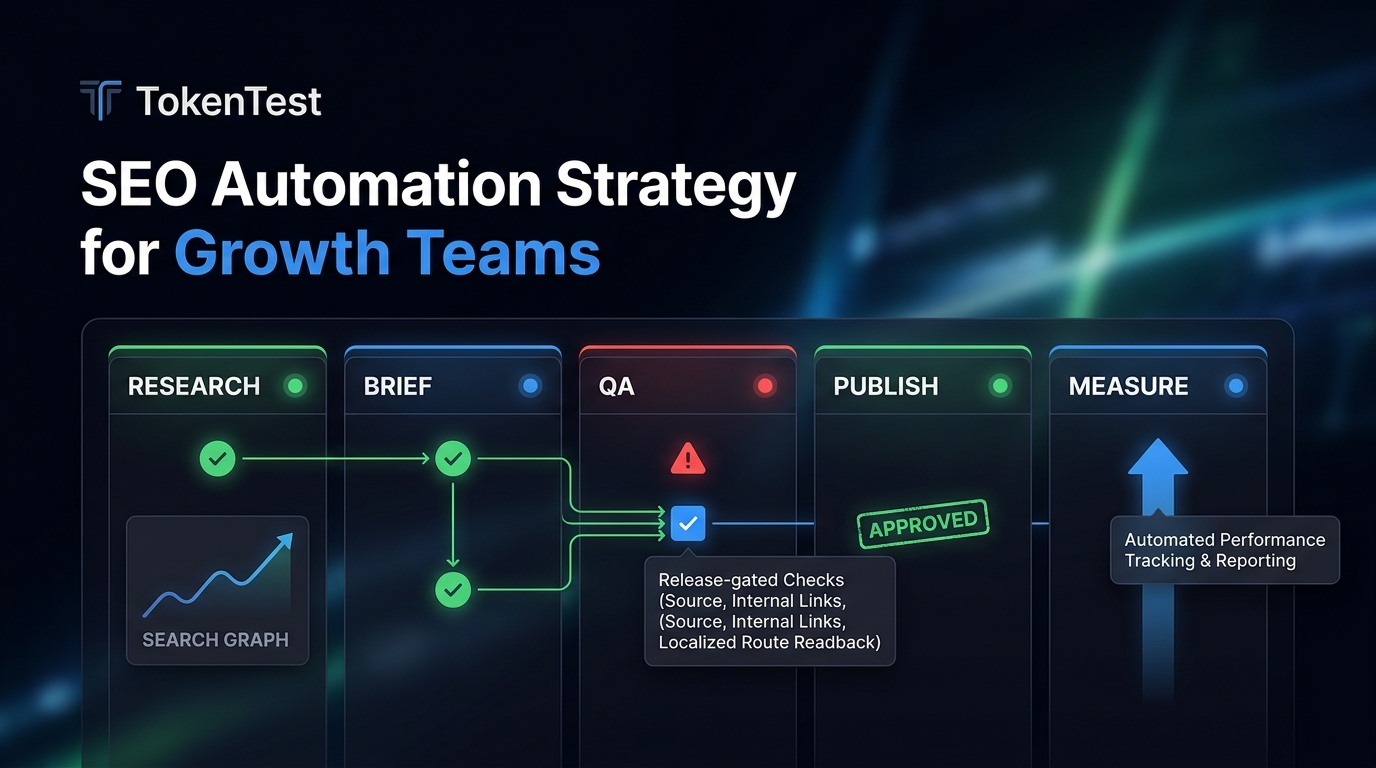
SEO automation is useful when it helps a growth team make better page decisions faster. It is risky when it simply turns weak inputs into more pages, more briefs, and more cleanup work.
For growth teams, the practical goal is not "automate SEO." The goal is to build a repeatable system that can find a search opportunity, verify the evidence, create a useful page, publish it safely, and measure whether the URL deserves more investment.
That matters because modern SEO work now includes keyword research tools, AI drafting, internal-link suggestions, CMS APIs, translation workflows, schema checks, route validation, and analytics. Without a clear operating model, SEO automation can make the team faster at publishing pages that should not have shipped.
This guide gives a practical SEO automation strategy for growth teams: what to automate, what to keep human, how to gate each step, and how to connect the workflow to measurable outcomes.
Quick Answer: What Is SEO Automation?
SEO automation is the use of software, scripts, APIs, AI systems, and workflow rules to handle repeatable SEO tasks such as query collection, clustering, brief creation, technical checks, internal-link suggestions, publishing QA, localization, and reporting.
The best SEO automation strategy does not remove judgment. It makes judgment easier to apply at the right moment.
| Workflow layer | Good automation | Human decision that should remain explicit |
|---|---|---|
| Demand collection | Pull queries, crawl URLs, collect page data, dedupe inputs | Decide which sources reflect real customer demand |
| Opportunity scoring | Score by intent, fit, freshness, proof, and internal-link support | Decide whether the page should exist now |
| Briefing | Draft outline, source checklist, entities, links, and FAQ coverage | Approve the angle and claims |
| Production | Generate draft, alt text, metadata, schema notes, and translations | Review usefulness, risk, and brand fit |
| Publishing QA | Check route, canonical, noindex, links, schema, and localized URLs | Decide publish, rollback, merge, or refresh |
| Measurement | Track clicks, indexed URLs, assisted conversions, and refresh triggers | Decide what to do with the evidence |
Why Growth Teams Need a Different SEO Automation Strategy
Most SEO automation advice is tool-led: buy a platform, connect data sources, generate briefs, and publish more. That is only part of the problem.
Growth teams need a release system because SEO decisions affect more than rankings. A page can create duplicate intent, weaken internal links, overstate a product claim, publish stale translations, or collect traffic that never converts.
A better SEO automation strategy starts with four constraints:
- Every new URL needs a search hypothesis.
- Every claim needs a source or a clear owner.
- Every publish event needs a live-route check.
- Every article needs a measurement plan before it ships.
This is where TokenTest's current content strategy fits the topic. TokenTest is positioned around production-reference evaluation, model verification, token usage, and workflow evidence. The same discipline applies to SEO automation: automated output should be treated like a release artifact, not a finished decision.
The Six-Stage SEO Automation Workflow
Use this six-stage workflow when building SEO automation for a growth team.
1. Collect Demand Signals
Automate collection before you automate writing.
Useful inputs include:
- Google Search Console queries
- existing blog and landing-page inventory
- site search terms
- sales and support notes
- competitor page patterns
- product roadmap themes
- community questions
- paid search query reports when available
The output should be a clean input table, not a content calendar yet.
| Field | Why it matters |
|---|---|
| Query or topic | Keeps the demand signal visible |
| Source | Separates Search Console evidence from brainstormed ideas |
| Intent | Prevents one page from trying to serve every searcher |
| Funnel stage | Aligns CTA and proof level |
| Existing URL owner | Prevents cannibalization |
| Proof available | Shows whether the team can support the article |
| Business relevance | Keeps traffic aligned with qualified signups or pipeline |
2. Cluster by Intent and Page Type
SEO automation should group similar terms by the job the searcher is trying to do.
For example, "SEO automation," "SEO automation guide," and "SEO automation tools" can all be related, but they may not deserve the same page. A guide should teach a workflow. A tools page should help compare options. A technical SEO automation page should focus on crawls, indexability, schema, and route monitoring.
The automation should propose clusters. A human owner should approve the canonical page decision:
- create a new article
- refresh an existing article
- merge into an existing page
- add an internal link
- defer because proof is weak
This gate protects the team from publishing several near-duplicate pages because an automation system found several keyword variants.
3. Score Opportunities Before Drafting
Do not score only on search volume. A high-volume topic can still be a poor fit if the team cannot answer it better than existing pages.
Use a small scoring model:
| Factor | Weight | Automation input | Human review |
|---|---|---|---|
| Intent match | 25 | Query modifiers, SERP page types, existing URL match | Does the planned page satisfy the dominant intent? |
| Business relevance | 20 | ICP tags, funnel stage, CTA fit | Would the right visitor be valuable? |
| Proof availability | 20 | Source list, product evidence, examples, data availability | Can claims be supported without stretching? |
| Content gap | 15 | SERP pattern notes, current inventory, competitor structure | What will this page add that generic results miss? |
| Internal-link support | 10 | Relevant existing URLs and anchor suggestions | Are the links useful to readers? |
| Publish readiness | 10 | category, schema, image, route, localization, measurement | Can this page ship cleanly? |
This keeps SEO automation tied to decisions instead of output volume.
4. Generate a Brief With Evidence
AI can help assemble a brief, but the brief should be structured enough to audit.
A usable SEO automation brief should include:
- primary keyword and intent
- secondary keywords and entities
- searcher pain
- article scarcity statement
- source checklist
- internal links
- outline
- product claim boundaries
- image brief
- schema notes
- CTA
- measurement plan
The scarcity statement is the most important field. If the brief cannot explain what the article gives readers that current results do not, the workflow should return to research.
For this article, the scarcity angle is a release-gated SEO automation strategy for growth teams: not just a tool list, but a workflow that separates repeatable automation, AI-assisted work, human review, publishing QA, localization, and measurement.
5. Gate Drafting, Publishing, and Localization
SEO automation often fails at the handoff between "content is drafted" and "URL is safely live." Treat publishing as a release.
Use three gates:
| Gate | Checks |
|---|---|
| Content gate | Intent match, source support, no unsupported claims, internal links, CTA fit, one H1, useful FAQ |
| Production gate | slug, metadata, category, canonical, schema notes, image alt text, route 200, no page-level noindex |
| Measurement gate | Search Console property, GA4 or analytics event, baseline date, conversion path, refresh trigger |
If the workflow translates articles, add localized route checks. A source article that works in English can still fail if the translated URL is missing, stale, or indexed with the wrong canonical.
6. Measure and Feed the Next Cycle
SEO automation should not end at publish. The useful loop is:
- publish the URL
- validate the live route
- store the baseline
- wait for crawl and discovery
- compare query impressions and clicks
- inspect qualified signup or assisted conversion behavior
- decide keep, refresh, merge, or retire
The planning metric for this article is organic clicks, indexed URL count, qualified signups, and assisted conversions from the article URL. That is a better target than raw article count.
What to Automate First
Start with low-risk, high-repeatability tasks.
| Priority | Automate this | Why it is safe |
|---|---|---|
| 1 | Link and route checks | Deterministic and easy to verify |
| 2 | Inventory and URL owner lookup | Reduces duplicate page decisions |
| 3 | Internal-link suggestions | Useful when human-reviewed |
| 4 | Source checklist generation | Speeds research without replacing verification |
| 5 | Brief skeletons | Helpful when backed by explicit evidence |
| 6 | Translation drafts | Useful only with localized route and canonical checks |
| 7 | Refresh alerts | Strong when connected to actual performance data |
Delay fully automated publishing until the team has stable source rules, category rules, image rules, schema rules, and readback checks.
What Should Stay Human
Keep these decisions explicit:
- whether a topic deserves a new URL
- whether a claim is strong enough to publish
- whether a product comparison is fair
- whether a searcher would trust the article
- whether a translated page preserves meaning
- whether a traffic opportunity matches the business
- whether a page should be merged, refreshed, or retired
Human review is not an apology for weak automation. It is the control point that keeps the workflow aligned with business and search intent.
Where TokenTest Fits
TokenTest is not a generic SEO suite. The live TokenTest homepage describes a production-reference evaluation console for AI middle-layer buyers, and the product manual documents model identity, protocol consistency, token usage integrity, output discipline, safety, and reliability checks.
That matters when SEO automation includes AI-generated briefs, AI-assisted drafting, model-routed content workflows, or translation. If a prompt, model, endpoint, or workflow can change the cost or quality of generated content, it should be verified before the content reaches the CMS.
In practical terms, TokenTest can support the verification layer around AI-assisted SEO work:
- verify model and endpoint behavior before large content batches
- check token usage and truncation risk in long briefs or translations
- compare model behavior before switching content-generation providers
- preserve evidence when a publishing agent creates or localizes articles
For nearby workflows, see the TokenTest guide to keyword research automation, the guide to technical SEO automation, and the content publishing QA workflow playbook.
SEO Automation Checklist for Growth Teams
Use this checklist before turning automation loose on a content queue.
- Is there one canonical owner for each intent cluster?
- Does every article have a primary keyword, secondary keyword set, and intent note?
- Are product, pricing, legal, and competitor claims sourced or removed?
- Does the brief include internal links and a measurement plan?
- Is the article category resolved before publishing?
- Is the banner image specific to the current article and useful to the reader?
- Does the CMS readback match the payload?
- Do source and localized routes return 200?
- Is canonical output correct?
- Is there no page-level noindex header or meta tag?
- Are analytics and Search Console baselines separated from zero-performance claims?
- Is there a refresh, merge, or rollback decision rule?
Common Failure Modes
SEO automation usually breaks in predictable ways.
| Failure mode | What it looks like | Prevention |
|---|---|---|
| Automated keyword sprawl | Many pages target the same intent | Require canonical owner lookup before drafting |
| Weak evidence | Draft includes claims no one can prove | Require source checklist before generation |
| Tool-list sameness | Article repeats generic software categories | Add a workflow, checklist, matrix, or example |
| Broken publish route | CMS says published but public URL fails | Run route readback before marking done |
| Localization drift | Translation exists but route, canonical, or meaning is wrong | Validate localized URL and inspect translated metadata |
| Measurement confusion | No clicks are reported before data can arrive | Store baseline and source lag assumptions |
A 30-Day Rollout Plan
Week 1: Build the Inventory
Create a table of current URLs, topics, categories, internal links, canonical owners, and last update dates. Add Search Console queries if available. Do not generate new pages yet.
Week 2: Add Brief Automation
Generate brief skeletons with intent, source checklist, outline, internal links, CTA, and measurement note. Review every brief manually.
Week 3: Add Publishing QA
Automate route checks, canonical checks, H1 count checks, image checks, and localized route validation. Store evidence files for each article.
Week 4: Add Measurement and Refresh Rules
Connect each published URL to indexed URL count, organic clicks, qualified signups, and assisted conversions. Decide what triggers a refresh, merge, or new supporting article.
Conclusion
SEO automation should make growth teams more disciplined, not just faster.
The winning system is a release workflow: collect demand, cluster by intent, score the opportunity, generate an evidence-backed brief, publish with QA gates, validate localization, and measure the result. Use AI where it reduces repetitive work, use deterministic checks where correctness matters, and keep business judgment visible.
If your SEO automation workflow uses AI to draft, translate, or route content, validate the model and token behavior before the output reaches production. That is the difference between a faster content machine and a system a growth team can trust.
FAQ
What is the first SEO automation workflow to build?
Start with inventory, route checks, internal-link suggestions, and brief skeletons. These are repeatable, auditable, and lower risk than fully automated publishing.
Should growth teams use AI for SEO automation?
Yes, but AI should assist research, clustering, briefs, drafts, and translations under evidence and QA gates. It should not silently decide which URLs deserve to exist.
How do you avoid duplicate pages in SEO automation?
Assign one canonical owner for each intent cluster before drafting. If an existing page already owns the intent, refresh or extend it instead of creating another URL.
What metrics should SEO automation track?
Track indexed URL count, organic impressions, organic clicks, qualified signups, assisted conversions, route health, and refresh decisions. Keep source lag separate from true performance.
Sources
- TokenTest homepage: https://tokentest.io/
- TokenTest product manual: https://tokentest.io/manual.html
- TokenTest blog index: https://tokentest.io/blog
- Keyword Research Automation Strategy for Growth Teams: https://tokentest.io/blog/2026-08-17-keyword-research-automation-2
- What Is Technical SEO Automation and When Does It Matter?: https://tokentest.io/blog/2026-08-17-technical-seo-automation-1
- Content Publishing QA Workflow Playbook: https://tokentest.io/blog/content-publishing-qa-workflow-playbook
- Google Search Central, creating helpful content: https://developers.google.com/search/docs/fundamentals/creating-helpful-content
- Google Search Central, spam policies: https://developers.google.com/search/docs/essentials/spam-policies