Content Publishing QA: Workflow Playbook for Preflight Manifests
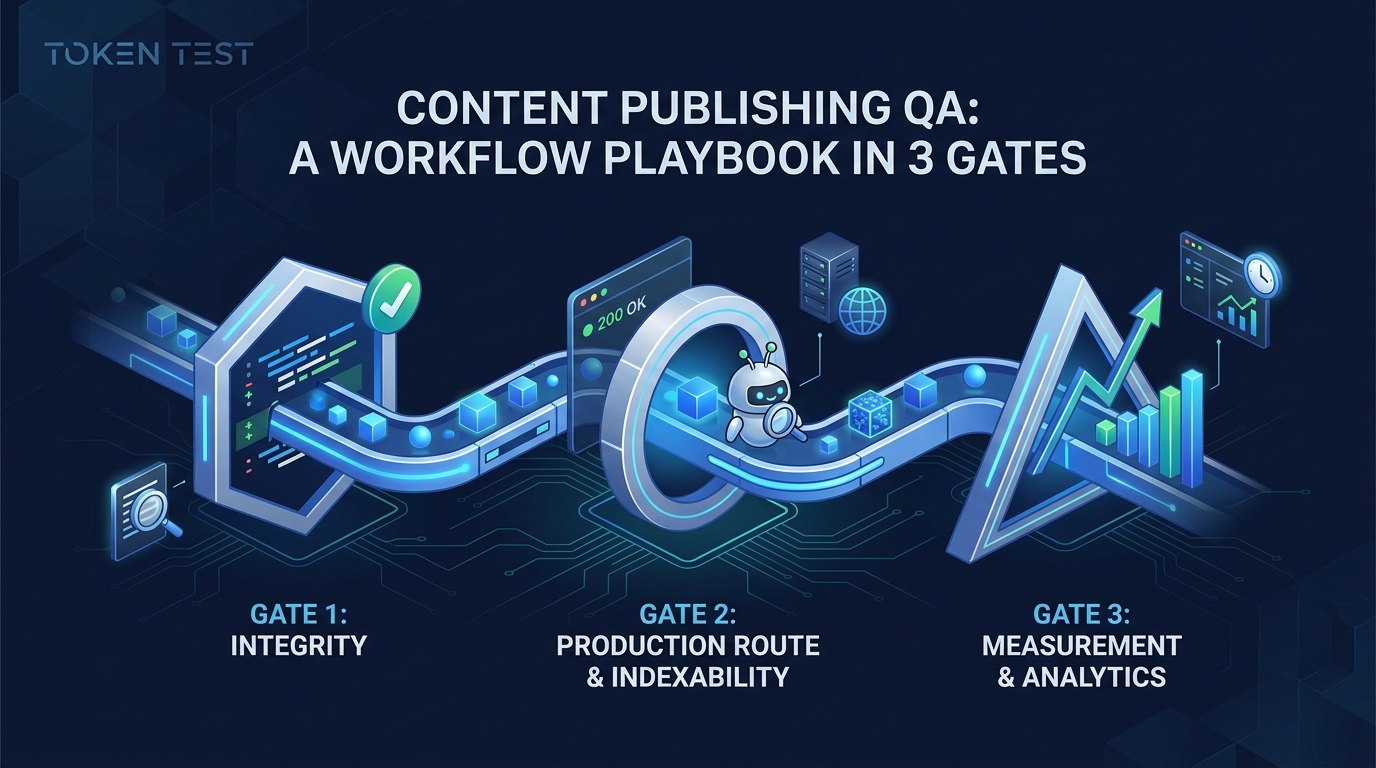
A content release can pass every visible editorial check and still fail production. The title is final, the body is approved, and the CMS status says published, but the public URL might still render an old version, the Chinese route might be stale, the canonical might point to a previous experiment, or the analytics baseline might confuse missing credentials with zero demand. A practical content publishing QA: workflow playbook prevents that by treating the article package as a release artifact before it reaches the CMS.
This version of the playbook is for teams that publish through a CMS, an API, or an AI agent and need a tighter preflight contract. Yesterday's release-readback model asked, "What does production return after publish?" The preflight-manifest model asks one step earlier: "What exactly are we allowed to publish, how will we prove it, and what will trigger rollback?"
That distinction matters for SEO teams shipping in batches. When five articles move through the same publishing path, one vague field can create five production defects. A useful content publishing QA: workflow playbook freezes the slug, category, cover, metadata, language targets, validation commands, rollback rules, and measurement state before the first write request.
The goal is not more ceremony. The goal is a release package another engineer or growth owner can rerun without trusting memory. That is why the content publishing QA: workflow playbook should live beside the publish payload, not in a separate policy document.
Content Publishing QA: Workflow Playbook Preflight Manifest
A preflight manifest is a short, machine-readable contract for a content release. It sits between the approved article and the CMS/API request. It should be specific enough to block a bad publish and simple enough to review in a pull request or task artifact. In this content publishing QA: workflow playbook, the manifest is the handoff point between editorial approval and production evidence.
| Manifest field | Required value | Why it matters |
|---|---|---|
slug | Stable canonical slug | Prevents duplicate pages for the same search intent |
source_url | Final public route | Gives route validation a fixed target |
language | Configured source language key | Prevents source records from landing under the wrong locale |
target_languages | Configured translation keys | Keeps multilingual publishing in the same release group |
category_id | Current CMS category readback | Avoids stale taxonomy IDs |
meta_title | Final SEO title | Prevents metadata drift from body title |
meta_description | Final description | Supports SERP snippet relevance and QA comparison |
cover_image_url or bannerPath | Public URL or upload-ready asset | Prevents local paths from entering production |
validation_commands | Route, header, HTML, link, and metric checks | Makes proof repeatable |
rollback_rule | Blocker thresholds and owner | Turns failures into a decision path |
For TokenTest's canonical article, the manifest preserves content-publishing-qa-workflow-playbook instead of creating a new competing slug. The query intent is unchanged, so the release should strengthen the existing URL rather than split links and measurement across variants.
Gate 1: Freeze the Release Contract Before the CMS Write
The first gate in a content publishing QA workflow is a freeze. Nothing goes to the CMS until the release contract is complete.
A strong freeze answers four questions:
| Question | Evidence | Blocker if missing |
|---|---|---|
| What page are we changing? | Source URL, slug, post ID, canonical URL | The release could create keyword cannibalization |
| What content are we sending? | Markdown body, HTML body when needed, metadata, excerpt | The CMS can publish a version nobody reviewed |
| What assets and taxonomy are attached? | Category readback, cover URL or uploaded asset, author | The page can disappear from listings or show stale imagery |
| What will prove success? | Route checks, indexability checks, translation checks, measurement baseline | The task can close on a CMS status alone |
Do not rely on a previous article package as the contract. Use previous memory to find known IDs and lessons, then read the current CMS category and current public route. A SEO publishing QA checklist is only reliable when it checks the system that exists now.
This gate also keeps body structure aligned with the site template. If the CMS template renders the post title as the page H1, the body should start with the introduction and use H2s for sections. That prevents duplicate page-level H1s without weakening the article.
Gate 2: Validate the CMS/API Field Contract
Content publishing QA often fails at field names, not strategy. A backend accepts meta_description, while an old script sends metaDesc. A translation endpoint needs html_content, while the source update endpoint rejects that field. A cover upload returns a public URL, but the article payload accidentally keeps the local filename.
Use a field-contract table before every source update:
| Release package field | CMS/API field | QA rule |
|---|---|---|
| Source Markdown | markdown_content | Must contain the exact frozen article body |
| Source HTML | Translation payload only when source PATCH rejects it | Must be semantically equivalent to Markdown |
| Title | title | Must match the final page title and metadata intent |
| Slug | slug | Lowercase, hyphenated, and stable for the canonical intent |
| Meta title | meta_title | Must include the core intent naturally |
| Meta description | meta_description | Must describe the current version, not a prior refresh |
| Cover | cover_image_url | Must be publicly reachable after upload |
| Category | category_id | Must come from a current category readback |
| Author | author_display_name | Must match site byline policy |
Save the request body and response body as release evidence. If the API returns success but production renders old content, those files let the team isolate whether the issue is payload, CMS state, cache, route rendering, or frontend template behavior. That makes the content publishing QA: workflow playbook useful during incidents, not only during planned release review.
Gate 3: Publish Source and Locales as One Release Group
A multilingual article is not fully shipped when only the English route is updated. The source and localized routes should be treated as one release group with per-language evidence.
The practical sequence is:
- Upload or verify the cover image URL.
- Save the source update payload.
- Update or create the source article.
- Publish the source record.
- Save the translation target manifest.
- Generate and publish each target language in a separate request.
- Read back source and localized API records.
- Validate every public route.
Separate translation requests are easier to diagnose. If zh succeeds and another locale fails, the report should name the exact target, response, route status, and next action. A content publishing QA: workflow playbook should never compress source success and locale failure into one vague publish status.
For a two-language site, the manifest can be simple:
{
  "source_language": "en",
  "target_languages": ["zh"],
  "source": "SEO_BLOGGER_LANGUAGE_KEYS"
}
That file becomes the release contract for translation parity.
Gate 4: Read the Public Route, Headers, and HTML
The public route is the first place users and search engines can observe the release. A CMS response is useful evidence, but it is not enough.
Run a route check:
curl -sS -o /dev/null -w '%{http_code} %{url_effective} %{num_redirects}\n' \
  -L https://tokentest.io/blog/content-publishing-qa-workflow-playbook
Then save headers and HTML:
curl -sS -D source-headers.txt -o source-public-readback.html \
  https://tokentest.io/blog/content-publishing-qa-workflow-playbook
The route check proves reachability. Headers can expose an X-Robots-Tag. HTML can expose the current title, canonical, robots meta tag, language alternates, internal links, body freshness, and page-level H1 count.
Block completion when source or configured localized routes return 404, 5xx, an unexpected redirect, an auth wall, a wrong canonical, an accidental noindex, missing body content, a stale title, or a broken primary CTA. Those are production defects, not review notes.
Gate 5: Validate Indexability as a Separate Layer
Indexability deserves its own table because a page can return HTTP 200 and still be unfit for search.
| Signal | Pass condition | Evidence file |
|---|---|---|
| HTTP status | Source and localized routes return 200 | Route check files |
| Redirects | Expected final URL with acceptable redirect count | Route check files |
| Canonical | Source route self-references the intended public URL | Public HTML readback |
| Robots meta | No accidental page-level noindex | Public HTML readback |
| X-Robots-Tag | No header-level noindex | Header readback |
| Hreflang | Configured locales reference each other when supported | Public HTML readback |
| H1 policy | Exactly one page-level H1 when the template renders title as H1 | Public HTML parse |
| Internal discovery | Relevant article links and CTA routes return 200 | Link check file |
Google Search Central documents robots directives in both robots meta tags and X-Robots-Tag headers. It also treats canonicalization and localized versions as separate signals. A useful post-publish validation step should therefore inspect headers and HTML rather than only checking page status.
Gate 6: Add a Rollback Decision Matrix
A content publishing QA: workflow playbook should explain when to rollback, when to patch forward, and when to accept an advisory with follow-up. Otherwise every failure becomes a judgment call under time pressure.
| Finding | Severity | Default action |
|---|---|---|
| Source route 404 or 5xx | Blocker | Roll back or republish before completion |
| Localized configured route 404 | Blocker | Republish target locale or report source published plus locale failed |
| Wrong canonical | Blocker | Patch metadata before closing release |
Accidental noindex | Blocker | Remove directive and re-read headers/HTML |
| Old title/body after API success | Blocker | Investigate cache/template/API state before completion |
| Broken primary CTA | Blocker | Fix link or change CTA before completion |
| GSC unavailable on release day | Advisory | Mark instrumentation gap, owner, and recheck date |
| GA4 property unavailable | Advisory | Mark instrumentation gap, owner, and recheck date |
| Sitemap endpoint unsupported | Advisory | Note unavailable if route and internal discovery pass |
This matrix avoids two bad habits: closing a release with a real production defect, and blocking a release because delayed performance data is not available on day zero.
Gate 7: Separate Measurement Results From Measurement Access
The task metric for this article cluster includes published URL, indexability, GSC clicks and impressions, GA4 engaged sessions, and conversions. Those should be reported as separate states.
| Metric | Release-day state | Correct interpretation |
|---|---|---|
| Published URL | Immediate | Route status and final URL can be verified now |
| Indexability | Immediate | Canonical, robots, headers, and alternates can be checked now |
| GSC clicks | Delayed or unavailable | Missing credentials are not zero clicks |
| GSC impressions | Delayed or unavailable | Missing credentials are not zero impressions |
| GA4 engaged sessions | Requires property access | Missing property ID is not zero engagement |
| GA4 conversions | Requires configured events | Missing event access is not zero conversions |
Save a baseline like this:
{
  "source_public_url": "https://tokentest.io/blog/content-publishing-qa-workflow-playbook",
  "published_url_status": 200,
  "indexability_status": "pass",
  "gsc_clicks": null,
  "gsc_impressions": null,
  "ga4_engaged_sessions": null,
  "ga4_conversions": null,
  "measurement_status": "instrumentation_gap",
  "reason": "Search Console credentials or GA4 property ID are unavailable in this runtime"
}
That baseline protects the team from reporting missing data as performance. It also gives the next owner a concrete follow-up: bind Search Console and GA4 access, then rerun the same measurement query.
Gate 8: Close an Evidence Bundle That Another Owner Can Rerun
A content release is complete when its evidence bundle is complete, not when the publisher feels confident.
| Artifact | Purpose |
|---|---|
article-en.md | Human-readable source article |
article-en.html | HTML used for translation and public comparison |
update-source.json | Exact source CMS payload |
update-source-response.json | Source update evidence |
publish-source-response.json | Source publish evidence |
translation-targets.json | Locale contract |
translation-payload-zh.json | Translation publish input |
publish-translation-zh-response.json | Translation publish evidence |
source-api-after.json | Source API readback after publish |
zh-api-after.json | Localized API readback after publish |
source-public-readback.html | Public source route evidence |
zh-public-readback.html | Public localized route evidence |
localized-route-checks.json | Route, canonical, robots, H1, and hreflang summary |
link-and-cover-checks.json | Internal link, CTA, external source, and cover checks |
measurement-baseline.json | GSC and GA4 status |
content-qa.json | Keyword, structure, and claim checks |
publish-report.md | Human-readable completion summary |
This bundle also improves future automation. When a later run fails, the team can compare exact payloads and readbacks instead of reconstructing the release from chat logs.
Copyable Preflight Manifest Template
Use this template before every source-plus-translation content release.
{
  "release_id": "content-publishing-qa-workflow-playbook-YYYY-MM-DD",
  "title": "Content Publishing QA: Workflow Playbook for Preflight Manifests",
  "slug": "content-publishing-qa-workflow-playbook",
  "source_url": "https://tokentest.io/blog/content-publishing-qa-workflow-playbook",
  "language": "en",
  "target_languages": ["zh"],
  "category_id": "current-category-id",
  "cover_image_status": "uploaded_public_url_verified",
  "validation": [
    "source_route_200",
    "localized_route_200",
    "canonical_self_reference",
    "no_robots_noindex",
    "no_x_robots_noindex",
    "single_page_h1",
    "internal_links_200",
    "measurement_baseline_saved"
  ],
  "rollback_on": [
    "source_route_not_200",
    "configured_locale_not_200",
    "wrong_canonical",
    "accidental_noindex",
    "stale_public_body",
    "broken_primary_cta"
  ]
}
Keep the template close to the publishing script. The point is not to create a policy document that nobody opens. The point is to make the release contract available at the exact moment an agent, editor, or engineer is about to write to production.
How TokenTest Teams Should Use This Playbook
TokenTest's audience already treats prompts, token budgets, model switches, and cost changes as release risks. Content publishing deserves the same discipline when a page can affect search visibility, signup attribution, and analytics interpretation.
Use this content publishing QA: workflow playbook when a page is published through an automated path, refreshed on a canonical URL, localized, or measured against GSC and GA4 outcomes. Freeze the manifest. Validate the API contract. Publish source and locales as one release group. Read public routes. Separate indexability from measurement access. Save the evidence bundle.
That is the difference between a CMS status and a release the next owner can trust.