How to Use Blog Publishing Automation in 2026
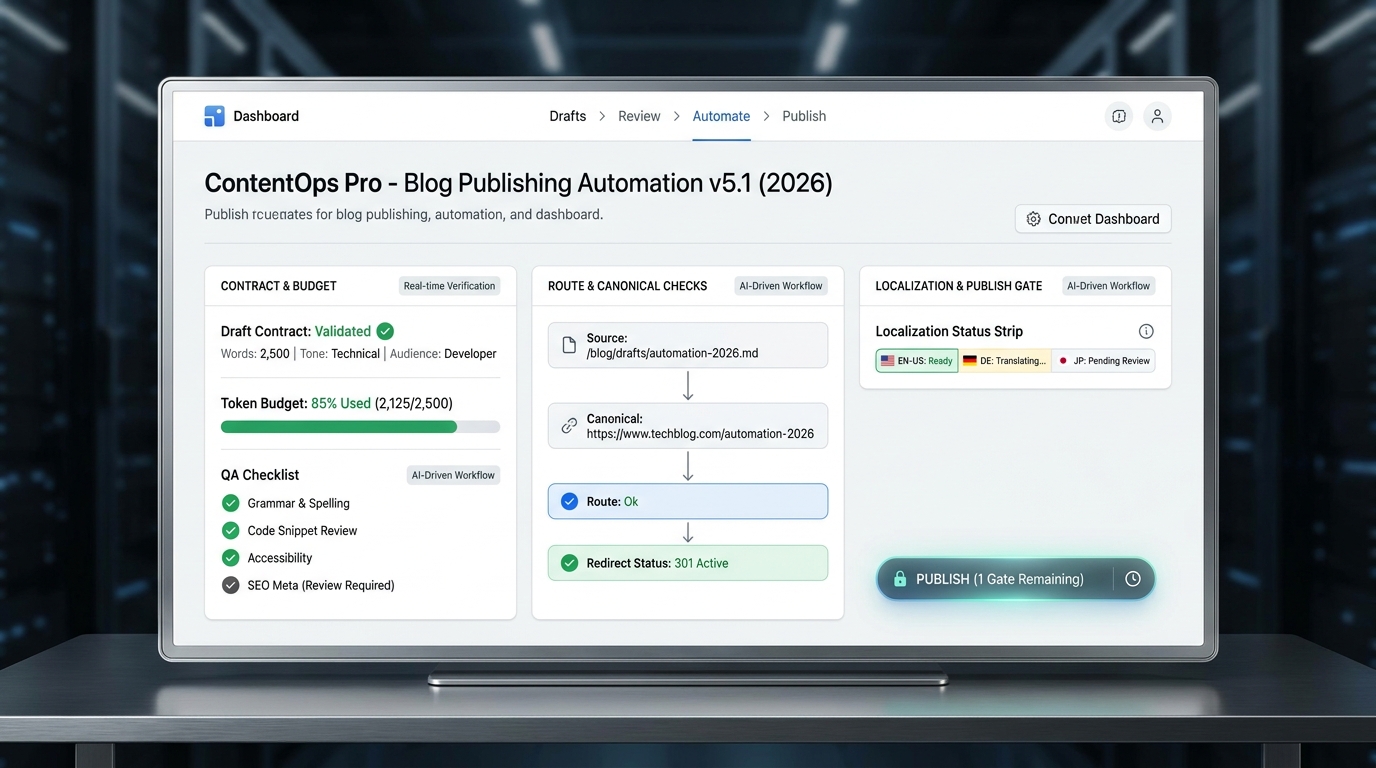
Blog publishing automation in 2026 is not about pressing a bigger publish button. It is about moving repeatable checks ahead of the CMS and keeping judgment where humans are still better.
If your workflow uses AI to draft, rewrite, or translate, TokenTest fits before the CMS boundary. The TokenTest homepage and product manual describe a black-box evaluation workflow that checks model identity, usage integrity, token behavior, and route-level evidence without storing your API key.
What blog publishing automation should own in 2026
Start with the steps that are stable, machine-readable, and easy to prove. Keep the subjective calls manual.
| Step | Automate first? | Keep manual? | Proof to require |
|---|---|---|---|
| Slug, title, excerpt, and meta fields | Yes | No | Final content contract |
| Internal links and public assets | Yes | No | Live link check and public image URL |
| Draft creation and CMS publish | Yes | No | Draft ID and publish response |
Route, canonical, and noindex checks | Yes | No | HTTP 200 and self-referencing canonical |
| Translation and localized routes | Yes | No | Per-language payload and route check |
| Angle, examples, and CTA | No | Yes | Editorial review |
That is the core rule of blog publishing automation: automate the repeated checks, not the final judgment.
Use this 6-step workflow
The fastest way to use blog publishing automation is to treat it as a release pipeline.
1. Lock the article contract
Before anyone drafts, freeze the content contract:
- Topic and search intent
- Primary keyword
- Secondary keywords
- Target language
- Category
- Canonical URL
- Required internal links
- Cover image role
- Measurement plan
If one of those is missing, stop. Blog publishing automation only saves time when the inputs are complete.
2. Build the evidence before the draft
Collect the live sources you will cite or rely on:
- Current product pages
- Current docs
- Public proof pages
- Search and route checks
- Any policy or platform guidance that affects publish behavior
For TokenTest articles, the useful public proof is the homepage, the manual, and the live blog cluster. Google Search Central, GitHub Actions, and Playwright are the current technical references for route and release checks.
3. Draft with a token budget gate
If AI is in the loop, add a budget before the CMS write.
| Stage | What to watch |
|---|---|
| Research | Source count and prompt size |
| Outline | Context growth and duplicate instructions |
| Draft | Input tokens, output tokens, retry count |
| Revision | Prompt drift and repeated context |
| Translation | Per-language token budget |
| QA | Cost of retries and validation calls |
TokenTest is useful here because it turns usage into evidence instead of guesswork.
4. Create the source article
Write the article with one visible H1, a clean metadata set, and a unique cover image. At this stage, blog publishing automation should still be working on the draft, not the live page.
5. Publish, then verify the public route
CMS success is not enough. Verify:
- The page returns HTTP 200
- The canonical is self-referencing
- No accidental
noindexis present - The page has one H1
- Internal links resolve
- The localized route returns 200 if translation is enabled
Google Search Central documents canonicalization and indexing control; Playwright assertions are useful when you want the route checks to retry until the page is actually ready.
6. Measure and decide
After publish, connect the URL to the metric you care about:
- Organic clicks
- Indexed URL count
- Qualified signups
- Assisted conversions
If the article does not move one of those, blog publishing automation is just output machinery.
What to automate first
When a team is new to blog publishing automation, these are the first wins.
| Symptom | Automate first | Why |
|---|---|---|
| Metadata gets copied wrong | Content contract checks | The rule is deterministic |
| Pages sometimes 404 after publish | Route checks | CMS success is not public success |
| Translation breaks localized URLs | Per-language readback | Each route can fail independently |
| AI cost keeps creeping up | Token budget gate | Drift shows up before publish |
| Internal links rot over time | Link checks | Broken references waste review time |
That is the same release logic used in broader SEO workflow posts, including SEO Automation Strategy for Growth Teams, Technical SEO Automation Tools: Evaluation Framework, and SEO Automation Use Cases by Funnel Stage.
What should stay manual
Blog publishing automation should not absorb every decision.
- Keep human review on positioning.
- Keep human review on claims and examples.
- Keep human review on exceptions and tradeoffs.
- Keep human review on the final CTA.
- Keep human review on whether the article actually answers the search intent.
Google’s helpful-content guidance still matters here: automate the process, not the editorial judgment.
A practical CI pattern
If you want a minimal release gate, wire the checks into CI:
name: blog-publish-check
on:
  push:
    paths:
      - "content/**"
      - ".github/workflows/blog-publish-check.yml"
jobs:
  verify:
    runs-on: ubuntu-latest
    steps:
      - uses: actions/checkout@v4
      - name: Run route checks
        run: |
          curl -fsS https://example.com/blog/my-slug >/dev/null
      - name: Run browser assertions
        run: npx playwright test route-check.spec.ts
The point is not the exact tool choice. The point is that blog publishing automation should fail before the public page ships if the route, canonical, or content contract is broken.
Where TokenTest fits
TokenTest is the verification layer before the CMS write. Use it when blog publishing automation depends on AI-generated drafts, summaries, or translations and you need evidence that the request shape, usage behavior, and output boundaries still make sense.
The product manual documents a black-box evaluation workflow for model identity, token usage, safety, and route integrity. That makes TokenTest a good fit when blog publishing automation has to control the hidden cost of AI steps instead of discovering it after publish.
Conclusion
The best blog publishing automation in 2026 removes repetitive work, keeps judgment visible, and stops before the CMS if the public page is not ready.
For the broader workflow view, read Blog Publishing Automation Checklist for Faster Decisions. For a publish-time evidence model, pair this with Content Publishing QA: Workflow Playbook for Preflight Manifests and SEO Test Workflow: Beginner Guide for Release Evidence.