Blog Publishing Automation Checklist for Faster Decisions
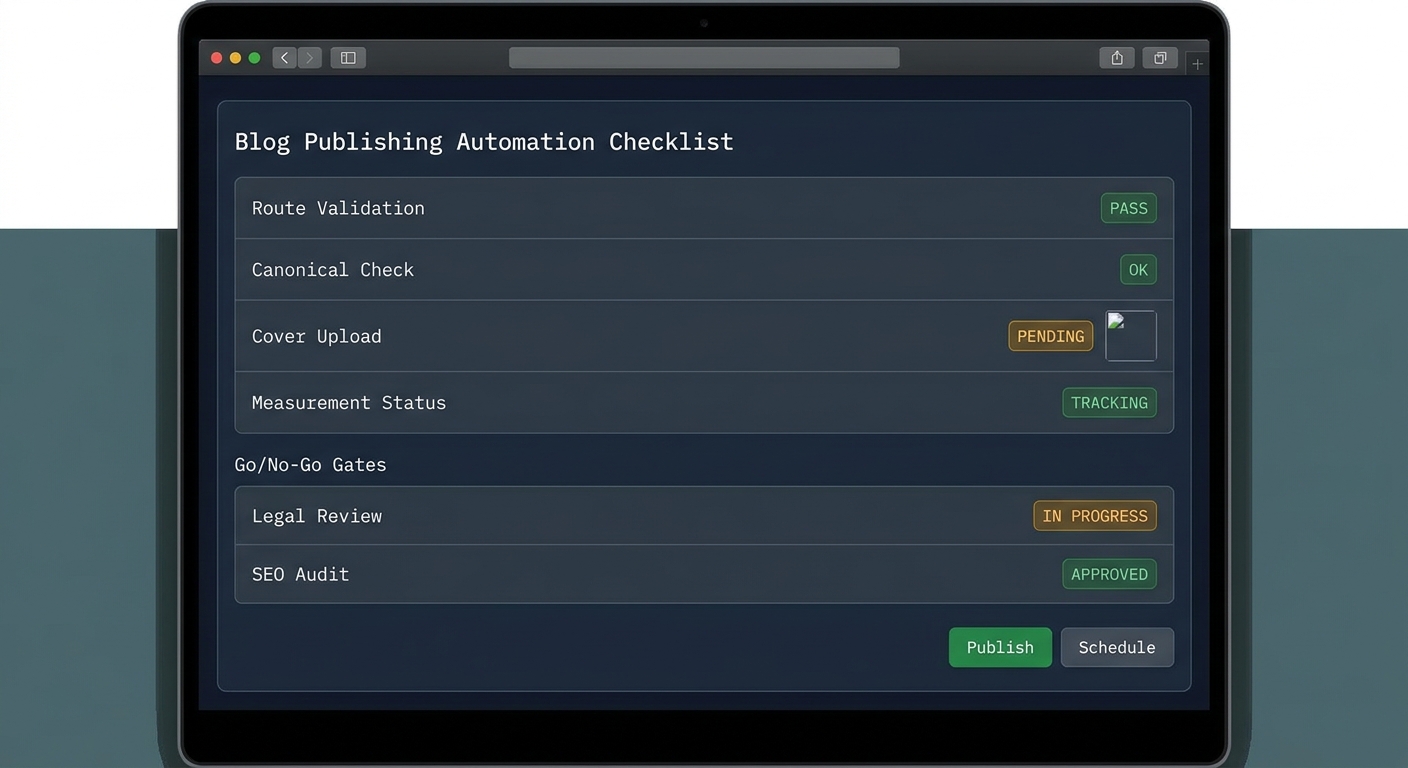
Blog publishing automation is useful when it shortens the path to publish without hiding the decision. The question is not whether you can automate a post. The question is which parts of blog publishing automation are repeatable, which parts still need judgment, and what evidence proves the page is ready.
If your workflow uses AI to draft, rewrite, or translate, TokenTest fits before the CMS boundary. The TokenTest homepage and product manual describe a black-box evaluation workflow that checks model identity, usage integrity, token behavior, and route-level evidence without storing your API key.
Where blog publishing automation should start
Start with the steps that are machine-readable, stable, and easy to verify. Keep human review for claims, positioning, and exceptions.
| Step | Automate first? | Keep manual? | Evidence to require |
|---|---|---|---|
| Slug, title, excerpt, and metadata | Yes | No | Final content contract |
| Internal links and cover URL | Yes | No | Live link check and public image URL |
| Claims, examples, and CTA | No | Yes | Reviewer sign-off |
| CMS create and publish | Yes | No | Draft ID and publish response |
| Public route and canonical | Yes | No | HTTP 200 and self-referencing canonical |
| Translation and localized routes | Yes | No | Per-language payload and route check |
| Final angle and brand voice | No | Yes | Editorial review |
That table is the core rule of blog publishing automation: automate the repeated checks, not the final judgment.
Freeze the article contract
The fastest decisions come from a fixed contract. If a required field is missing, do not create the draft yet.
| Field | Why it matters |
|---|---|
| Title | Defines the page promise |
| Slug | Locks the final URL |
| Category | Places the article in the right taxonomy |
| Language | Keeps source and translation aligned |
| Excerpt | Powers list and preview cards |
| Meta title | Supports search intent and click-through |
| Meta description | Explains the value in one line |
| Canonical URL | Prevents route ambiguity |
| Cover image URL | Proves the page has a public visual asset |
| Internal links | Connects the article to the rest of the cluster |
If you are using blog publishing automation at scale, treat that contract as a release gate. A draft that misses one of these fields is not ready to publish, even if the CMS accepts it.
Separate repeatable checks from judgment calls
This is the part most blog publishing automation stacks get wrong. They automate the final output before they automate the checks around it.
Repeatable checks:
- Slug format
- Category resolution
- Cover upload
- Broken internal links
- Canonical URL
noindexdetection- Source route returning
200 - Localized route returning
200 - Measurement path recorded
Judgment calls:
- Whether the angle is strong enough
- Whether the claim is fair
- Whether the example is useful
- Whether the CTA fits the reader
- Whether the topic belongs in the current cluster
Keep those layers separate. If blog publishing automation cannot tell you what it checks, it is too broad.
Add token gates when AI is in the loop
If blog publishing automation uses AI for research, drafting, editing, or translation, add a token budget gate before the CMS write.
| Stage | What to watch |
|---|---|
| Research | Source count and prompt size |
| Outline | Context growth and duplicate instructions |
| Draft | Input tokens, output tokens, retry count |
| Revision | Repeated context and prompt drift |
| Translation | Per-language token budget |
| QA | Cost of retries and validation calls |
TokenTest is useful here because it turns usage into evidence instead of guesswork. For a broader budgeting pattern, see Token Budget Planning for Multi-Agent Workflows and Token Budgets for SEO Article Generation and Content Localization.
Blog publishing automation gets expensive when the team keeps retrying the same prompt shape without measuring the request. A simple token gate is often the first control that prevents that drift.
Blog publishing automation checklist
Use this list before you press publish.
- ☐ The target keyword matches the article purpose.
- ☐ The title, slug, and meta title are final.
- ☐ The article has one clear H1 and no extra page-level H1 in the body.
- ☐ The cover image is unique to this post and publicly reachable.
- ☐ The category matches the article type.
- ☐ The internal links all point to live URLs.
- ☐ The claims are sourced or clearly framed as guidance.
- ☐ The public route is expected to return
200. - ☐ The canonical URL is self-referencing.
- ☐ No accidental
noindexis present. - ☐ Translation targets are known before source publish.
- ☐ The measurement path is recorded for later review.
If any item above is unclear, the right move is not to guess. The right move is to pause blog publishing automation until the missing proof exists.
What to automate first
When a team starts blog publishing automation, these are the best first wins.
| Symptom | Automate first | Why |
|---|---|---|
| Metadata gets copied wrong | Content contract checks | It is deterministic |
| Published pages sometimes 404 | Route checks | CMS success is not public success |
| Translation breaks localized URLs | Per-language readback | Each route can fail independently |
| AI costs keep rising | Token budget gate | Budget drift shows up before publish |
| Internal links rot over time | Link checks | Broken references are expensive to debug |
This is also where Content Publishing QA: Workflow Playbook for Preflight Manifests helps. If you need the exact release mechanics, Blogger Integration Test: Implementation Checklist for Evidence-Ready Publishing goes deeper on source publish, route checks, localization, and measurement.
What to keep manual
Blog publishing automation should not absorb every decision.
- Keep human review on positioning.
- Keep human review on claims and examples.
- Keep human review on exceptions and tradeoffs.
- Keep human review on the final CTA.
- Keep human review on whether the article actually answers the search intent.
That balance is what makes blog publishing automation faster instead of just louder.
A simple go/no-go rule
Use this rule when the team is deciding whether a post can ship:
| Question | If yes | If no |
|---|---|---|
| Can the result be verified automatically? | Automate it | Keep it manual |
| Does the step change public metadata or routes? | Add a release gate | Do not trust CMS success alone |
| Does the step use AI-generated text? | Add a token budget gate | Keep the prompt short and bounded |
| Does the step affect search or measurement? | Record the route and metric | Do not mark the run complete |
That decision table is the fastest way to keep blog publishing automation honest.
Why TokenTest belongs in this workflow
TokenTest is not the CMS. It is the verification layer before the CMS write. Use it when blog publishing automation depends on AI-generated drafts, summaries, or translations and you need evidence that the request shape, usage behavior, and output boundaries still make sense.
The product manual documents a black-box evaluation workflow for model identity, token usage, safety, and route integrity. That makes it a good fit when blog publishing automation has to control the hidden cost of AI steps instead of discovering it after publish.
Conclusion
The best blog publishing automation is the kind that removes repetitive work, keeps judgment visible, and stops before the CMS if the public page is not ready.
If you want a tighter release model, read Best SEO Automation Workflows and Examples for the broader workflow view, then pair it with SEO Test Workflow: Beginner Guide for Release Evidence for publish-time validation.
Sources and references
- TokenTest homepage
- TokenTest product manual
- Content Publishing QA: Workflow Playbook for Preflight Manifests
- Blogger Integration Test: Implementation Checklist for Evidence-Ready Publishing
- SEO Test Workflow: Beginner Guide for Release Evidence
- Google Search Central: canonical URLs
- Google Search Central: noindex
- GitHub Actions continuous integration
- Playwright assertions