Best SEO Automation Workflows and Examples
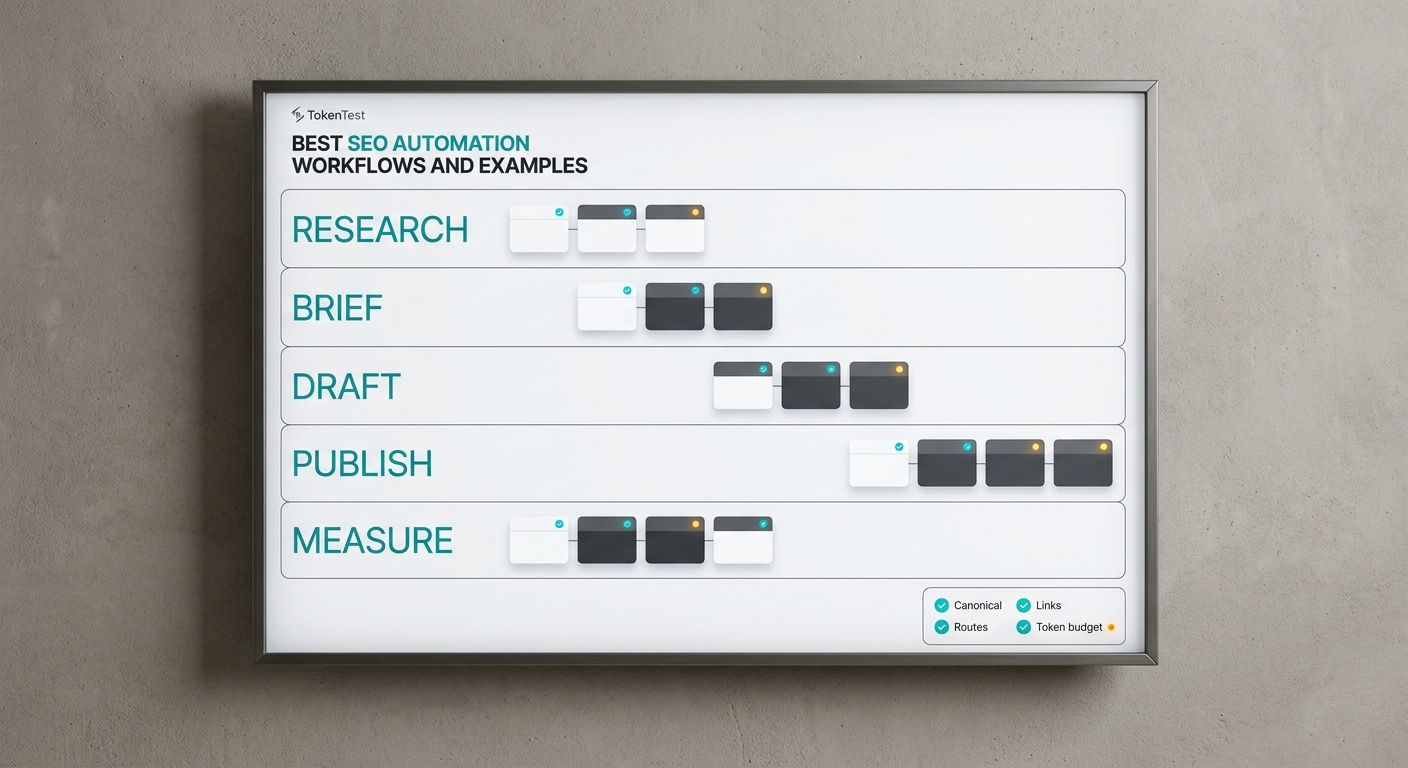
SEO automation is useful when it removes repetitive work without hiding the decision. The best SEO automation workflows are the ones that save time on research, briefs, linking, publishing, and measurement while leaving judgment to a human.
That matters because not every SEO task should be automated the same way. Some steps are deterministic, like checking canonical tags or broken links. Some steps are probabilistic, like brief generation or title variants. The strongest SEO automation workflows separate those layers instead of treating one tool as a full SEO system.
This article shows practical SEO automation examples for teams that publish regularly and want a more reliable process. It is written for operators who care about search intent, internal links, content freshness, indexability, and release evidence.
What SEO automation should do
| Workflow | What it automates | Human still decides | Good example |
|---|---|---|---|
| Research | Query collection, clustering, SERP capture | Which topic is worth shipping | Cluster search terms into one page or one refresh |
| Briefing | Outline, source collection, internal-link suggestions | Final angle and proof standard | Generate a draft brief from a keyword cluster |
| Drafting | First-pass copy, summaries, metadata ideas | Facts, positioning, and tone | Turn notes into a publishable draft |
| Linking | Related-page suggestions and anchor text ideas | Which link is actually useful | Add internal links from existing articles |
| Publishing | Payload checks, image upload, route validation | Whether the article is ready to go live | Verify slug, category, canonical, and cover image |
| Measurement | GSC and GA4 capture, baseline comparison | Keep, update, or revert | Review clicks, impressions, and engaged sessions |
The practical rule is simple: automate the repeated checks, not the final judgment.
1. Keyword research and clustering
The first SEO automation workflow should organize demand before anyone writes.
Example:
- Pull candidate queries from Search Console, site search, or a keyword tool.
- Group them by intent and page type.
- Separate new pages from refresh candidates.
- Mark the cluster owner, the target URL, and the next action.
This works well because one query can hide several jobs. "SEO automation" might support a general guide, a comparison page, a workflow checklist, or a publishing QA article. Good SEO automation turns that ambiguity into a decision.
For a team like TokenTest, the useful output is not just a list of keywords. It is a page plan that tells you whether the content should cover research, briefs, publishing QA, or measurement.
2. Brief generation with source collection
The next SEO automation workflow is brief generation.
A useful brief usually includes:
- Search intent
- Primary keyword
- Secondary keywords
- Suggested outline
- Internal links
- Sources to verify
- Conversion path
The mistake is letting an AI draft the brief without source control. A good workflow makes the source pack explicit, then checks the output for gaps. That keeps SEO automation useful instead of vague.
Example:
- Collect the live pages, docs, and competitor notes.
- Ask the model for a concise outline.
- Check the outline against the target intent.
- Add human edits for claims, CTA, and internal links.
If the brief is for an AI-assisted article, add a token budget before the draft step. That prevents a prompt from quietly growing into a cost problem.
3. Refresh detection and content updates
One of the best SEO automation examples is content refresh detection.
Automation can flag pages that are likely stale by looking for:
- Declining clicks or impressions
- Dropping internal-link count
- Old publication dates
- Missing sections that newer SERP results cover
- Title and meta drift
Example refresh workflow:
- Identify the candidate URL.
- Compare the current page with the last good version.
- Check whether the target keyword still matches the page intent.
- Update the weakest section first.
- Revalidate route, canonical, and indexability after publish.
This is where SEO automation should be careful. A page refresh is not just a rewrite. It is a release. If the URL changes, the canonical changes, or the locale route breaks, the SEO gain can disappear.
4. Internal link automation
Internal links are a high-value automation target because the work is repetitive but the decisions still matter.
Good internal link automation can:
- Suggest related articles
- Detect orphaned pages
- Find broken links
- Recommend anchor text variants
- Identify pages that should point to a new article
Example:
- Scan the site for pages with overlapping topics.
- Rank candidates by topical fit and traffic value.
- Propose anchor text that matches the destination page.
- Review the list before publishing.
The human check matters because the best internal link is the one that helps a reader, not the one that merely uses the keyword.
5. Publishing QA and indexability
This is the SEO automation workflow that saves the most pain.
Before a post is treated as live, verify:
- Slug is stable and lowercase
- Category matches the article type
- Cover image is public
- Canonical points to the intended URL
- No accidental
noindexis present - Source route returns
200 - Localized routes return
200when configured - Title and body match the source payload
That is the difference between publishing and releasing.
TokenTest fits here as a verification layer for AI-assisted workflows. The live manual says it is a black-box evaluation platform that does not store API keys and checks model identity, usage integrity, nonce replay, safety and protocol risk, billing boundaries, and token usage. In practice, that makes it useful when SEO automation uses an LLM to draft, rewrite, or translate before content reaches the CMS.
If the workflow also generates copy with a model, pair it with Token budgets for SEO content and localization.
For the publishing side, see the content publishing QA workflow playbook and the Blogger integration test: implementation checklist for evidence-ready publishing.
6. Measurement and iteration
SEO automation should not stop at publish.
A practical measurement workflow tracks:
- Search Console clicks and impressions
- Landing-page CTR
- Engaged sessions
- CTA clicks or signups
- Which pages need a refresh
Example:
- Save the public URL and publish timestamp.
- Record the page type and target query.
- Check Search Console after the normal lag window.
- Compare the page against nearby articles in the same cluster.
- Decide keep, revise, or expand.
If you want a clean experimentation frame, connect this with the SEO test workflow: beginner guide and the SEO testing workflow: your first 14-day experiment.
Example stack by team type
| Team | Useful stack | Why it works |
|---|---|---|
| Small marketing team | Sheets, CMS checks, manual review | Low overhead, easy to explain |
| Content team with AI drafts | AI briefing, token budget gate, CMS QA | Faster drafting without losing control |
| Developer-led team | GitHub Actions, route checks, link checks, measurement notes | Repeatable and auditable |
The right SEO automation stack is usually smaller than people expect. Start with one workflow that removes the most friction and gives you a clear failure signal.
Common mistakes
SEO automation fails when teams automate the wrong layer.
The usual mistakes are:
- Automating the final judgment instead of the checks
- Skipping source verification
- Writing content before the page type is decided
- Publishing without route or canonical checks
- Ignoring token growth in AI-assisted workflows
- Measuring after the fact without a baseline
If a workflow cannot say what it checks and what it does not check, it is probably too broad.
A simple rollout plan
If you are building SEO automation from scratch, use this order:
- Add a research and clustering step.
- Add a brief template with required fields.
- Add internal-link suggestions.
- Add publishing QA and route checks.
- Add measurement and refresh triggers.
- Add token-budget gates for any AI step that drafts or translates.
That sequence keeps the workflow practical and makes each layer easy to inspect.
Conclusion
SEO automation works best when it reduces repetitive work and keeps evidence visible. The best SEO automation workflows are usually the ones that protect the release path, not the ones that generate the most content.
If your team publishes with AI in the loop, start with one controlled workflow: brief generation, publishing QA, or refresh detection. Then add TokenTest-style token and usage checks so the process stays predictable as it scales.