Token Budgets for SEO Article Generation and Content Localization
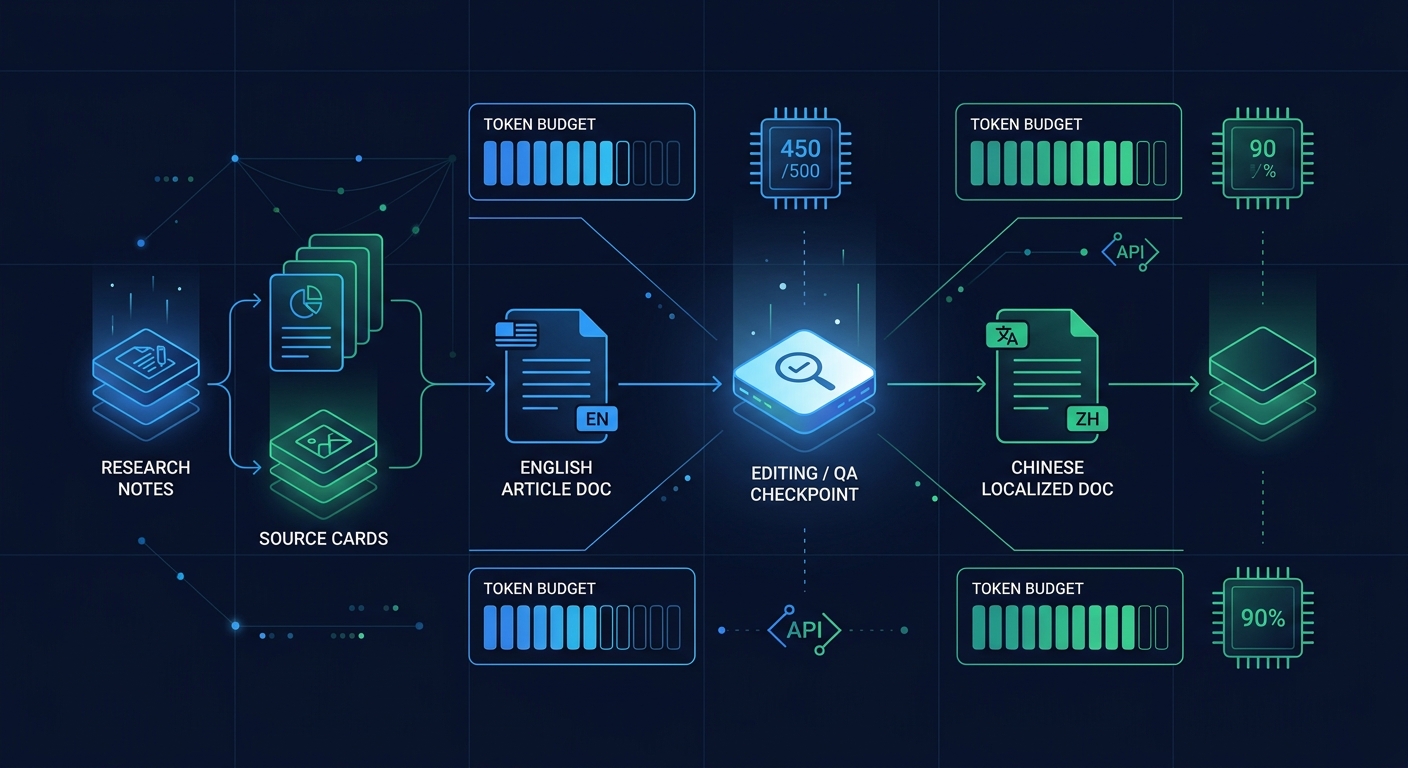
An SEO article workflow can consume far more tokens than the final word count suggests. The model may read research notes, a content brief, brand rules, examples, the current draft, reviewer comments, and localization instructions before it produces a single publishable paragraph.
The practical solution is to budget the whole workflow, not only the first draft.
This guide shows how to estimate input and output tokens for research, outlining, drafting, editing, and English–Chinese localization. It also includes a reusable worksheet and test prompts you can use with the endpoint you evaluate in TokenTest.
The Short Answer
Use this formula for every stage:
Stage token budget = maximum calls × (maximum input tokens + maximum output tokens)
Then calculate the workflow budget:
Total workflow budget = sum of stage budgets + retry reserve + safety reserve
For a bilingual article, treat localization as a separate production pipeline. Do not assume the translated version will use the same number of tokens as the source article.
Why Final Word Count Is the Wrong Budget
Suppose you want a 2,000-word article. Budgeting only for 2,000 words ignores most of the request:
- system and brand instructions;
- target keyword and search intent;
- research excerpts and source notes;
- article outline and required headings;
- examples, tables, and formatting rules;
- the previous draft during revision;
- the full source article during localization;
- terminology rules and reviewer feedback;
- output reserved for the answer.
Tokens measure the text and structure processed by a model, not the business artifact you eventually publish. OpenAI, Anthropic, and Google all provide model-specific ways to count or estimate request tokens because tokenization and request overhead are not universal across providers.
That leads to the first operating rule:
Count the complete request shape for the model you will actually call.
A local tokenizer or rough words-to-tokens ratio can help with early planning. It should not replace the official counter, preflight endpoint, or returned usage data for the selected model.
Map the SEO Workflow Before Assigning Numbers
A reliable budget starts with a call map. A typical bilingual workflow has seven stages.
| Stage | Typical input | Typical output | Main risk |
|---|---|---|---|
| Research synthesis | Search results, source excerpts, product facts | Findings and source notes | Too much retrieved context |
| Content brief | Research summary, keyword, audience, constraints | Outline and writing brief | Repeating raw research |
| First draft | Brief, selected sources, brand voice | Full English article | Under-reserved output |
| Editorial revision | Full draft, review criteria, comments | Revised article | Resending the entire draft |
| SEO and factual QA | Draft, metadata rules, source checklist | Findings or corrected copy | Mixing QA with another rewrite |
| Localization | Approved source, glossary, locale rules | Chinese article | Assuming equal token ratios |
| Localization QA | Source and translation, terminology rules | Corrections and review notes | Duplicate full-text passes |
Your workflow may have fewer stages, but every actual model call should appear somewhere in the budget. If a human performs a stage without an LLM, its model token budget is zero.
A Practical Token Budget Formula
Create one row per stage and record five values:
- Maximum calls: Include planned passes, not the optimistic minimum.
- Maximum input tokens per call: Count instructions, context, examples, and the current artifact.
- Maximum output tokens per call: Reserve enough room for the required deliverable.
- Retry rate: Use your historical rate when available.
- Safety reserve: Protect the workflow from normal variation without hiding poor prompt design.
The basic formulas are:
Stage budget = calls × (input cap + output cap)

Base workflow budget = sum of all stage budgets

Retry reserve = base workflow budget × expected retry rate

Planned budget = base workflow budget + retry reserve + fixed safety reserve
Use token caps as planning limits, not targets. A well-designed call should normally finish below its cap.
Example: A Bilingual SEO Article Budget
The following worksheet is an example, not a universal recommendation. Replace every value with counts from your own prompts and target models.
| Stage | Calls | Input cap | Output cap | Stage budget |
|---|---|---|---|---|
| Research synthesis | 3 | 4,500 | 1,500 | 18,000 |
| Content brief | 1 | 5,000 | 1,200 | 6,200 |
| English first draft | 1 | 4,500 | 3,000 | 7,500 |
| Editorial revision | 1 | 7,500 | 2,800 | 10,300 |
| SEO and factual QA | 1 | 6,000 | 1,000 | 7,000 |
| English-to-Chinese localization | 1 | 6,500 | 3,500 | 10,000 |
| Chinese localization QA | 1 | 7,000 | 1,500 | 8,500 |
| Base workflow | 67,500 | |||
| 15% retry reserve | 10,125 | |||
| Planned total | 77,625 |
This total does not predict billing. It is a capacity plan that helps a team decide whether a workflow is safe to run, where limits should be placed, and which stage needs optimization.
How to Set the Input Budget
Break every input into components instead of guessing one large number.
Input budget = fixed instructions
             + variable source material
             + current draft or source article
             + examples and schema
             + tool or request overhead
Fixed instructions
These include the system prompt, brand voice, audience, prohibited claims, style rules, and output contract. They may be repeated on every call, so small reductions can compound across a large content calendar.
Variable source material
Research is usually the least predictable input. Control it with limits such as:
- maximum sources per section;
- maximum excerpt length per source;
- deduplication before synthesis;
- a structured fact table instead of copied pages;
- one research summary reused by downstream stages.
Do not send an entire research dump to every stage. The brief needs selected facts and citations, while the copy editor usually needs the draft and review criteria.
Current artifact
Revision and localization calls often include a full article. Their input grows with the draft, so measure the approved source article again before localization instead of reusing the original estimate.
Request overhead
Messages, tools, images, files, schemas, and other structured request elements can affect token counts. Official model-specific counting methods are more reliable than counting only the visible prose.
How to Reserve Output Tokens
Output capacity should match the deliverable, not a generic maximum.
For each stage, define:
- required sections or fields;
- approximate length range;
- whether tables, JSON, or citations are required;
- whether the model must explain its decisions;
- what happens if the response reaches the limit.
An outline may need only a modest output allowance. A full article or localization needs more. A QA stage is often cheaper if it returns a compact issue list rather than rewriting the entire article.
If a task requires structured output, reserve tokens for keys, punctuation, arrays, and warnings—not only the human-readable text.
Budget Localization as Its Own Workflow
English and Chinese do not have a permanent conversion ratio. Token counts depend on the exact text, tokenizer, model, punctuation, mixed-language terminology, URLs, numbers, and request structure.
Avoid this shortcut:
Chinese budget = English budget × fixed language multiplier
Use this process instead:
- Select representative short, medium, and long source articles.
- Count the full English-to-Chinese request with the target model's official method.
- Run localization with the glossary and formatting rules included.
- Record actual input, output, and total usage.
- Measure the Chinese QA call separately.
- Repeat for Chinese-to-English if that direction matters.
- Rebuild the baseline after changing models, prompt templates, glossaries, or output schemas.
For a deeper treatment, see Token Counting for Translation Workflows in English and Chinese and Why Chinese Prompts Can Use Different Token Budgets Than English Prompts.
Three Paste-Ready Tests for Your Content Endpoint
TokenTest evaluates a real API endpoint, so the most useful experiment is to put controlled prompts into the request payload behind that endpoint and compare returned usage across runs.
Test 1: Brief Size
Create an SEO brief for the keyword "token budget for article generation."

Audience: developers and technical content leads.
Return: search intent, reader questions, H2 outline, evidence needed, internal-link ideas, and one CTA.
Do not draft the article.
Run it once with only the prompt, then again with your normal research packet. Compare input tokens and output stability.
Test 2: Rewrite Versus Issue List
Review the attached article for unsupported claims, repetition, weak transitions, and missing search-intent coverage.

Return a prioritized issue list only. Do not rewrite the article.
Compare this with a second version that requests a complete rewrite. The difference shows how output design changes the editorial budget.
Test 3: Localization Overhead
Translate the article into Simplified Chinese for a technical audience.

Preserve these terms exactly: TokenTest, API, JSON, SEO.
Preserve headings, links, code blocks, and tables.
Localize examples naturally rather than translating word for word.
Return only the localized article.
Run the same approved source article through the actual localization endpoint. Then add a terminology glossary and compare the change in input tokens, output tokens, and consistency.
TokenTest can help you compare endpoint behavior and inspect reported input, output, and total usage. It is not a substitute for the provider's official tokenizer or token-counting endpoint. Start with the TokenTest manual to configure the endpoint and model you want to evaluate.
Ways to Reduce Token Use Without Weakening the Article
Reuse structured research
Convert raw source material into a compact evidence table once. Pass only the relevant rows to the brief, draft, and QA stages.
Separate diagnosis from rewriting
Ask a reviewer for an issue list first. Rewrite only the sections that need work instead of regenerating the full article.
Cap retrieval by section
Retrieve evidence for one planned section at a time. This reduces irrelevant context and makes citation review easier.
Protect localization instructions
Do not trim the glossary, prohibited translations, locale, link-preservation rules, or formatting contract merely to save tokens. Remove duplicate context before removing requirements.
Reserve retries explicitly
A retry is not free because the first answer was unusable. Track malformed output, factual failure, truncation, safety refusal, and endpoint errors separately so the team can fix the real cause.
Validate after material changes
Recount and rerun the workflow when you change the model, tokenizer, system prompt, research format, article template, glossary, tools, or structured output schema.
A Reusable Planning Template
Copy this table into a spreadsheet or project document:
| Stage | Model | Calls | Fixed input | Variable input | Output cap | Retry rate | Planned tokens | Actual tokens |
|---|---|---|---|---|---|---|---|---|
| Research | ||||||||
| Brief | ||||||||
| Draft | ||||||||
| Edit | ||||||||
| SEO QA | ||||||||
| Localization | ||||||||
| Localization QA |
At the end of each batch, compare planned and actual values. Update the baseline with percentiles from real jobs rather than replacing it with one unusually short or long article.
Pre-Publish Checklist
Before scaling an SEO generation and localization workflow, confirm that you have:
- mapped every model call;
- counted complete requests with the target model's method;
- separated input and output allowances;
- included research, revision, QA, localization, and retries;
- tested English and Chinese separately;
- preserved a reviewer reserve;
- defined stop or fallback behavior near the limit;
- compared planned usage with returned endpoint usage;
- documented what changes trigger a new baseline.
Frequently Asked Questions
How many tokens does an SEO article need?
There is no reliable universal number. The final article is only one part of the workflow. Count the full request for research, drafting, editing, and localization with the model-specific method you will use.
Should I use the context window as my token budget?
No. A context window is a technical capacity limit, not an operating budget. Your workflow budget should be lower and should reserve output capacity, retries, and reviewer steps.
Can I estimate tokens from words?
Words-to-tokens ratios are useful for rough early estimates, especially for plain English prose. They become less reliable with Chinese, code, URLs, tables, JSON, mixed languages, and structured requests. Verify the complete payload before production.
Should English and Chinese articles share one budget?
No. Measure each language and translation direction separately. The approved English source, Chinese output, glossary, and localization QA all contribute different token loads.
What should I test in TokenTest?
Evaluate the real endpoint and model used by the content workflow. Compare prompt versions, output caps, translation directions, and reported input/output/total usage. Use the provider's official counting method for preflight estimation and TokenTest for live endpoint evaluation.
Build a Budget You Can Improve
A useful token budget is not a one-time guess. It is a measured operating model:
- map the calls;
- count the complete inputs;
- reserve outputs by deliverable;
- isolate localization;
- add explicit retries;
- compare the plan with actual usage;
- tighten the workflow without removing critical instructions.
Use TokenTest to evaluate the real model endpoint behind your content pipeline, then turn the observed usage into a repeatable budget for the next article batch. For broader workflow allocation, see Token Budget Planning for Multi-Agent Workflows.