SEO Automation Use Cases by Funnel Stage
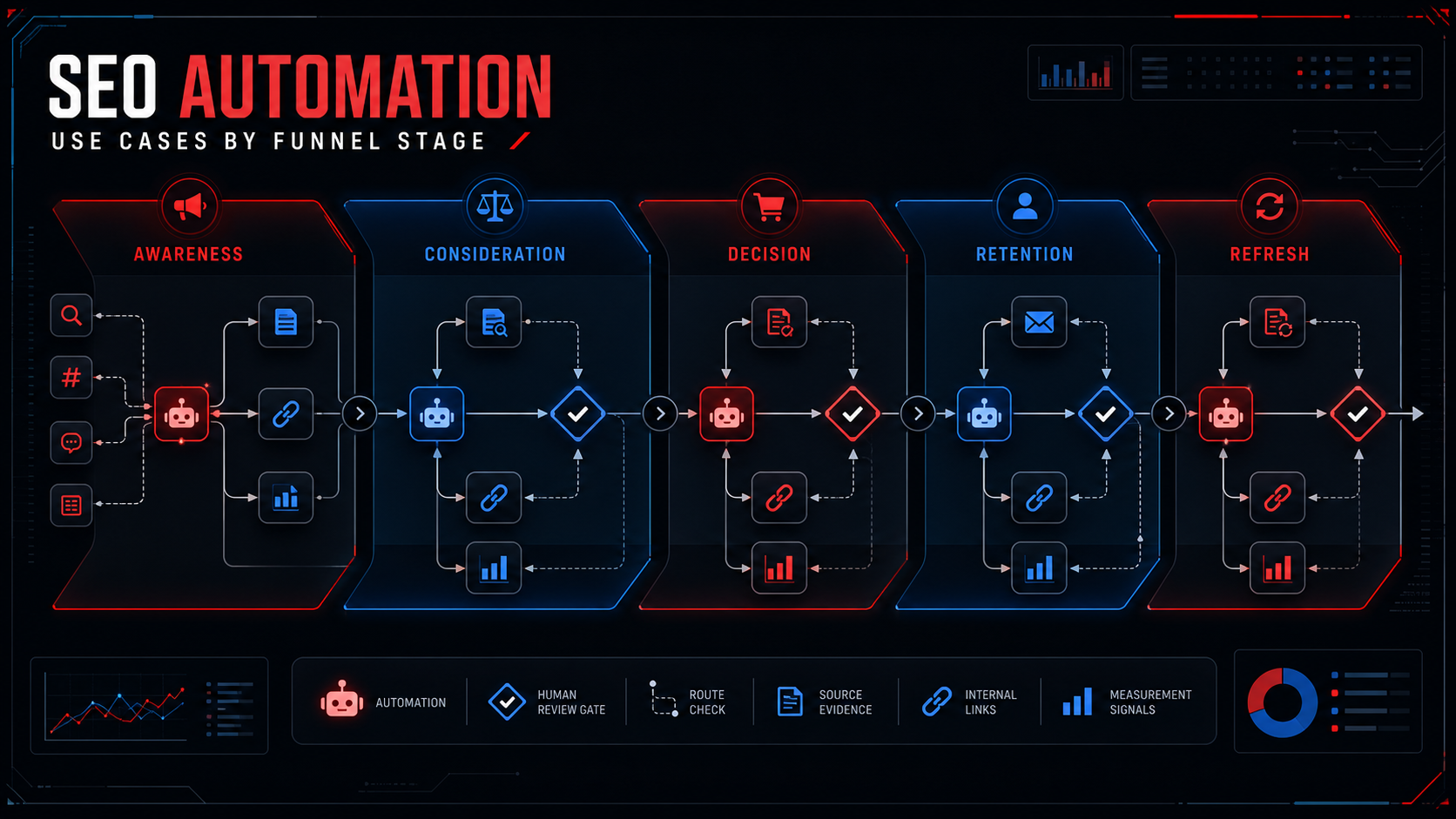
SEO automation is easier to buy than to operate. A crawler can find broken links, an AI system can draft briefs, a CMS API can publish pages, and an analytics job can collect post-launch data. The hard question is where each automation belongs in the funnel.
Use the wrong automation at the wrong stage and the team gets faster at the wrong thing: thin awareness pages, unsupported comparison claims, untracked conversion pages, stale translations, or refresh work that creates duplicate URLs. Use SEO automation by funnel stage and the workflow gets much more useful. Each page has a job, a proof standard, a release gate, and a measurement rule.
This guide maps practical SEO automation use cases across TOFU, MOFU, BOFU, retention, and refresh work. It is written for growth teams, technical founders, and SEO operators who want a concrete operating model instead of another generic list of SEO automation tools.
Quick Answer: What Is SEO Automation by Funnel Stage?
SEO automation by funnel stage means matching repeatable SEO tasks to the reader's state and the business risk of the page. Top-of-funnel automation should help explain problems and route readers to deeper resources. Middle-of-funnel automation should help compare workflows and criteria. Bottom-of-funnel automation should protect product claims, CTA paths, and publishing evidence. Retention and refresh automation should keep useful pages current without creating content churn.
| Funnel stage | Best SEO automation use case | What to automate | What a human should approve |
|---|---|---|---|
| TOFU: awareness | Turn problem language into useful explainers | Query grouping, outline skeletons, FAQ ideas, internal-link suggestions | Whether the article explains the problem clearly and avoids premature product claims |
| MOFU: consideration | Build workflow guides, checklists, and evaluation criteria | SERP/source capture, criteria tables, comparison structure, related links | Whether the criteria are fair, useful, and supported |
| BOFU: decision | Release conversion pages and implementation guides safely | CMS field validation, schema notes, route checks, CTA checks, evidence packs | Product facts, proof level, CTA fit, and risk-sensitive claims |
| Retention | Keep docs, playbooks, and tutorials current | Change detection, stale link checks, localized route checks, support-question clustering | Whether the update preserves meaning and reflects current behavior |
| Refresh | Improve, merge, or retire existing URLs | GSC/analytics pulls, cannibalization checks, changed-source alerts, internal-link gaps | Whether to keep, update, merge, redirect, or retire the page |
That is the practical distinction. SEO automation should not be a content-volume machine. It should be a control system that helps the team decide what belongs in the funnel, what evidence is required, and what happens after the URL ships.
Why Funnel Stage Changes the Automation
Search intent changes as a reader moves through the funnel. Someone searching "what is SEO automation" does not need the same page as someone comparing SEO automation tools or validating an automated publishing workflow. The automation should change with that intent.
Google's own guidance points in the same direction. Its SEO Starter Guide emphasizes helpful pages, descriptive titles, useful links, accessible images, and Search Console monitoring. Its guidance on AI-generated content focuses on content quality rather than the production method. Its spam policies also call out scaled content abuse when many pages are generated primarily to manipulate rankings rather than help people.
Those principles are operational, not theoretical. If a workflow can generate many pages quickly, the team needs stage-specific gates before publishing. The higher the funnel risk, the stronger the review and measurement gate should be.
TOFU SEO Automation: Capture Problem Language Without Creating Thin Pages
Top-of-funnel pages usually serve readers who are still naming the problem. They may search for definitions, beginner guides, symptoms, examples, or "why does this happen" questions.
Good TOFU SEO automation use cases include:
- collecting Search Console queries and community questions;
- clustering "what is," "why," and beginner "how" terms;
- drafting outline options from a source pack;
- generating FAQ candidates for editorial review;
- suggesting internal links to deeper guides;
- checking title, meta description, H1, and image alt text before publish.
The main risk is shallow scale. A workflow that creates a new page for every question variant can produce overlap fast. The TOFU gate should ask whether the article gives the reader a clearer mental model or whether it is just another definition.
| TOFU control | Automation output | Pass condition |
|---|---|---|
| Intent owner | Existing URL or new URL recommendation | One canonical owner exists for the query cluster |
| Source pack | Authoritative sources and product boundaries | Definitions and claims are supportable |
| Internal links | Next-step articles and anchors | Links help readers move deeper in the cluster |
| Release check | Metadata, headings, image, route, crawlability | The page is accessible and not technically broken |
| Measurement | Impressions, long-tail queries, internal-link clicks | The page attracts relevant discovery demand |
For TokenTest's own content cluster, a TOFU page might explain why model access risk, token usage integrity, or route reliability matters before production. The call to action should be soft: read a deeper guide, inspect the TokenTest manual, or run a small evaluation when the reader is ready.
MOFU SEO Automation: Help Readers Compare Workflows
Middle-of-funnel readers already know the category or workflow. They want a practical way to compare options. This is where SEO automation can create strong leverage if it supports evidence instead of just format.
MOFU SEO automation use cases include:
- capturing top-ranking page patterns and source gaps;
- building evaluation matrices and checklist drafts;
- mapping features to use cases;
- comparing build, buy, and hybrid workflows;
- suggesting internal links to adjacent tool, strategy, and QA pages;
- flagging unsupported vendor, pricing, or capability claims.
The review standard is higher here because the page may influence a buying or workflow decision. If the article names vendors, claims features, or compares product categories, those claims need current source pages or docs. If those sources are missing, publish neutral criteria instead of pretending the tool landscape is known.
| MOFU asset | Useful automation | Human review question |
|---|---|---|
| Evaluation framework | Criteria table, scoring dimensions, source checklist | Are these criteria fair and decision-useful? |
| Workflow guide | Stage map, inputs, outputs, handoffs | Does this help a team change its process? |
| Tool checklist | Feature groups, evidence fields, proof requirements | Are tool claims sourced or kept generic? |
| Comparison article | Side-by-side structure and objection list | Does the page avoid biased or stale claims? |
This article sits in the MOFU lane. The value is the funnel-stage operating map: what to automate, what to review, and what to measure for each business moment. For the broader operating model, read the TokenTest guide to SEO automation strategy. For upstream demand collection, use the guide to keyword research automation.
BOFU SEO Automation: Treat Conversion Pages Like Releases
Bottom-of-funnel pages have a smaller margin for error. A reader may sign up, start an evaluation, compare the product with a competitor, or send the page to a teammate. SEO automation should protect the live page, not just produce it.
BOFU SEO automation use cases include:
- validating product facts against current docs or pages;
- checking pricing only from a current pricing source;
- confirming CTA links, signup paths, and event names;
- validating schema, canonical, slug, metadata, and category;
- checking that the public route returns 200;
- checking localized routes when translations are configured;
- storing CMS readback and publish evidence.
For pages that include AI-assisted drafting or translation, add one more gate: model and workflow verification. TokenTest's current homepage describes a production-reference evaluation console for model access risk before production, and the manual documents checks for model identity, output discipline, token usage integrity, safety, protocol risk, and reliability. That is relevant when an SEO workflow depends on a model or routed endpoint to generate large source packs, drafts, or translations.
The BOFU rule is simple: if the page can influence a conversion, the automation should leave evidence. A polished article is not enough if the canonical is wrong, the CTA is untracked, the translated route 404s, the page is accidentally blocked with noindex, or the product claim has no source. For implementation details, pair this with TokenTest's content publishing QA workflow and technical SEO automation guides.
Retention SEO Automation: Keep Useful Pages Accurate
Retention SEO does not always look like SEO. It may be a product manual update, an implementation guide, a troubleshooting page, or a workflow playbook that current users return to.
Good retention SEO automation use cases include:
- detecting stale docs after product changes;
- clustering repeated support questions;
- finding broken internal and external links;
- flagging screenshots or code snippets that need review;
- checking localized pages after the source changes;
- reminding owners to refresh high-value evergreen tutorials.
The human review question is different from acquisition content. The owner should ask what changed, what must stay stable, and whether the updated page preserves user trust.
Measurement is also different. Instead of judging only new organic clicks, retention pages can be measured by returning users, support deflection, feature adoption, successful task completion, or fewer repeated support questions.
Refresh SEO Automation: Improve Existing URLs Before Creating More
Refresh work is where SEO automation often saves the most waste. A new article is not always the right answer. Sometimes the site already has a URL that owns the intent, but it needs better evidence, clearer links, updated examples, or a tighter CTA.
Useful refresh automation includes:
- pulling Search Console queries, clicks, impressions, CTR, and average position when available;
- comparing the live page to newer source material;
- detecting overlap between existing URLs;
- finding outdated internal links;
- checking whether a translated route is stale or missing;
- creating a decision log: keep, update, merge, redirect, expand, or retire.
The automation should not rewrite by default. It should assemble evidence so the owner can choose the least disruptive action. If the existing URL is already indexed and serving the right intent, preserve it unless there is a strong migration reason.
A Practical SEO Automation Funnel Map
Use this map when deciding what to automate next.
| Stage | Automate first | Delay until controls exist | Primary metric |
|---|---|---|---|
| TOFU | Query grouping, FAQ candidates, internal-link suggestions | Fully automated definition-page publishing | Relevant impressions, long-tail clicks, internal-link movement |
| MOFU | Source packs, criteria tables, evaluation frameworks | Vendor claims without current source checks | Organic clicks, engaged sessions, assisted conversions |
| BOFU | CMS QA, route checks, CTA checks, readback evidence | Automated product or pricing claims | Qualified signups, CTA events, assisted conversions |
| Retention | Stale-link checks, docs change alerts, localized route checks | Bulk rewrites of working docs | Returning users, support deflection, task success |
| Refresh | Performance pulls, cannibalization checks, changed-source alerts | Creating new URLs for every query variant | Pre/post clicks, impressions, CTR, position, conversions |
The highest-confidence starting point is usually not AI drafting. Start with deterministic SEO automation: route checks, link checks, canonical checks, inventory owner lookup, CMS field validation, structured data validation, and measurement baselines. Then add AI-assisted briefs and drafts once source rules and review gates are stable.
Common Mistakes
The most common SEO automation mistakes are operating mistakes.
- Automating the draft before the decision. The page should have an intent owner, source pack, funnel stage, and value asset before writing starts.
- Using one checklist for every page. Awareness articles, comparison guides, conversion pages, docs, and refreshes need different proof standards.
- Treating AI output as source evidence. AI can summarize sources, but the claim still needs a durable source URL or owner.
- Skipping readback after publish. A CMS API success response is not the same as a live, crawlable, localized page.
- Measuring only traffic. Organic clicks matter, but qualified signups and assisted conversions decide whether the article supported the business.
- Creating new URLs instead of refreshing. If an existing page owns the intent, SEO automation should recommend a refresh or merge before adding another page.
SEO Automation Checklist by Funnel Stage
Before publishing, answer these questions:
- Which funnel stage does this page serve?
- Does an existing URL already own this intent?
- What should SEO automation produce for this stage: source pack, brief, draft, QA evidence, measurement report, or refresh recommendation?
- Which claims require current source checks?
- Which human decision should block publication if it is unresolved?
- Which internal links should help the reader move to the next stage?
- Which route, canonical, schema, image, and localization checks must pass?
- Which metric decides keep, refresh, merge, or expand?
SEO automation works when it narrows decisions. It should make the team faster at collecting evidence, checking releases, and learning from URLs. It should not make the team faster at publishing unsupported pages.
For a practical next step, audit one article from each funnel stage. Mark what was automated, what was reviewed, what evidence was stored, and what metric decides the next action. That small map will show whether your SEO automation is a controlled workflow or just a faster content queue.
If your SEO automation uses AI models, routed endpoints, or translation workflows, run a small pre-production evaluation before scaling the batch. TokenTest is built for production-reference model evaluation, token usage integrity checks, protocol risk checks, and reliability evidence, which are the same kinds of controls a serious automated publishing workflow needs before it reaches the CMS.
FAQ
What SEO automation should a small team start with?
Start with deterministic checks: URL inventory, broken links, route status, canonical checks, internal-link suggestions, CMS field validation, and basic measurement baselines. Add AI-assisted briefs only after the team has source rules and review gates.
Should SEO automation publish pages automatically?
Only after the workflow has stable source rules, category rules, schema rules, image rules, canonical checks, route readback, and measurement. Until then, automatic publishing should stop at a reviewable package.
How is SEO automation different at TOFU and BOFU?
TOFU SEO automation should help explain a problem and guide readers deeper. BOFU SEO automation should protect product facts, CTA paths, route integrity, schema, localization, and conversion measurement.
What is the biggest risk of SEO automation?
The biggest risk is scaled low-value output: pages that look complete but lack a clear intent owner, source support, useful internal links, accurate product facts, or measurement. Stage-specific gates reduce that risk.