Blog Publishing Automation Strategy for Growth Teams
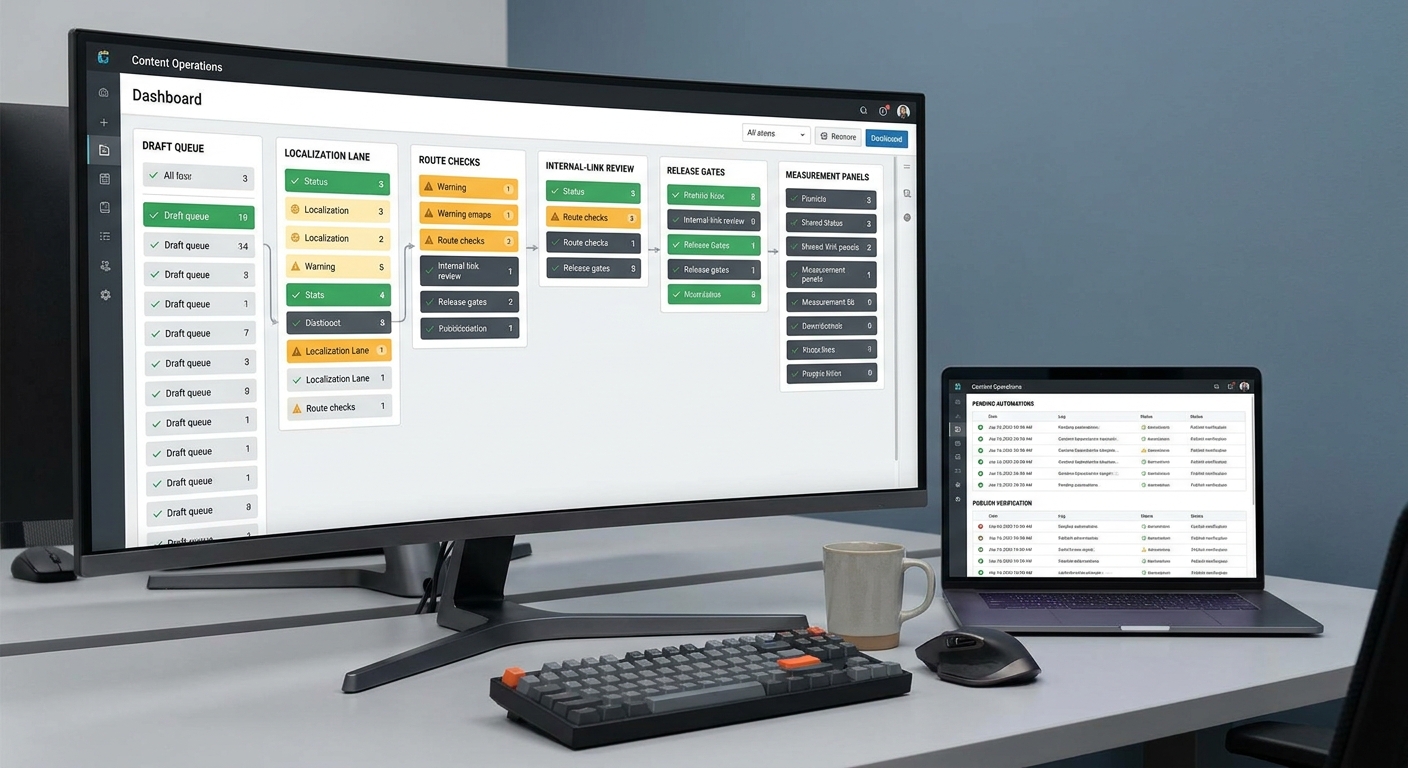
Blog publishing automation strategy for growth teams is not about shipping more posts faster. It is about deciding which parts of the release process are repeatable, which parts still need judgment, and which checks should block a publish.
That matters because most teams do not fail on drafting alone. They fail when metadata drifts, routes break, translations slip, or AI-generated copy ships without a release gate. A good blog publishing automation strategy makes those failure modes visible before the CMS write.
If your workflow uses AI to draft, rewrite, or translate, TokenTest fits before the CMS boundary. The TokenTest homepage and product manual describe a black-box evaluation workflow for model identity, usage integrity, token behavior, and route-level evidence without storing your API key.
The strategy layer
Blog publishing automation should be treated as an operating model, not a tool list.
| Layer | Automate first? | Keep manual? | Proof to require |
|---|---|---|---|
| Topic selection | Partly | Yes | Search intent, ICP fit, internal-link gap |
| Content contract | Yes | No | Final title, slug, meta, category, canonical |
| Draft creation | Yes | No | Source-backed outline and draft artifact |
| QA gate | Yes | No | Route, canonical, noindex, cover, internal links |
| Localization | Yes | No | Per-language payload and localized route check |
| Measurement | Yes | No | URL-level KPI mapping and review cadence |
That is the core rule of blog publishing automation for growth teams: automate repeatable checks, not the final judgment.
What to automate first
When a team starts blog publishing automation, the highest-return automations are the ones that prevent expensive rework.
| Failure mode | Automate first | Why |
|---|---|---|
| Metadata gets copied wrong | Content contract checks | The rule is deterministic |
| Published pages sometimes 404 | Route checks | CMS success is not public success |
| Translation breaks localized URLs | Per-language readback | Each route can fail independently |
| AI costs keep rising | Token budget gate | Drift shows up before publish |
| Internal links rot over time | Link checks | Broken references waste review time |
This is where blog publishing automation becomes a release system instead of a content factory.
What should stay manual
Not every part of blog publishing automation belongs in a script.
- Keep human review on positioning.
- Keep human review on claims and examples.
- Keep human review on exceptions and tradeoffs.
- Keep human review on the final CTA.
- Keep human review on whether the article actually answers the search intent.
If automation starts deciding the angle, the article usually gets faster and weaker at the same time.
A practical rollout sequence
For most growth teams, the rollout should happen in this order:
- Freeze the content contract.
- Validate the source evidence.
- Generate the draft with a token budget.
- Run the QA gate before CMS create.
- Publish the source article.
- Publish the translated route.
- Verify public routes and measurement hooks.
| Step | Owner | Exit condition |
|---|---|---|
| Contract | SEO / content lead | Title, slug, meta, category, canonical locked |
| Evidence | Writer / reviewer | Sources captured and current |
| Draft | Writer / AI workflow | Article meets intent and style |
| QA | Ops / editor | Internal links, routes, and noindex checked |
| Publish | CMS operator | Source route live |
| Localization | Localization owner | Target language route live |
| Measure | Growth analyst | KPI path recorded |
That sequence keeps blog publishing automation honest. It also gives the team a clear place to stop when proof is missing.
Where TokenTest fits
TokenTest is not the CMS. It is the verification layer before the CMS write.
Use it when blog publishing automation depends on AI-generated drafts, summaries, or translations and you need evidence that the request shape, token behavior, and output boundaries still make sense. The product manual shows the kind of black-box checks that make release decisions more reliable: identity, usage integrity, safety, and route integrity.
For a broader implementation view, pair this article with Blog Publishing Automation Checklist for Faster Decisions and How to Use Blog Publishing Automation in 2026.
Measurement that matters
If blog publishing automation is working, the page should move something concrete.
- Organic clicks
- Indexed URL count
- Qualified signups
- Assisted conversions
Tie each article to one primary metric and one review date. Otherwise, the system can produce more posts without learning whether the posts matter.
A simple decision rule
Use this rule when the team is deciding whether a step belongs in the automation path:
| Question | If yes | If no |
|---|---|---|
| Can the result be verified automatically? | Automate it | Keep it manual |
| Does the step change public metadata or routes? | Add a release gate | Do not trust CMS success alone |
| Does the step use AI-generated text? | Add a token budget gate | Keep the prompt short and bounded |
| Does the step affect search or measurement? | Record the route and metric | Do not mark the run complete |
That is the fastest way to keep blog publishing automation useful instead of noisy.
Conclusion
Blog publishing automation strategy for growth teams works when it removes repetitive release work, keeps judgment visible, and stops before the CMS if the public page is not ready.
If you need the broader workflow context, read SEO Automation Strategy for Growth Teams and SEO Automation Examples: 6 Workflows With Release Gates. For release QA, Content Publishing QA: Workflow Playbook for Preflight Manifests is the closest companion page.