How to Use SEO Workflow in 2026
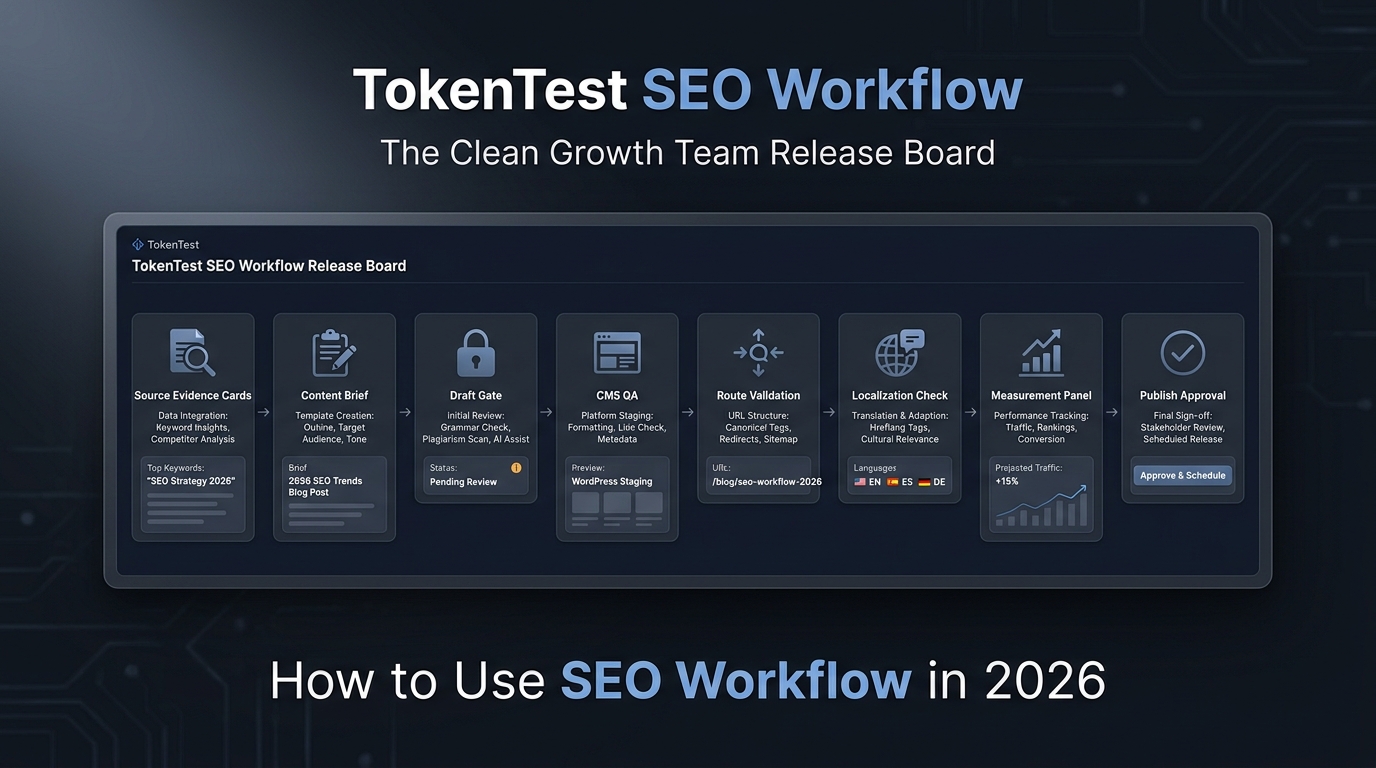
How to use an SEO workflow in 2026 is mostly a question of release discipline. The teams that do it well do not treat SEO as a pile of disconnected tasks. They treat it as a repeatable path from query selection to source evidence, draft, QA, publish, localization, and measurement.
That matters more in 2026 than it did a few years ago. Google still pushes the same basic standard: make helpful pages, keep the page structure clear, use useful links and images, and measure what happens after publish. If your SEO workflow includes AI drafting or translation, you also need a control layer before the CMS write so the model does not turn weak inputs into public pages.
The practical version is simple: choose one intent cluster, prove the page is worth shipping, draft against a source table, pass a publish gate, and review the URL after it is live. That is the SEO workflow.
Quick answer: the 7-step SEO workflow
| Step | What to do | Output | Go/no-go check |
|---|---|---|---|
| 1 | Pick one query cluster and page owner | One canonical URL idea | No duplicate intent owner |
| 2 | Collect current source evidence | Source table and notes | Every risky claim is traceable |
| 3 | Write the draft with constraints | Article body and metadata | No unsupported product or pricing claim |
| 4 | Run content QA | Final article package | Title, slug, canonical, links, and image are valid |
| 5 | Publish source, then locale | Live source route and translated route | Both routes return 200 |
| 6 | Validate the public page | Readback, schema, and route checks | No accidental noindex or broken canonicals |
| 7 | Measure and decide next action | Search Console and analytics review | Keep, refresh, merge, or retire |
If a team skips one of those gates, the workflow usually becomes faster at producing cleanup.
How to Use SEO Workflow in 2026
Start with the page decision, not the draft. A strong SEO workflow begins by answering one question: what should this URL own that the current site does not already own?
Use this order:
- Define the query cluster and search intent.
- Check your live site for overlap.
- Gather sources, examples, and proof requirements.
- Draft the article or landing page.
- Add internal links, metadata, and schema notes.
- Validate the public route after publish.
- Measure clicks, indexation, signups, and assisted conversions.
That is the core SEO workflow in 2026. The exact tools can change, but the sequence should not. If you reverse the order and draft first, you end up with more pages and weaker decisions.
1. Pick one intent cluster
The first mistake teams make is treating SEO workflow as a content calendar problem. It is not. It is a page ownership problem.
Pick one intent cluster and make the canonical URL decision first. Ask:
- Is this query informational, comparative, or decision-oriented?
- Do we already have a page that owns it?
- Is the new page a better fit, or should we refresh an existing URL?
This matters because one SEO workflow can easily create two pages for the same job. That is how cannibalization starts.
For this site, the surrounding cluster already includes SEO Automation Strategy for Growth Teams, SEO Automation Examples: 6 Workflows With Release Gates, and Keyword Research Automation Strategy for Growth Teams. The right SEO workflow for a new article should complement those pages, not repeat them.
2. Collect evidence before drafting
A useful SEO workflow does not start with adjectives. It starts with evidence.
Current Google guidance is still clear on the basics:
- helpful, reliable, people-first content
- clear titles and structure
- useful links and images
- Search Console monitoring after publish
If AI is involved, the same workflow needs one more control layer. TokenTest fits there. The live homepage and manual describe a production-reference evaluation console that checks model identity, token behavior, safety, and route integrity without storing your API key. That makes it useful before the CMS boundary when the draft or translation is AI-assisted.
Build the source table before you write. A simple table is enough:
| Claim type | Source | Notes |
|---|---|---|
| Product behavior | TokenTest homepage and manual | Use live product wording only |
| SEO guidance | Google Search Central docs | Use current official guidance |
| Measurement | Search Console and GA4 docs | Tie each URL to a review metric |
| Internal context | Existing TokenTest blog posts | Avoid duplicate intent |
If a claim cannot point to a source, leave it out or mark it for review.
3. Draft with constraints that survive review
The draft phase is where SEO workflow usually drifts. A clean draft needs constraints:
- one page purpose
- one primary keyword
- one CTA
- one canonical URL
- one measurement plan
- one internal-link plan
That is enough to keep the article useful without overfitting it to a keyword list.
For a 2026 SEO workflow page, the draft should answer these questions:
- What step does the team automate first?
- What step should still be reviewed by a human?
- What evidence must exist before publish?
- What changes after the page goes live?
If you use AI drafting, keep the prompt bounded. TokenTest is a good upstream check for that kind of workflow because it can surface token usage, output discipline, and route-level risk before you let the draft reach the CMS.
4. Run publish QA before the CMS write
This is the part many teams skip. They treat a CMS draft as a finish line. It is not.
Your SEO workflow should verify:
- title and meta description
- slug and canonical
- one page-level H1 in the template, not duplicated in body content
- internal links
- image alt text
- schema notes
- route status
- locale parity if translations exist
That is exactly why the workflow should look like a release process. A good publish gate catches the kind of problem that only appears on the live route.
If the page includes a translated version, validate the locale separately. Source success does not prove translated success.
5. Publish source, then locale
Publish the source article first. Then publish the translated route with the same intent, the same proof standard, and locale-specific metadata.
In 2026, the SEO workflow should treat localization as a release group, not a side effect. That means:
- localized slug or route rule
- translated title and meta description
- public route check
- canonical and hreflang behavior
- cover image parity
This is also where a lot of automation gets sloppy. If the translated route 404s or the canonical points somewhere unexpected, the workflow is not complete.
6. Measure the URL like a release
The right SEO workflow does not end at publish. It ends at the first measurement review.
Track the metrics that tell you whether the page actually helped:
- organic clicks
- indexed URL count
- qualified signups
- assisted conversions
Search Console is the first evidence layer. GA4 key events are the second. If your property also has newer Search Console views for AI surfaces, add those to the same review cadence when available.
Do not measure only article count. A workflow that produces 20 pages and no qualified outcomes is not a working SEO workflow.
SEO workflow checklist
- one intent cluster
- one canonical owner
- current sources captured
- unsupported claims removed
- internal links added
- metadata complete
- image alt text complete
- route check passed
- locale check passed
- measurement plan assigned
If any item fails, stop the release and fix the workflow before the page ships.
Where TokenTest fits
TokenTest is not your CMS and not your content calendar. It is useful before the CMS boundary when your SEO workflow depends on AI-generated drafts, summaries, or translations.
The homepage frames TokenTest as a production-reference model evaluation console. The manual shows the dimensions that matter for real release decisions: model identity, usage integrity, token usage, safety, reliability, and route evidence. That fits neatly into an SEO workflow that needs to verify the machine side before it changes public content.
For adjacent workflow context, read How to Use Blog Publishing Automation in 2026 and Content Publishing QA: Workflow Playbook for Preflight Manifests.
Conclusion
How to use SEO workflow in 2026 comes down to one thing: treat SEO as a release process.
Choose one page owner, collect evidence, draft with constraints, run publish QA, publish source and locale, then measure the URL against a real outcome. That keeps the SEO workflow useful instead of busy.
If you want the adjacent operating model, read SEO Automation Strategy for Growth Teams and Technical SEO Automation Tools: Evaluation Framework. For the AI-side control layer, use the TokenTest manual.
Sources and references
- TokenTest homepage
- TokenTest manual
- TokenTest blog
- Google Search Central: helpful, reliable, people-first content
- Google Search Central: SEO Starter Guide
- Google Search Central: Search Console start guide
- Google Search Central: article structured data
- GA4 help: key events
FAQ
What is an SEO workflow?
An SEO workflow is the repeatable process for choosing a page, collecting evidence, drafting, publishing, localizing, and measuring it.
What should automation handle first?
Start with evidence collection, metadata checks, route validation, and measurement setup. Keep page decisions and claims under review.
When should a team refresh instead of create?
Refresh when an existing URL already owns the intent and only needs better evidence, structure, links, or measurement.