AI Blog Writer Implementation Guide for Teams
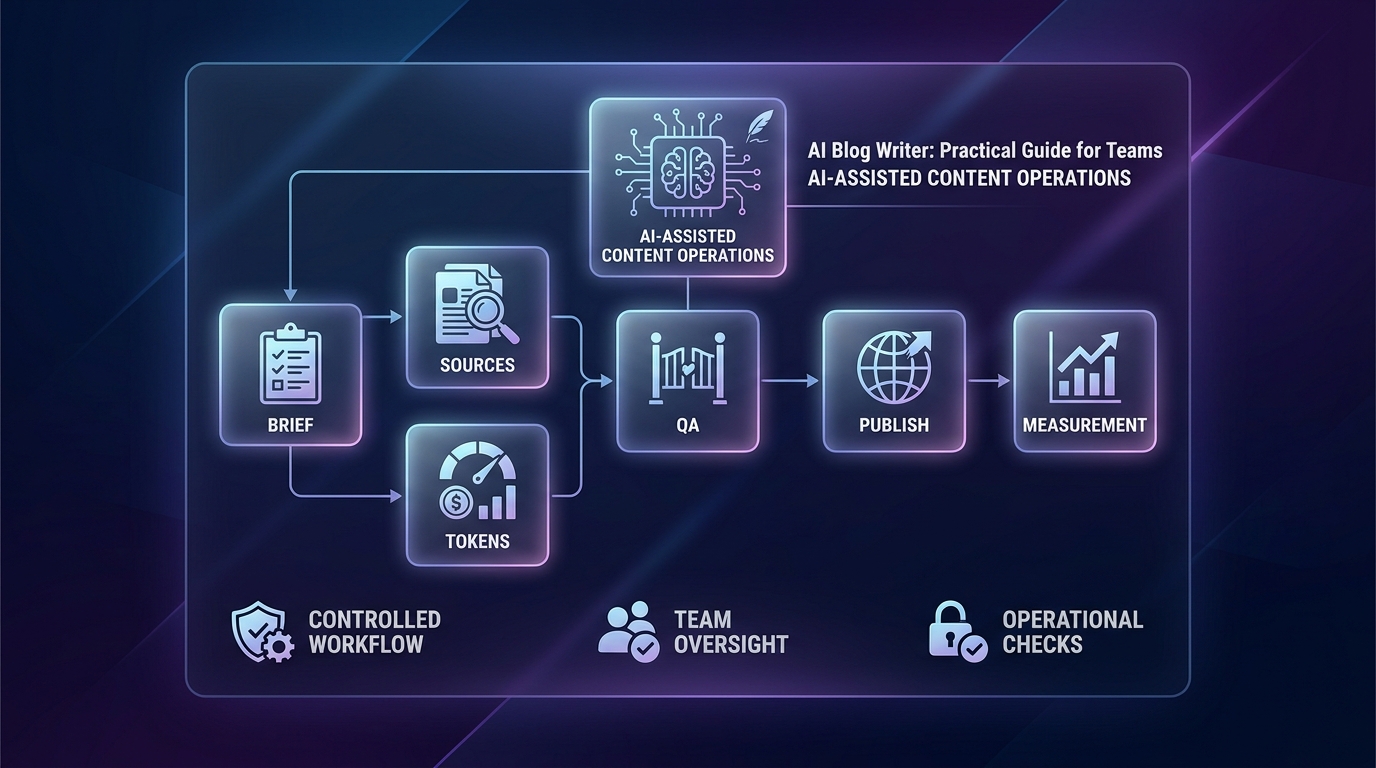
An AI blog writer is useful for teams only when it runs inside a controlled publishing system. The model can help with briefs, outlines, drafts, rewrites, metadata, and localization, but the team still owns the page decision, source quality, token budget, edit standard, CMS handoff, and live URL checks.
This practical guide is for teams that already know an AI blog writer can produce a draft and now need to make the workflow reliable. It gives a 7-day rollout plan, owner map, token budget worksheet, source QA gate, publishing checklist, and measurement loop.
The core idea is simple: treat an AI blog writer like a content production service, not like a blank text box.
Quick Answer: The Team Workflow
A team-ready AI blog writer workflow has six gates:
| Gate | Owner | What must pass |
|---|---|---|
| Page decision | SEO or content lead | The query, intent, audience, and article angle are specific enough to justify a new URL. |
| Source pack | Editor or researcher | Product claims, external facts, competitor references, and internal links are approved before drafting. |
| Token budget | AI workflow owner | Source input, draft output, retries, QA, and translations have a visible token plan. |
| Draft control | Editor | The AI blog writer follows the brief, avoids unsupported claims, and adds real workflow value. |
| Publish QA | CMS owner | Slug, metadata, schema, cover image, links, canonical, and public route checks pass. |
| Measurement | Growth owner | Organic clicks, indexed URL status, qualified signups, and assisted conversions are tracked by URL. |
If any gate is missing, the AI blog writer may still save drafting time. It is not yet safe as a repeatable team workflow.
Why Teams Need a Practical AI Blog Writer Process
Most AI blog writer failures do not look like obvious failures. The draft may read smoothly, use the keyword, include tables, and look ready for CMS import. The problems usually sit underneath:
- the page duplicates an existing article;
- the model cites weak or stale evidence;
- product claims drift from current docs;
- a rewrite removes the evidence trail;
- token use grows when source packs and translation are added;
- the CMS import changes headings or metadata;
- the localized route is created but not published;
- the team measures draft volume instead of URL outcomes.
Google's current guidance is a useful guardrail here: AI or automation can be part of content creation, but content still has to be helpful, reliable, people-first, original, and not created primarily to manipulate search rankings. That means the workflow around the AI blog writer matters as much as the writing model.
For TokenTest's audience, the operational issue is even sharper. Engineering-led teams already know that LLM output can regress when prompts, models, context, or routing change. Content workflows have the same shape: a prompt change can create a weaker page, a larger request, a wrong claim, or a broken publishing artifact. Treating those risks as gates makes the AI blog writer easier to trust.
Day 1: Decide Whether the Page Should Exist
Do not start with a draft. Start with a page decision.
For each candidate topic, complete this table before asking the AI blog writer to outline anything:
| Decision field | Practical test |
|---|---|
| Primary keyword | Can the page use the exact query naturally in the title, intro, at least one heading, body, meta description, and final CTA? |
| Search intent | Is the reader trying to learn, compare, choose, troubleshoot, or implement? |
| Existing overlap | Do you already have a page that answers the same job? |
| New value | What will this article provide that the existing SERP and your existing site do not? |
| Conversion path | What is the next useful page or product action for this reader? |
| Refresh trigger | What would make this page outdated later? |
For this article, the overlap check matters. TokenTest already has pages explaining what an AI blog writer is, how to evaluate AI blog writer tools, and which AI blog writer metrics matter. This page therefore focuses on implementation: how a team can roll out an AI blog writer workflow without losing source control, budget visibility, or publish QA.
Day 2: Build the Source Pack Before the Prompt
An AI blog writer should not be asked to "research and write" a publishable page in one uncontrolled pass. That hides the boundary between approved facts, model memory, and plausible filler.
Build a source pack first:
| Source type | Include | Exclude |
|---|---|---|
| Product proof | Current homepage, docs, manuals, pricing pages, changelog, screenshots, or API docs | Old positioning notes that no longer match public pages |
| External guidance | Official docs, search guidance, vendor docs, standards, or credible primary sources | Unsourced social posts or copied listicles |
| SERP examples | Ranking page formats, repeated headings, common questions, and visible gaps | Claims about traffic, difficulty, or authority without tool evidence |
| Internal pages | Existing cluster URLs and anchor text candidates | Links added only for volume |
| Editorial constraints | Claims to avoid, byline rules, disclosure rules, and reviewer notes | Hidden requirements that appear only after drafting |
For TokenTest, safe product proof comes from the current homepage and manual. The homepage positions TokenTest as a black-box production-reference model evaluation console for model capability, route protocol, token usage, safety boundaries, and channel reliability. The manual expands the evaluation dimensions, including token usage integrity, safety and robustness, stability, stream usage, max-token linkage, cache-token evidence, and production reference signals.
That product proof supports a narrow role in this AI blog writer guide: TokenTest is not the writing tool. It is the evaluation layer that helps teams think about model behavior, token measurement, and production readiness before they rely on AI output in a publishing pipeline.
Day 3: Write a Brief the AI Blog Writer Cannot Misread
A practical brief should constrain the article before it constrains the prose.
Use this minimum brief:
Primary keyword:
Search intent:
Audience:
Page job:
Angle:
Existing pages to avoid duplicating:
Approved sources:
Internal links:
Claims to avoid:
Required value asset:
CTA:
QA gates:
Example:
Primary keyword: AI blog writer
Search intent: informational, practical implementation
Audience: SEO lead, technical marketer, AI engineer supporting content ops
Page job: teach a repeatable team workflow
Angle: use an AI blog writer only after source, token, QA, publish, and measurement gates are explicit
Existing pages to avoid duplicating: AI blog writer definition, tools evaluation, metrics
Approved sources: Google Search guidance, OpenAI token counting and prompt engineering docs, TokenTest homepage/manual
Internal links: /blog, AI blog writer tools, blog publishing automation, content planning AI
Claims to avoid: best tool, cheapest tool, guaranteed rankings, unsupported pricing
Required value asset: 7-day rollout plan and publish checklist
CTA: evaluate model-side and token-side risk before scaling AI content workflows
QA gates: source support, keyword placement, metadata, internal links, route checks, translation checks
This brief gives the AI blog writer fewer places to invent. It also gives the reviewer a concrete contract.
Day 4: Add a Token Budget Worksheet
Teams often budget an AI blog writer as if one article equals one prompt. In practice, a team workflow can include source extraction, outline generation, draft generation, rewrite, metadata, FAQ, localization, QA, and CMS formatting.
OpenAI's current token counting documentation is relevant because it shows a direct Responses API path for counting input tokens before a request. For production teams, the larger lesson is that token planning should happen before expensive or context-heavy calls, not after the workflow becomes normal.
Use this worksheet before scaling:
| Workflow step | Budget question | Stop rule |
|---|---|---|
| Source pack | How many tokens will the approved source excerpts add? | Remove duplicate or low-authority sources before drafting. |
| Outline | How many variants are allowed? | Stop after one approved outline plus one revision. |
| Draft | What output length is expected? | Set maximum output and section length expectations. |
| Evidence pass | Does the reviewer need the full source pack again? | Use source IDs and excerpts instead of reloading everything. |
| Revision | How many rewrite passes are acceptable? | Block endless polish loops. |
| Metadata and FAQ | Can these be generated from the final body only? | Do not reopen broad research unless the angle changed. |
| Translation | Which languages are required? | Budget separately for each target language. |
| Publish QA | What must be checked after CMS save? | Do not mark done until public routes are validated. |
The goal is not to make every content team obsess over tokens. The goal is to make request size, retry cost, context pressure, and translation cost visible before an AI blog writer workflow turns into an always-on production system.
Day 5: Draft in Stages
One giant prompt is hard to review. Staged prompts are slower at the beginning and safer over time.
Use this sequence:
- Intent summary: Ask the AI blog writer to summarize the reader problem, search intent, and likely page format from the brief.
- Gap check: Ask it to compare the angle against existing internal pages and identify the page's unique job.
- Outline: Generate H2s, H3s, tables, and value assets only after the gap is clear.
- Draft: Write the body from the approved outline and source pack.
- Evidence pass: Mark factual claims that need source support or removal.
- SEO pass: Generate title, meta description, FAQ, anchors, and image alt text.
- Publish pass: Format the final Markdown or HTML for the CMS.
OpenAI's prompt engineering guidance supports this pattern at a high level: break complex work into simpler subtasks, give reference material when relevant, and use clearer instructions. For an AI blog writer, that means the model should solve one reviewable task at a time.
Day 6: Run Editorial QA Before CMS Import
Use a blocking editorial QA gate before the article reaches the CMS.
| QA check | Pass condition |
|---|---|
| Search intent | The article answers the practical question implied by "AI blog writer," not just the tool category. |
| Keyword placement | AI blog writer appears naturally in the title, meta title, meta description, intro, one H2, body, alt text, and CTA. |
| Source support | Product, vendor, search, and competitor claims map to approved sources. |
| Original value | The page includes a workflow, checklist, worksheet, matrix, or example the reader can reuse. |
| Internal links | Links point to relevant pages and do not duplicate the same anchor repeatedly. |
| Risk language | The article avoids unsupported superlatives, pricing claims, ranking promises, and legal/compliance claims. |
| Token plan | The workflow explains where request size and retry cost can grow. |
| Human review | The byline, disclosure policy, and final accountability are clear for the site. |
The highest-risk AI blog writer drafts are usually not terrible. They are plausible. The reviewer should look for unsupported certainty, repeated generic advice, buried source gaps, and smooth sections that do not help the reader make a better decision.
Day 7: Publish, Read Back, and Measure the URL
Publishing QA starts after CMS save, because the live artifact can differ from the approved draft.
Check:
| Publish check | Why it matters |
|---|---|
| Public route returns 200 | Confirms the article is actually accessible. |
| Canonical URL matches the slug | Avoids wrong-route and duplicate signals. |
| Title and meta match the package | Catches CMS field drift. |
| Cover image loads | Prevents broken first-viewport media. |
| Alt text is accurate | Keeps image context accessible and search-relevant. |
| Internal links resolve | Preserves the reader path. |
| Schema is present and valid | Reduces structured data errors. |
| Translation route returns 200 | Catches localized publishing failures. |
| Source and translation share category and cover | Keeps multilingual versions aligned. |
Then measure the URL, not the draft count:
- indexed URL status;
- organic clicks and impressions;
- query set that triggers the page;
- qualified signups from article sessions;
- assisted conversions from later journeys;
- internal-link clicks into deeper TokenTest pages;
- translation performance by language;
- refresh triggers when the SERP, product, or tool category changes.
For a top-of-funnel AI blog writer guide, the conversion should be useful rather than aggressive. A reader who learns to control an AI writing workflow may next need to evaluate model behavior, token measurement, prompt changes, and production-readiness checks. That is the natural bridge to TokenTest.
AI Blog Writer Rollout Checklist
Use this checklist before making an AI blog writer part of the team's recurring publishing process:
| Area | Ready when |
|---|---|
| Topic selection | Every new URL has a clear keyword, intent, unique angle, and internal-link role. |
| Source workflow | The source pack is created before drafting and stored with the article package. |
| Prompt workflow | Prompts are staged by task: intent, gap, outline, draft, evidence, SEO, publish. |
| Token workflow | Input, output, retry, QA, and localization budgets are visible. |
| Editorial workflow | Reviewers can block unsupported claims, generic sections, and duplicate pages. |
| Publishing workflow | The CMS payload, image, category, schema, canonical, and route checks are verified. |
| Localization workflow | Source and translated pages are checked separately, including route status. |
| Measurement workflow | URL-level clicks, indexing, signups, assisted conversions, and refresh triggers are tracked. |
This is the difference between "we use an AI blog writer" and "we operate an AI-assisted content system."
Where TokenTest Fits
TokenTest should not be positioned as an AI blog writer. It fits one layer deeper: evaluating model-side behavior before teams rely on LLM output in production workflows.
In content operations, that means TokenTest can help teams reason about:
- whether the model or route returns auditable token usage;
- whether input and output token behavior looks plausible;
- whether max-token limits and stop behavior are reflected;
- whether safety and protocol boundaries are tested;
- whether model or route changes create new production-readiness risk.
Those checks matter when AI-generated content becomes a repeatable workflow. Draft fluency is only one part of the system. The team also needs confidence that model changes, prompt changes, context size, and publishing automation do not silently degrade the output.
For adjacent TokenTest reading, start with the AI blog writer tools evaluation framework, the AI blog writer metrics guide, and the blog publishing automation workflow. You can also browse the TokenTest blog for model verification and token workflow articles.
Final Takeaway
An AI blog writer helps teams when it makes controlled content production faster. It hurts teams when it turns weak briefs, stale sources, invisible token costs, and unverified CMS output into more published pages.
The practical path is to install gates: page decision, source pack, token budget, staged drafting, editorial QA, publish readback, localization checks, and URL-level measurement.
Use the AI blog writer for speed. Keep the team responsible for proof.
Sources
- Google Search Central: Creating helpful, reliable, people-first content
- Google Search Central: Guidance on using generative AI content
- Google Search Central Blog: Google Search's guidance about AI-generated content
- OpenAI API docs: Counting tokens
- OpenAI API docs: Prompt engineering
- TokenTest homepage
- TokenTest product manual