AI Blog Writer Metrics That Actually Matter
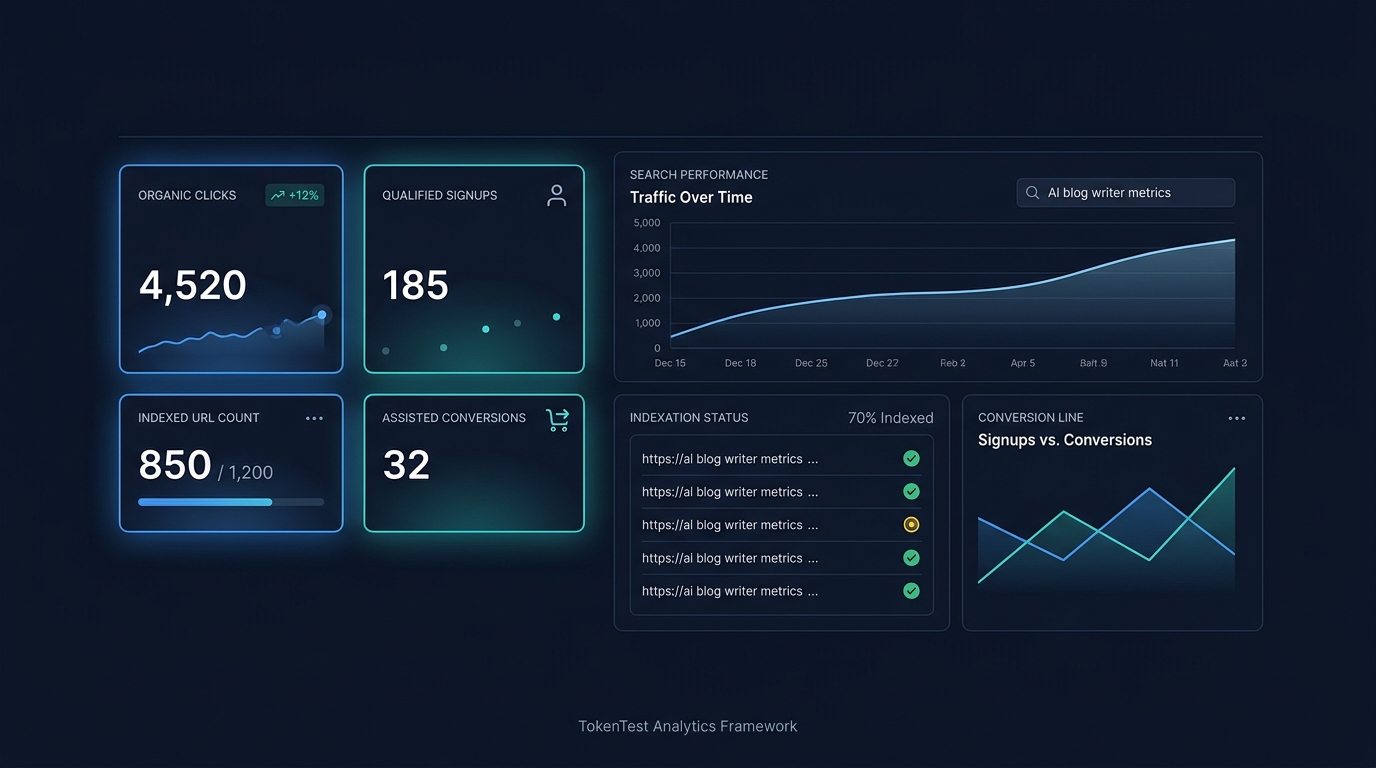
AI blog writer metrics that actually matter are the ones that show whether the article was found, indexed, read by the right audience, and useful enough to move someone closer to a signup. Draft count is not one of them. Word count is not one of them either.
If a team uses an AI blog writer only to produce more drafts, it can miss the real question: did the article earn organic clicks, get indexed, create qualified signups, or assist conversions later in the journey? For TokenTest, those are the metrics worth tracking because they connect content output to search behavior and business outcome.
Quick Answer
| Metric | What it tells you | When to use it | What to avoid |
|---|---|---|---|
| Organic clicks | The page is earning search demand and the snippet matches intent | After the URL is indexed | Treating clicks as the final goal |
| Indexed URL count | The page is crawlable and eligible to surface | Early after publish and during audits | Counting thin or duplicate pages as wins |
| Qualified signups | The article is attracting the right reader and moving them deeper | Once the page has traffic | Using raw signups without an ICP definition |
| Assisted conversions | The article contributed to a later conversion path | Longer lookback windows | Reading only last-click attribution |
If those four move in the right direction, the AI blog writer is probably helping. If only draft volume moves, the workflow is just making more content.
Why the Usual Metrics Mislead
A lot of teams start with drafts, tokens, or pageviews. Those are useful diagnostics, but they are not the outcome. More drafts can mean more waste. More words can mean more filler. More pageviews can mean nothing if the visitor bounces and never qualifies.
Search Console and GA4 answer different questions. Search Console shows how the page performs in search results. GA4 shows what happens after the click. Use both, not one or the other.
Google’s current guidance also matters here: AI or automation can be part of content creation, but the page still has to be helpful, people-first, and worth keeping. That is a measurement problem as much as a writing problem.
The Four AI Blog Writer Metrics
1. Organic clicks
Organic clicks tell you whether the title, meta description, and query match are working. If impressions rise but clicks stay flat, the page may be ranking for the wrong angle or presenting itself poorly in the snippet.
2. Indexed URL count
Indexed URL count tells you whether the page is even eligible to participate. If the URL is not indexed, downstream metrics do not matter yet. Fix crawlability, canonical quality, duplication risk, and coverage before you celebrate traffic.
3. Qualified signups
Qualified signups tell you whether the article reached the right reader. For TokenTest, a qualified signup is not every signup. It is a developer, founder, backend engineer, staff engineer, or engineering manager who enters the lead path after engaging with the article.
4. Assisted conversions
Assisted conversions tell you whether the article contributed to a later conversion, even if it was not the final click. This matters for educational posts because the reader often returns later through another page, another channel, or a direct visit.
Support Metrics Worth Tracking for AI Blog Writer Metrics
These AI blog writer metrics support the main scorecard, but they do not replace it.
These metrics are useful, but they are support signals rather than the scorecard itself:
- CTR
- average position
- internal-link clicks
- time to publish
- rewrite distance
- token cost per article
They help you find workflow leaks. They do not replace outcome metrics.
A Simple Scorecard
| Stage | Main metric | Decision if weak |
|---|---|---|
| Pre-index | Indexed URL count | Fix crawl, canonical, or duplication issues |
| Early search | Organic clicks | Rework title, description, and search intent fit |
| Post-traffic | Qualified signups | Tighten the CTA and reader-to-offer match |
| Multi-touch | Assisted conversions | Improve internal links and downstream page path |
A page can have good clicks and weak signups if the topic is broad but not specific enough. It can have weak clicks and strong signups if it reaches a smaller but sharper audience. Use the whole stack, not a single number.
What AI Blog Writer Metrics Should Ignore First
Before teams chase more output, they should stop treating these as success metrics:
- draft count
- word count
- token count per draft
- pageviews without a qualified definition
- raw signups without article attribution
Those numbers can help with operations, but they do not prove that the AI blog writer is improving the content system.
Where TokenTest Fits in AI Blog Writer Metrics
TokenTest is the control layer, not the content output. The homepage and manual position TokenTest as a production-reference evaluation console with checks for model identity, output discipline, token measurement credibility, safety, and stability.
That matters because an AI blog writer should not just produce text. It should produce text through a workflow the team can trust.
TokenTest is useful when AI blog writer metrics need a model-side control layer before the URL-side measurement starts.
In practice, TokenTest helps content teams think about the model-side risk before the page is published. Search Console and GA4 handle the URL-side result after publish. The article only matters if both sides improve.
For a deeper workflow view, see What Is an AI Blog Writer and When Does It Matter?, AI Blog Writer Guide for Teams: Workflow, QA Gates, and Token Budgets, and How to Use Blog Publishing Automation in 2026.
Final Takeaway
The AI blog writer metrics that actually matter are the ones tied to search visibility and business value: organic clicks, indexed URL count, qualified signups, and assisted conversions.
Track the support metrics too, but do not confuse them with success. If the workflow is producing drafts and those four metrics stay flat, the problem is not the writing speed. It is the topic, the intent, the page fit, or the measurement loop.