AI Blog Writer Tools: Evaluation Framework
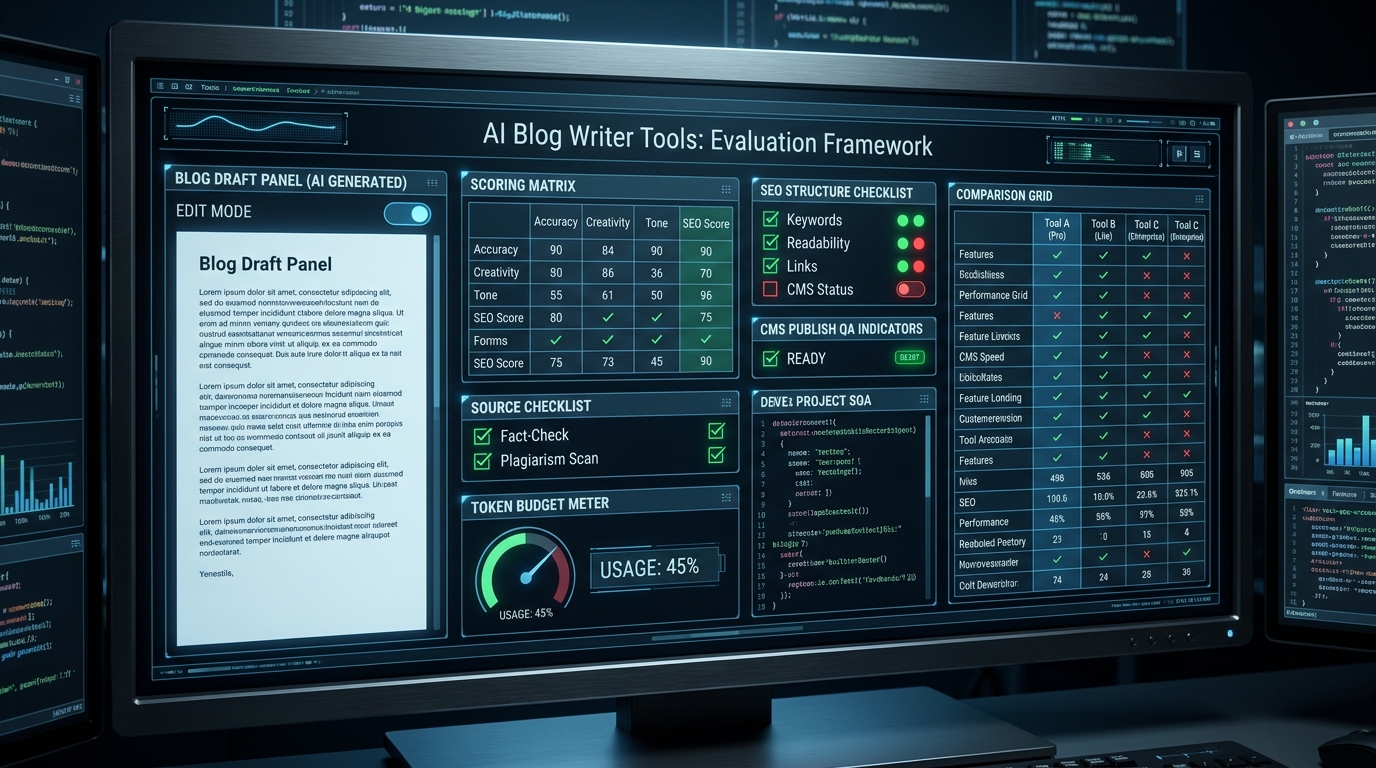
Most AI blog writer tools can produce a draft quickly. That is not the hard part.
The hard part is whether the tool survives the rest of the publishing workflow: brief quality, source fidelity, SEO structure, token cost, CMS export, and post-publish QA. That is the difference between a useful drafting assistant and an expensive content detour.
Search results for this topic mostly fall into three buckets: "best tools" roundups, vendor use-case pages, and generic AI evaluation guides. Those pages are useful, but they usually stop at output quality and basic SEO features. They rarely show how to test the same brief across tools, score the edit burden, or decide whether the tool belongs in a live publishing system.
This framework is built to answer that question.
What the SERP Already Covers
The current search pattern repeats a few themes:
| SERP pattern | What it does well | What it misses |
|---|---|---|
| Tested-and-ranked listicles | Quick tool shortlists, simple verdicts, and practical examples | Repeatable test method, source fidelity, and edit burden |
| Vendor use-case pages | Feature lists, templates, and workflow claims | Cross-tool comparison and failure cases |
| Enterprise evaluation guides | Adoption, governance, and change management | Blog-specific release QA and CMS fit |
| Generic AI evaluation posts | Framework language and high-level advice | Actual publishing constraints and scoring rules |
Examples in the current results include AIOSEO's "tested and ranked" roundup, NextGrowth's 7-point evaluation framework, Kontent.ai's content writer tool list, Writer's enterprise evaluation guide, and Cuppa's blog writer use-case page. The pattern is consistent: most pages describe the tools. Few show how to test them.
That missing layer is where this article lives.
The Evaluation Framework
Use these seven criteria to compare AI blog writer tools.
| Criterion | Weight | What to test | Fail signal |
|---|---|---|---|
| Brief fidelity | 20% | Can the tool stay inside a tight brief with audience, intent, CTA, and exclusions? | Generic outline, topic drift, or invented strategy |
| Source fidelity | 20% | Can it use provided sources without distorting facts or hiding unsupported claims? | Claims with no source basis |
| SEO structure | 15% | Does it produce a clean title, outline, H2s, intro, and meta suggestions? | Sloppy headings, duplicate intent, or keyword stuffing |
| Brand voice and edit distance | 15% | How much human rewriting is needed to match tone and positioning? | The draft sounds usable only after heavy rewrite |
| Token and cost behavior | 10% | Can you estimate prompt size, output size, and retry cost before scaling? | The workflow hides cost, retries, or context growth |
| Workflow integration | 10% | Does it fit into your CMS, docs, review, and translation flow? | Copy-paste friction at every step |
| Governance and measurement | 10% | Can you review changes, approvals, and post-publish results? | No audit trail or URL-level measurement plan |
This is the simplest useful filter: if a tool wins on drafting but fails on source fidelity or workflow integration, it is not a publishing tool. It is a draft toy.
A 60-Minute Test Run
Test every candidate tool with the same inputs.
- Write one 150 to 250 word brief.
- Attach 3 to 5 source URLs or source notes.
- Ask for the same blog format from every tool.
- Score the first draft against the seven criteria above.
- Run one revision pass with the same edit instructions.
- Test export into your CMS or publishing format.
- Measure how much human rewrite was required before publish.
Keep the prompt fixed. Change only the tool.
That gives you a real comparison instead of a demo comparison.
What the Test Should Include
| Test item | Why it matters |
|---|---|
| One source pack | Prevents the tool from winning because it had better inputs |
| One target keyword | Reveals whether the tool can respect intent |
| One brand voice sample | Shows whether tone is controllable |
| One publish target | Tests whether the tool fits your CMS or docs flow |
| One revision pass | Measures the actual edit burden |
| One measurement plan | Keeps the workflow tied to results |
If you want a tool to help with blog writing, the useful question is not "Did it write something?" The useful question is "How much of the publishing system still needs to be built around it?"
Tool Archetypes
Most AI blog writer tools fall into one of four groups:
| Archetype | Best for | Not ideal when |
|---|---|---|
| Drafting assistant | Fast first drafts and ideation | You need strict source control or auditability |
| SEO writer | Keyword-led outlines and metadata | You need strong brand governance or CMS automation |
| Publishing platform | Teams that need workflow and approvals | You only need a lightweight drafting helper |
| Enterprise content system | Large teams with review, policy, and measurement | You need something simple and fast for solo use |
That distinction matters because buyers often compare tools across categories as if they were interchangeable. They are not.
What Good Results Look Like
A good tool should:
- preserve the brief without drifting into generic advice;
- keep facts tied to the source pack;
- produce a structure that matches the search intent;
- reduce editing time instead of shifting it downstream;
- export cleanly into the publishing workflow;
- make cost and token usage visible enough to control;
- support review, approval, and measurement after publish.
A weak tool usually looks impressive in a demo and expensive in production.
Where TokenTest Fits
TokenTest is not the blog writer. It is the evaluation layer around the writing workflow.
The public homepage frames TokenTest as a production-reference model evaluation console for AI teams. The product manual goes deeper and describes evaluation around identity and protocol integrity, output discipline, token measurement credibility, safety, and stability. That is useful when an AI blog writer becomes part of a broader publishing pipeline.
If the tool is generating drafts, rewriting sections, or helping produce localized versions, you still need a way to check:
- whether the output stayed inside the brief;
- whether token usage stayed measurable;
- whether the workflow handled safety and stability;
- whether the final release is ready for the CMS and the public route.
That is why a blog writing tool should be judged as part of a system, not as a standalone word generator.
A Simple Buy-or-Build Rule
Use this rule:
| Situation | Better choice |
|---|---|
| You need quick ideation and rough drafts | Buy a drafting-focused tool |
| You need SEO structure and faster outlines | Buy an SEO-oriented tool |
| You need approvals, routing, and publish QA | Use a platform or add your own workflow layer |
| You need traceable evaluation before production | Add a control layer like TokenTest-style checks |
If the tool cannot explain its own output well enough to be reviewed, it is not ready for production content.
FAQ
What is an AI blog writer tool?
It is software that uses a language model to help draft, rewrite, outline, or repurpose blog content. The useful versions do more than write text. They support a controlled workflow.
Should I use an AI blog writer tool for SEO content?
Yes, if the tool helps you produce original, helpful, people-first content with clear review gates. No, if it is only a shortcut to mass-produce thin pages.
How do I test factual accuracy?
Use one source pack, compare the raw draft to the sources, and reject any tool that invents claims or hides unsupported details.
Why do token budgets matter?
Because content workflows are rarely one request. If prompt size, retries, and revision passes are not measurable, the tool can become expensive and slow fast.
Final Takeaway
The best AI blog writer tools are not the ones that write the fastest first draft. They are the ones that fit a repeatable workflow, respect source constraints, keep cost visible, and make publish QA easier instead of harder.
If a tool cannot survive the evaluation framework above, it should stay in drafting, not production.
Sources
- Google Search's guidance about AI-generated content
- Creating Helpful, Reliable, People-First Content
- Google Search guidance on using generative AI content
- Counting tokens
- Text generation
- TokenTest homepage
- TokenTest product manual
- Technical SEO Automation: When It Matters
- Keyword Research Automation Strategy for Growth Teams
- Content Publishing QA Workflow Playbook