SEO Agent Tools: Evaluation Framework
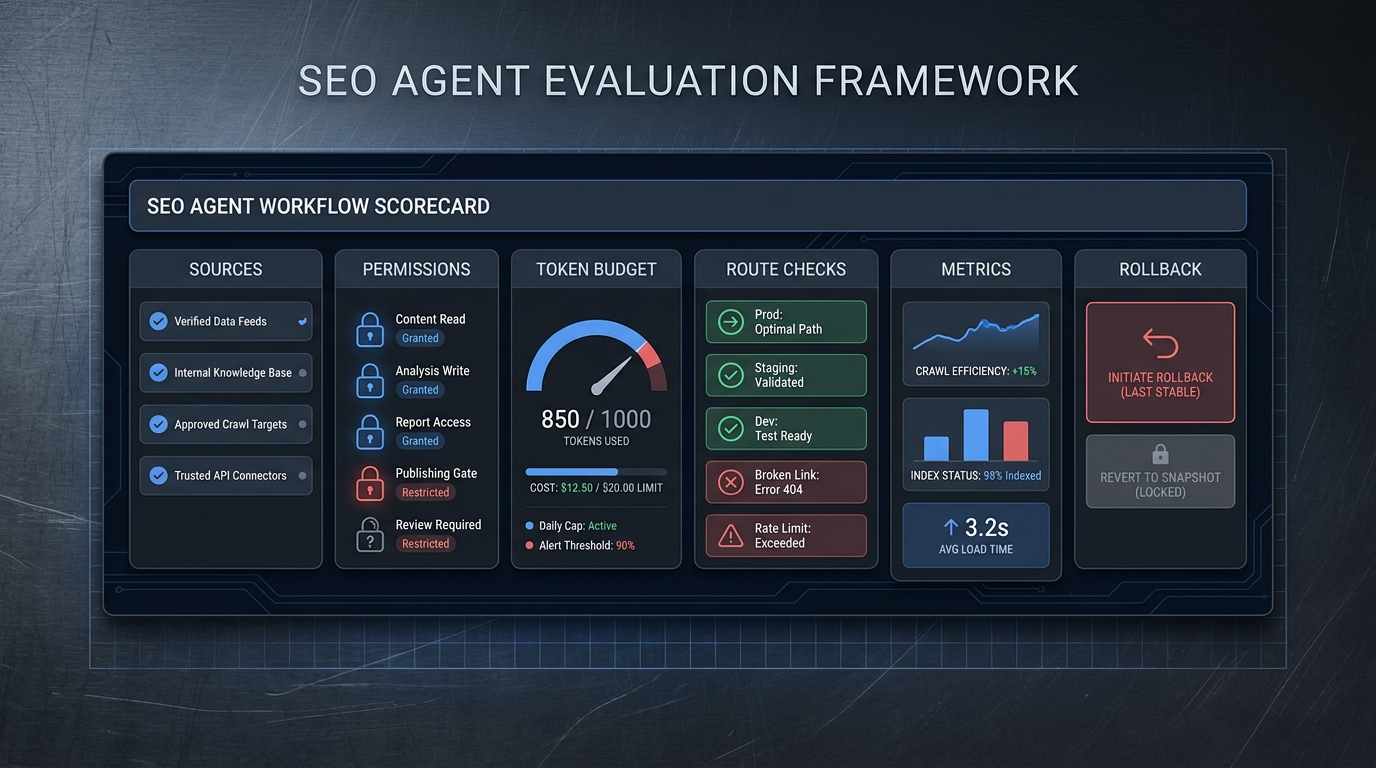
An SEO agent can look impressive in a demo. Give it a keyword, and it may return a brief, draft, metadata, internal links, image prompts, translations, and a CMS publish action.
That is useful only if the workflow also proves that the page deserves to ship.
The right question is not "Can this SEO agent create content?" Most modern AI SEO tools can create content. The better question is whether the SEO agent can preserve evidence, respect permissions, control model cost, avoid duplicate URLs, publish safely, validate localized routes, and connect the final page to business outcomes.
Use this evaluation framework when you are comparing SEO agent tools, piloting an internal SEO agent, or deciding whether an automated SEO workflow is ready for production publishing.
Quick Answer: How Should You Evaluate an SEO Agent?
Evaluate an SEO agent as a release workflow, not as a writing shortcut.
| Evaluation layer | What to inspect | Production risk if missing |
|---|---|---|
| Search intent | Reader job, funnel stage, page type, and objection model | The agent creates plausible pages that miss the buyer's actual question |
| Source evidence | Source URLs, source dates, claim mapping, and proof_needed flags | Unsupported product, pricing, market, or competitor claims go live |
| Site awareness | Existing URLs, drafts, planned articles, internal links, and translations | Duplicate pages and keyword cannibalization |
| Permission design | Separate read, draft, publish, overwrite, and rollback permissions | One broad key can change production content too easily |
| Token budget | Model calls, context size, image steps, localization, QA, and retries | Hidden cost appears only after the workflow scales |
| CMS evidence | Payload, category, canonical, cover URL, status, and public readback | The CMS accepts a post that the public site cannot render correctly |
| Measurement | Indexed URL count, organic clicks, qualified signups, assisted conversions | Success is counted as "articles generated" instead of business impact |
| Rollback | Previous state, raw API responses, route checks, and owner | A bad publish becomes hard to diagnose or restore |
An SEO agent does not need to automate every step on day one. It does need to show which decisions are automated, which decisions are reviewed, and which checks stop the workflow before a bad page reaches the site.
What Is an SEO Agent?
An SEO agent is an AI-assisted workflow that can perform SEO tasks with some autonomy. Depending on the product or internal system, an SEO agent may:
- Research keywords and search intent.
- Cluster topics.
- Build content briefs.
- Collect sources.
- Draft articles or landing pages.
- Suggest internal links.
- Generate metadata and structured data.
- Create or update CMS drafts.
- Publish content.
- Generate translations.
- Monitor rankings, Search Console data, analytics, or AI visibility.
- Queue refresh, merge, or rollback work.
Current public tool pages often market this category around end-to-end execution. For example, The SEO Agent positions around keyword research, drafting, fact checking, and publishing; Frase's AI SEO agent roundup compares tools by how much of the SEO pipeline they automate; and SEO.AI positions its product around an AI SEO agent that plans, writes, publishes, and keeps visibility growing.
Those are useful signals for the category. They also explain why buyers need a stronger evaluation lens. Once an SEO agent can move from idea to published URL, it is no longer just a writing assistant. It is part of the release system for public pages.
Why SEO Agent Tool Comparisons Are Easy to Get Wrong
Many SEO agent comparisons over-index on visible capabilities:
- Does it write long-form content?
- Does it research keywords?
- Does it optimize for Google?
- Does it publish to WordPress, Webflow, Shopify, or a custom CMS?
- Does it generate AI-search or GEO recommendations?
- Does it monitor rankings?
Those questions matter, but they are incomplete. A tool can support all of those actions and still be unsafe if it cannot show where claims came from, whether the page overlaps with an existing URL, who approved publishing, how much the run cost, or whether the public route works after deployment.
Google's public guidance creates a useful boundary here. Its documentation on helpful, reliable, people-first content focuses on usefulness for people, and its spam policies give teams a reason to control scaled content workflows. The takeaway is practical: an SEO agent should not be evaluated by output speed alone. It should be evaluated by evidence, controls, and reader value.
The SEO Agent Evaluation Scorecard
Use this 100-point scorecard during demos and pilots. Ask every vendor or internal team to run the same workflow with the same keyword, source rules, site inventory, internal-link pool, and publishing constraints.
| Category | Weight | Strong evidence | Red flag |
|---|---|---|---|
| Search intent and page fit | 15 | The SEO agent explains the reader job, funnel stage, page type, objections, and conversion path before drafting | Starts from keyword plus word count |
| Source grounding | 15 | Risky claims map to current URLs, approved knowledge, or proof_needed decisions | Sources are hidden, stale, or mixed into generated copy |
| Existing-site awareness | 10 | The agent checks published URLs, drafts, planned content, internal links, language routes, and cannibalization risk | Creates a near-duplicate because it never inspected the site |
| Brief quality | 10 | The brief includes outline, evidence table, internal-link plan, CTA, schema notes, and measurement contract | The brief is just headings and target keywords |
| Permission scope | 10 | Read, draft, publish, overwrite, translation, and rollback permissions are separate | One admin credential can do everything by default |
| Token and retry budget | 10 | Research, drafting, QA, image, localization, publishing, readback, and retries are budgeted by stage | Cost is discussed only as the SaaS subscription price |
| CMS and route evidence | 10 | The final payload, cover image, canonical, category, status, and public readback are stored | The agent reports success before checking the public route |
| Localization controls | 5 | Target language routes, content parity, hreflang, and localized metadata are validated | Translation is generated with no route or parity check |
| Measurement | 10 | The final URL has indexed-status, organic-click, signup, assisted-conversion, and refresh-review tracking | The agent measures only pages shipped |
| Rollback and incident evidence | 5 | Previous state, raw responses, route checks, and failure reasons are retained | A bad page can only be fixed manually from memory |
Score each row from 0 to its maximum weight:
- 0% of row weight: missing or entirely manual.
- 50% of row weight: partially supported, but weak evidence or manual handoffs remain.
- 100% of row weight: supported with durable artifacts, limits, and reviewable output.
A pilot-ready SEO agent should usually clear 70 points with no zero in source grounding, permission scope, CMS evidence, or rollback. An unattended production SEO agent should clear 85 points and preserve enough artifacts for another teammate to review the run after the fact.
1. Test Source Discipline Before You Test Writing Quality
The first SEO agent evaluation question is simple: where did this answer come from?
A reliable SEO agent should keep three layers separate:
- Source facts: product pages, documentation, pricing pages, search results, customer language, analytics exports, Search Console exports, or approved internal knowledge.
- Writing instructions: audience, voice, page type, keyword plan, CTA, schema, image requirements, and formatting rules.
- Model judgment: summaries, recommendations, outlines, draft copy, and QA notes.
Do not accept a workflow that blends those layers into one untraceable answer. That makes review harder and increases the chance that unsupported claims reach production.
High-risk claims should be sourced, omitted, or marked for review:
- Product features.
- Pricing.
- Performance benchmarks.
- Legal, medical, financial, or compliance advice.
- Competitor comparisons.
- Market-size statements.
- "Best," "only," "guaranteed," or "most accurate" claims.
For a commercial investigation page about an SEO agent, this matters because buyers are actively comparing tools. The page can discuss categories and evaluation criteria, but exact ranking, traffic, pricing, DR, or "best tool" claims should come from validated data. If the data is missing, the safer output is a framework, not an invented leaderboard.
2. Test Existing-Site Awareness
An SEO agent that ignores your current site will create cleanup work.
Before approving a new page, the agent should check:
- Published blog URLs.
- Drafts in progress.
- Planned calendar rows.
- Assigned primary keywords.
- Existing internal-link anchors.
- Localized versions.
- Canonicals and redirects.
- Current conversion paths.
For TokenTest, this matters because the blog already has related pages on AI blog writer tools, technical SEO automation tools, blog publishing automation, and SEO automation strategy. A new SEO agent article should not repeat those pages. It should use them as supporting context and answer a narrower buyer question: how to evaluate an SEO agent before giving it real publishing authority.
That is the difference between a useful topical cluster and keyword cannibalization.
3. Test Permission Design
Feature lists hide the most important risk: what can the SEO agent actually change?
Use staged permissions:
| Stage | Allowed action | Required evidence |
|---|---|---|
| Research | Read public pages, approved knowledge, exports, and analytics summaries | Source list and query notes |
| Brief | Create a source-backed brief and evidence table | Reviewer can inspect intent and source plan |
| Draft | Create article draft, metadata, image brief, and schema notes | Risky claims are resolved or removed |
| CMS draft | Create or update a CMS draft | Payload, category, canonical, author, and cover image are reviewable |
| Publish | Publish source article and configured translations | Release QA passes |
| Refresh | Update an existing page | Previous state and changed sections are retained |
| Rollback | Restore, unpublish, or redirect a bad route | Incident owner approves recovery |
If a vendor says its SEO agent can publish automatically, ask what stops it from publishing the wrong thing. A serious answer should include scoped credentials, required fields, idempotency, route checks, logs, and rollback artifacts.
4. Test Token Budgets and Retry Behavior
An SEO agent workflow is usually larger than the demo suggests.
One production article may include:
- Keyword and SERP research.
- Source collection.
- Existing URL checks.
- Brief generation.
- Drafting.
- Fact QA.
- SEO QA.
- Metadata and schema.
- Hero image generation.
- Translation.
- CMS payload generation.
- Route validation.
- Readback checks.
- Revision retries.
Each stage uses context, model calls, tool calls, and time. A buyer should ask for the budget by stage.
| Workflow stage | Budget question |
|---|---|
| Research | How many sources enter the context, and how are long pages summarized? |
| Brief | How much existing-site context is included? |
| Draft | How long is the article, and are tables or FAQs generated separately? |
| QA | Does the model re-read the full article and source table? |
| Image | Is the hero generated once, retried, or manually selected? |
| Localization | Are translations generated from the final source article or from earlier drafts? |
| Publishing | How many CMS calls, upload calls, and route checks run per article? |
| Retry | What percentage of runs need a second pass, and who pays for it? |
This is where TokenTest fits the evaluation mindset. TokenTest is not an SEO agent or content calendar. It is a production-reference model evaluation console that helps teams inspect model capability, route protocol, token usage, safety, and channel reliability. The TokenTest manual also documents evaluation dimensions, reports, exports, and token metering. That makes TokenTest relevant when a team wants evidence that the model or request path behind an AI-assisted workflow is reliable enough for recurring use.
5. Test CMS and Route Evidence
Publishing is not complete when the SEO agent says "done." Publishing is complete when the public page is accessible, indexable, linked, localized if required, and measurable.
Require a publish evidence pack:
| Evidence | What to inspect |
|---|---|
| Final payload | Title, slug, language, body, metadata, category, canonical, author, and cover image |
| Cover image | Public image URL renders and has accurate alt text |
| Public route | Source URL returns HTTP 200 |
| Canonical | Canonical points to the intended page |
| Indexability | No unintended noindex or blocked route |
| H1 | One page-level H1 |
| Internal links | Relevant internal links resolve |
| External links | Sources are credible and still accessible |
| Structured data | Article or BlogPosting schema is valid if used |
| Localization | Target language routes return HTTP 200 and preserve source meaning |
| Measurement | URL is ready for Search Console and analytics review |
Google's Article structured data documentation is useful if the workflow adds schema to blog pages. Search Console is the later evidence layer for Google-facing status, impressions, clicks, and query coverage.
6. Test Localization Before Calling It Multilingual SEO
Many SEO agent tools can translate a post. Translation alone is not a multilingual publishing system.
For each target language, require:
- Target-language slug or route rule.
- Localized title and meta description.
- Hreflang output if the site supports it.
- Public route status.
- Cover image parity.
- Canonical behavior.
- Internal-link behavior for that locale.
- A content-parity check for the main claims and CTA.
If the SEO agent reports "published" but a localized route returns 404, the multilingual run is partial. That distinction should appear in the final report.
7. Test Measurement Beyond "Content Created"
The weakest SEO agent metric is throughput. It rewards the agent for making more pages even when the pages do not earn qualified traffic.
For a middle-funnel article like this one, define the measurement contract before publishing:
| Metric | Why it matters |
|---|---|
| Indexed URL count | Confirms source and localized routes are discoverable |
| Organic clicks | Shows whether the URL earns search visits |
| Impressions and query mix | Shows whether Google understood the intended topic |
| Qualified signups | Shows whether traffic matches the target audience |
| Assisted conversions | Shows whether the page supports later conversion paths |
| Internal-link contribution | Shows whether the page helps related content and product pages |
| Refresh decision | Shows whether to update, merge, expand, or retire the URL after the observation window |
Day-zero reports should be honest. They can validate payloads, routes, links, and readbacks. They should not claim SEO success before indexing and analytics data exist.
8. Test Rollback and Incident Handling
SEO teams rarely ask rollback questions during tool evaluation. They should.
Ask every SEO agent vendor or internal team:
- Can we see the exact payload that created the page?
- Can we see the previous version before an update?
- Can we restore it without rebuilding the article from memory?
- Can we identify whether a failure came from source research, drafting, image upload, CMS create, translation, route rendering, or analytics?
- Can the agent stop after a failed publish step instead of continuing with partial evidence?
- Can the agent tell the difference between "zero performance" and "missing analytics credentials"?
The answer matters because SEO agent tools touch public pages. A bad comparison claim, broken canonical, stale translation, or misconfigured redirect can create more cleanup than the automation saved.
SEO Agent Demo Questions for Buyers
Use these questions in a live demo or pilot:
- Can you run the same keyword through the workflow using our site, our sources, and our existing blog inventory?
- Which claims are tied to sources, and which claims are model judgment?
- How does the agent detect overlap with an existing URL?
- Can the agent create a draft without permission to publish?
- What must be true before the agent can publish?
- Can we see the token and model-call budget for research, draft, QA, image, translation, and retries?
- How does the workflow handle a failed image upload, duplicate slug, translation timeout, or 404 route?
- What does the agent store for rollback?
- How are localized routes validated?
- Which metric decides whether the page should be refreshed, merged, or retired?
SEO Agent Red Flags
Be cautious when an SEO agent workflow has these patterns:
- It publishes without preserving sources.
- It treats generated claims as verified by default.
- It cannot show which URLs already cover the topic.
- It has one all-powerful API key for draft, publish, overwrite, and delete actions.
- It creates translations without route checks.
- It reports success before checking the public URL.
- It optimizes for word count instead of reader value.
- It cannot estimate model-call cost or retry rate.
- It cannot separate missing analytics access from zero performance.
- It cannot restore the previous version of a refreshed page.
These issues are normal production risks whenever AI moves from suggestion to action.
Practical SEO Agent Evaluation Template
Copy this template into your pilot notes:
Keyword:
Search intent:
Target audience:
Existing URLs checked:
Source URLs:
Claims marked proof_needed:
Internal links:
CMS action requested:
Permission scope:
Token budget:
Image requirement:
Translation languages:
Route checks:
Schema checks:
Measurement window:
Rollback owner:
Go / no-go decision:
For each candidate SEO agent, require the same completed template. Then compare evidence, not just output quality.
Final Takeaway
An SEO agent is worth evaluating seriously because it can shorten the path from search opportunity to published page. But the stronger the automation becomes, the more important the release controls become.
The safest SEO agent tools do not hide behind "AI wrote it." They show the brief, sources, permissions, token budget, CMS payload, route checks, translation evidence, measurement plan, and rollback path.
That is the evaluation bar: not more autonomous content, but more trustworthy SEO work.