Token Counting for Customer Support Bots With Long Conversation History
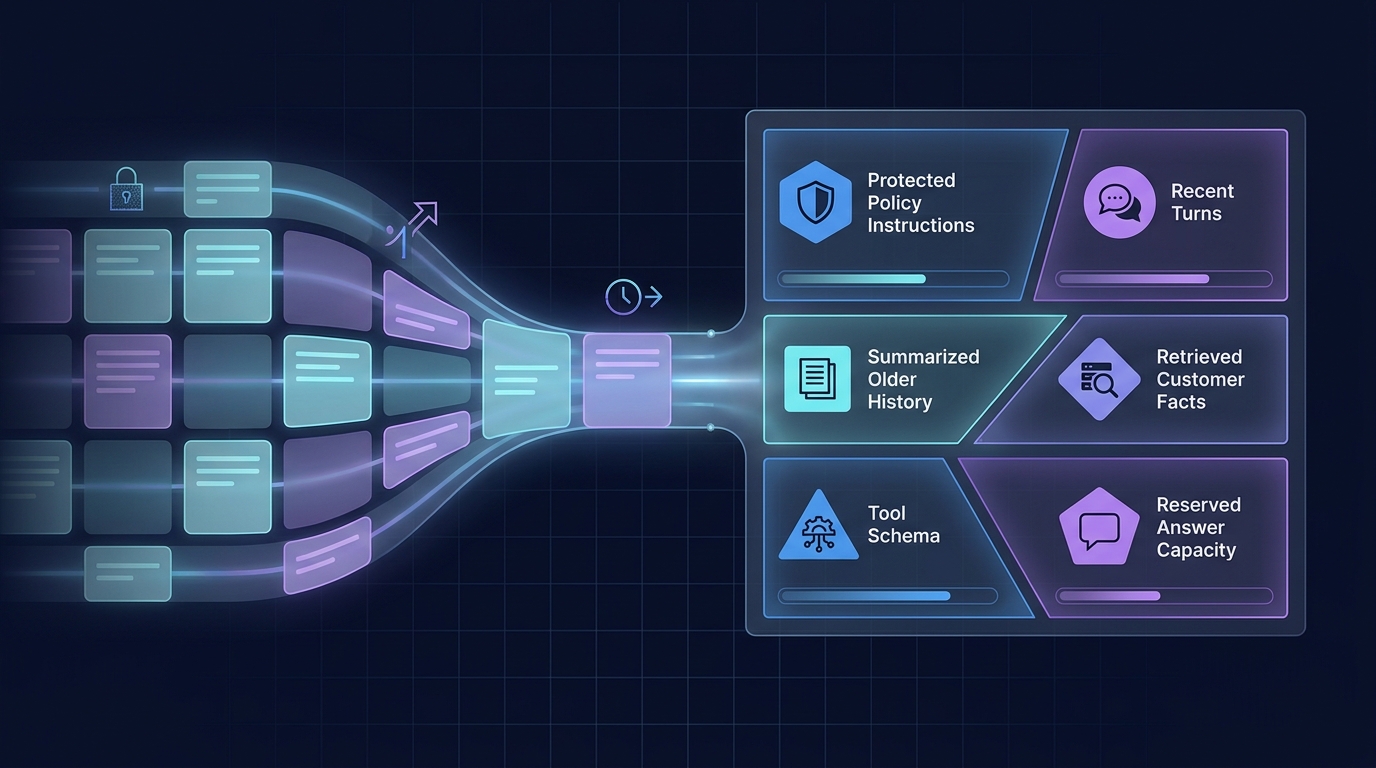
Customer support bots rarely fail because one customer message is too long. They fail because the request quietly accumulates a system prompt, policy rules, customer profile data, tool definitions, retrieved help-center passages, and dozens of earlier turns.
Token counting for customer support bots with long conversation history makes that growth visible before it causes an error, a truncated answer, or an expensive request. More importantly, it helps you shorten the conversation without deleting the facts the next response still needs.
The practical goal is not to preserve every word. It is to preserve the support state: what the customer wants, what has already been tried, what the company promised, which identifiers matter, and whether the case must be escalated.
Why long support conversations are unusually risky
A general chatbot can often recover by starting a fresh thread. A support bot cannot always do that safely. The conversation may contain:
- an order, ticket, subscription, or device identifier;
- the customer’s verified account state;
- troubleshooting steps already completed;
- consent or identity-verification status;
- a refund, replacement, or follow-up promise;
- an escalation decision and assigned queue;
- restrictions from policy or regional rules;
- the customer’s preferred language and channel.
If you simply drop the oldest messages, the bot may repeat failed troubleshooting, ask for information the customer already provided, contradict a previous promise, or miss an escalation trigger.
That is why token counting for customer support bots with long conversation history should be paired with state extraction, not blind truncation.
What counts toward the request budget
The visible conversation is only one part of the assembled request. A useful planning equation is:
working_context
= protected_instructions
+ tool_schemas
+ customer_state
+ retrieved_knowledge
+ conversation_history
+ current_message
+ reserved_output
+ safety_margin
Current provider documentation follows the same operational pattern: measure the complete input before sending, then inspect actual usage after generation. OpenAI documents counting tokens for structured inputs and notes that output usage can include tokens beyond the visible answer. Google documents a preflight countTokens method and runtime usage metadata. Anthropic’s context-window guidance also treats accumulated messages as part of the active context rather than as free storage.
The exact tokenizer and accounting fields depend on the model and endpoint. Do not use a generic word-to-token estimate as a production control. Count the same assembled payload shape you will actually send.
A support-safe token budget
For operations teams, token counting for customer support bots with long conversation history works best when every request component has an explicit retention rule.
Start by assigning each request component a status.
| Component | Treatment | Examples |
|---|---|---|
| Protected | Keep verbatim | Safety rules, authorization boundaries, refund policy constraints |
| Structured state | Keep compactly | Order ID, plan, device, verification, sentiment, escalation status |
| Recent turns | Keep verbatim | The latest problem statement, clarification, and promised next step |
| Older history | Summarize | Resolved questions, repeated explanations, completed troubleshooting |
| Retrievable evidence | Remove and fetch on demand | Help-center articles, policy passages, old case notes |
| Output reserve | Protect before sending | Space for the answer, citations, tool calls, and handoff instructions |
Then enforce a threshold such as:
usable_input_budget
= model_context_capacity
- reserved_output
- safety_margin

if assembled_input > usable_input_budget:
    compact_history()
    recount()
Do not copy a context-capacity number from a blog post into production. Use the current documentation and API behavior for the exact model and route you deploy.
The best history strategy: three layers
For most customer support bots, a three-layer memory design is easier to control than replaying the entire transcript.
This is where token counting for customer support bots with long conversation history becomes a memory architecture decision rather than a last-minute trimming task.
1. Immutable support rules
Keep the instructions that define what the bot may do, when it must escalate, and which claims require tool verification. These rules should not be rewritten by a conversation summarizer.
2. Structured case state
Store durable facts outside the prose transcript. A compact record might look like this:
{
  "customer_goal": "replace damaged item",
  "order_id": "ORD-48291",
  "identity_verified": true,
  "steps_completed": [
    "photo received",
    "shipping address confirmed"
  ],
  "company_commitment": "replacement review within 24 hours",
  "escalation_status": "specialist_queue",
  "next_action": "check replacement approval"
}
This is usually more token-efficient and less ambiguous than asking the model to rediscover the same facts from 40 turns.
3. A rolling conversation window
Keep the latest turns verbatim because wording, tone, corrections, and immediate references still matter. Summarize older turns into a concise case history, and retrieve the original transcript only when the current task needs evidence from it.
The result is not “memory loss.” It is a deliberate split between instructions, durable state, recent dialogue, and archived evidence.
When to summarize conversation history
Do not wait for a hard context error. Trigger compaction when any of these conditions is true:
- The assembled input crosses a percentage of the usable input budget.
- The bot has completed a distinct support stage, such as identity verification or diagnosis.
- Several turns repeat the same issue without adding new facts.
- Retrieval or tool schemas expand and reduce answer headroom.
- A language switch materially changes the token count.
A practical system uses two thresholds. The first creates or refreshes the summary. The second blocks the request until history has been compacted and recounted.
Thresholds make token counting for customer support bots with long conversation history predictable across short tickets, multi-day investigations, and escalated cases.
A paste-ready conversation compaction prompt
Paste the following prompt with a sample transcript into TokenTest to compare the original history with the compacted version:
You are compressing a customer support conversation for the next assistant turn.

Preserve exactly:
- customer goal and current blocker
- order, ticket, account, product, and device identifiers
- identity or consent status
- troubleshooting steps already attempted and their outcomes
- policy constraints already confirmed
- promises, deadlines, refunds, replacements, or credits discussed
- escalation status, owner, and next action
- customer corrections, preferences, and unresolved questions

Remove:
- greetings and acknowledgements
- repeated explanations
- abandoned hypotheses
- wording that does not change the case state

Return JSON with these keys:
customer_goal, identifiers, verified_facts, completed_steps,
commitments, constraints, escalation, unresolved_questions,
next_action, recent_turns_to_keep_verbatim.

Do not invent missing facts. Mark uncertainty explicitly.
Count the original transcript, the compaction prompt, and the returned state separately. The summary is useful only if the complete next request is smaller and still preserves the facts required for a correct response.
Token counting workflow for a production support bot
Use the following workflow to make token counting for customer support bots with long conversation history repeatable in development and production.
Step 1: Assemble the real request
Include the actual system instructions, tool schemas, retrieved content, structured state, recent turns, and current customer message. Counting a simplified text-only sample will understate production usage.
Step 2: Count by component
Record tokens for each major segment rather than only the total. This shows whether growth comes from history, retrieval, tools, or instructions.
Step 3: Protect response capacity
Reserve output before deciding how much history fits. A support answer may need to explain a decision, request evidence, call a tool, and produce a handoff note.
Step 4: Compact in a fixed order
Remove duplicate retrieval passages first, then summarize resolved stages, then shrink the rolling window. Do not shorten safety instructions or delete unresolved commitments merely because they are old.
Step 5: Recount the complete payload
Token counting for customer support bots with long conversation history is a feedback loop. Every summary, retrieval change, or tool update changes the request and must be measured again.
Step 6: Verify the live endpoint
Preflight counting answers “should this fit?” Runtime usage answers “what did this route actually report?” TokenTest’s current product manual describes its D4 evaluation as checking usage integrity, including input, output, total, cached, and reasoning-related evidence when available. That makes it useful for testing representative support payloads and comparing reported behavior across OpenAI-compatible routes.
Test multilingual support histories separately
Do not assume an English conversation and its Chinese localization have the same token budget. Tokenization varies by language, wording, punctuation, identifiers, and model tokenizer.
Multilingual validation is a required part of token counting for customer support bots with long conversation history because the same case can occupy different budgets after localization.
For a bilingual support bot, test at least four payloads:
- English system instructions with English history.
- Chinese system instructions with Chinese history.
- English instructions with Chinese customer turns.
- A mid-conversation language switch.
Use the same case facts and output reserve in each test. The goal is not to prove one language is always larger. It is to find the real budget for each deployed payload.
Metrics worth logging
Track more than total tokens. Useful operational fields include:
- input tokens by component;
- reserved and actual output tokens;
- number of verbatim turns retained;
- age and token size of the case summary;
- retrieval tokens and document count;
- compaction events per conversation;
- missing-state or repeated-question incidents;
- escalation accuracy after compaction;
- endpoint-reported usage and finish reason.
These metrics connect token savings to support quality. A smaller prompt is not an improvement if it increases repeated questions, broken promises, or incorrect escalations.
Common mistakes
Counting only the latest customer message
The latest message may be tiny while hidden instructions, tools, retrieval, and history dominate the request.
Summarizing without a schema
Free-form summaries often omit identifiers, commitments, or uncertainty. A support-state schema makes omissions easier to detect.
Keeping every turn “just in case”
This delays the design decision until the context window makes it for you.
Deleting old promises
Age does not make a commitment irrelevant. Preserve it until it is fulfilled, cancelled, or superseded.
Using one budget for every language and route
Tokenizers and endpoint behavior vary. Validate each production configuration.
The operating rule
The safest rule for token counting for customer support bots with long conversation history is simple:
Keep policy, case state, unresolved commitments, and recent dialogue; summarize resolved history; retrieve old evidence only when needed; reserve the answer; then count the complete request again.
Use TokenTest to run representative support payloads before launch. For adjacent planning problems, see what to do when a message exceeds the maximum context length and the production context-window planning guide.
Frequently asked questions
Should a customer support bot keep the full conversation history?
Usually not in every request. Keep a durable case-state record, a summary of older resolved stages, and a verbatim window of recent turns. Archive the full transcript for retrieval and audit.
How often should conversation history be summarized?
Summarize at support-stage boundaries or when the assembled request crosses a defined budget threshold. Recount after every compaction.
What facts should never be lost during compaction?
Preserve identifiers, verification or consent state, completed troubleshooting, confirmed policy constraints, company commitments, escalation status, unresolved questions, and the next action.
Is a token estimate based on characters or words enough?
It is useful for rough planning, not production enforcement. Count with the tokenizer or provider method that matches the deployed model and payload format.
Can TokenTest replace provider usage logs?
No single preflight tool replaces runtime evidence. Use TokenTest for repeatable payload and route evaluation, then compare the result with provider-reported usage, finish reasons, and your application logs.