How TokenTest.io Helps Debug Expensive Prompts Before Deployment
How TokenTest.io Helps Debug Expensive Prompts Before Deployment
An expensive prompt rarely becomes expensive because of one dramatic mistake. More often, cost grows quietly as a product adds another policy block, a longer conversation history, extra retrieved documents, larger tool schemas, duplicated examples, and more output headroom.
The prompt still works. The pull request looks harmless. Then production traffic multiplies a small per-request increase across every user, retry, agent step, and language.
To debug expensive prompts before deployment, you need more than a word counter. You need to inspect the complete request, isolate which component caused the token increase, test representative variants, and verify that the target endpoint reports plausible usage under real request conditions.
TokenTest.io supports that workflow as a production-reference evaluation console. Its token-integrity checks examine usage presence, total consistency, input monotonicity, output reasonableness, stop-limit linkage, streaming usage, cache-token evidence, reasoning-token evidence, and truncation behavior. That makes it useful for finding both prompt bloat and endpoint behavior that a local estimate cannot reveal.
Why expensive prompts are hard to diagnose
The text a developer edits is usually not the full request sent to the model.
production request
= system and policy instructions
+ user message
+ conversation history
+ retrieved documents
+ tool definitions
+ response schema
+ application wrapper
+ reserved output
A local tokenizer can estimate some of this input when the model and encoding are known. But a production request may also include provider-specific message formatting, hidden application wrappers, cached-input accounting, reasoning usage, streaming behavior, and gateway normalization.
That creates four common debugging traps:
- The wrong object is measured. The team counts a prompt fragment instead of the assembled request.
- The total hides the cause. A request is over budget, but nobody knows whether retrieval, tools, history, or instructions created the increase.
- The cheapest fixture passes. A short English happy path fits while long, multilingual, or tool-heavy requests fail.
- An estimate is treated as proof. A local count is assumed to match the usage reported by the live endpoint.
TokenTest helps close the gap between those estimates and production-reference evidence.
The five-pass workflow for debugging prompt cost
Pass 1: Reproduce the complete request
Start with a fixture that mirrors what the application actually sends. Keep the same message roles, tools, schema, retrieval formatting, conversation wrapper, and output limit.
Create at least three versions:
| Fixture | Purpose | What it should include |
|---|---|---|
| Typical | Represents normal traffic | Average user input, normal retrieval, standard tools |
| Heavy | Tests the expected operating ceiling | Long history, maximum useful retrieval, full schema |
| Adversarial | Exposes hidden bloat | Repetition, dense formatting, multilingual text, tool-heavy input |
If you cannot reproduce the expensive request outside production, you cannot reliably optimize it.
Pass 2: Build a component-level token diff
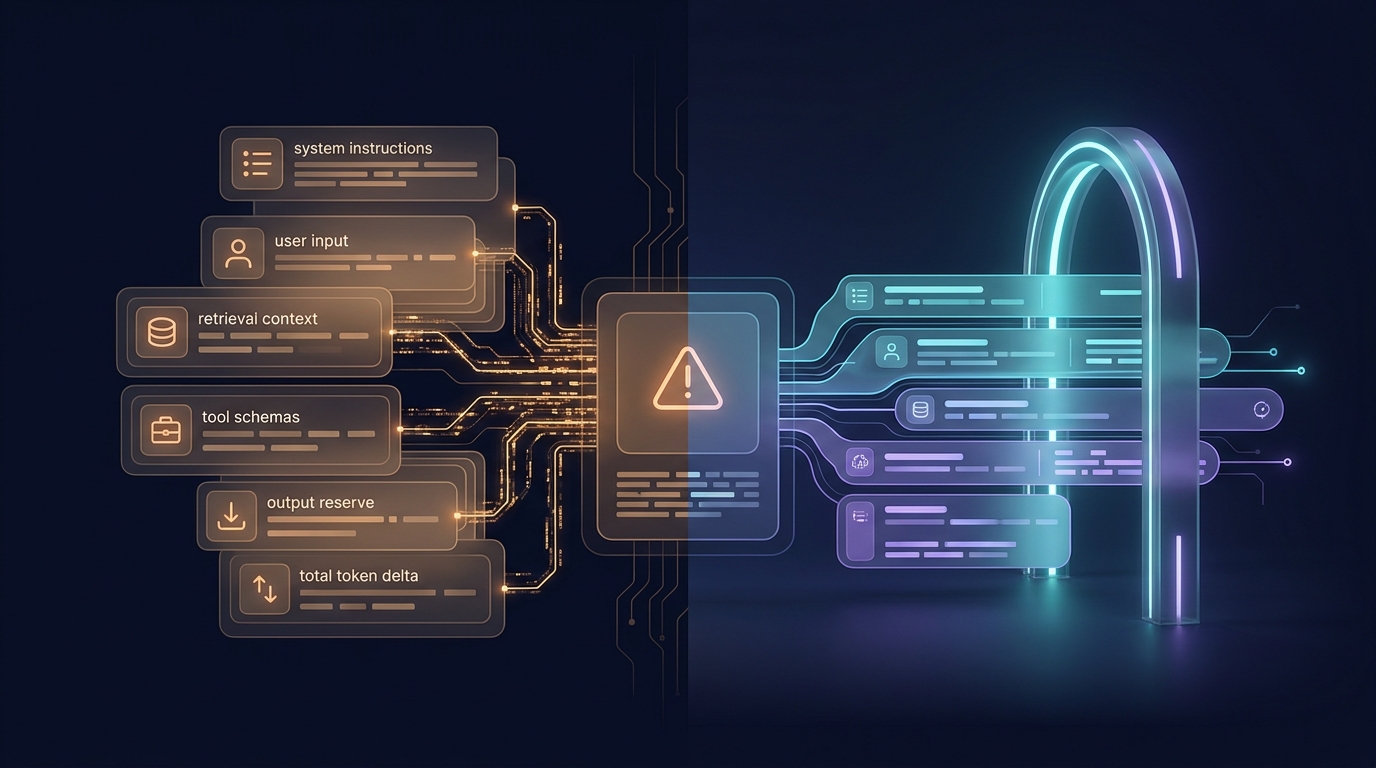
Do not compare only the grand total. Measure the baseline and proposed version by component.
| Component | Baseline | Proposed | Delta | Debug question |
|---|---|---|---|---|
| System instructions | 1,150 | 1,470 | +320 | Was a policy or example duplicated? |
| Conversation history | 2,100 | 2,100 | 0 | Is the history cap still enforced? |
| Retrieved context | 3,800 | 5,250 | +1,450 | Did chunk count or formatting change? |
| Tool schemas | 980 | 1,620 | +640 | Are unused tools or descriptions included? |
| Output reserve | 1,400 | 1,400 | 0 | Is enough answer space protected? |
| Planned total | 9,430 | 11,840 | +2,410 | Which increases are intentional? |
These figures are illustrative, not universal limits. The useful artifact is the delta and its owner.
TokenTest’s input-monotonicity and usage-integrity checks add another layer: as controlled input grows, reported input usage should move in a plausible direction, and totals should reconcile with the fields returned by the endpoint.
Pass 3: Use controlled subtraction to isolate the culprit
Once a regression is reproduced, remove or replace one component at a time.
- Run the full proposed request.
- Replace retrieved documents with a short placeholder.
- Restore retrieval and remove optional tools.
- Restore tools and truncate conversation history.
- Restore history and switch back to the baseline system prompt.
Record the usage change after each run. This is prompt-cost debugging by controlled subtraction: the largest drop identifies the component with the greatest budget impact.
Avoid changing several components in one run. You may reduce the total without learning what fixed it.
Pass 4: Test endpoint behavior, not just token estimates
Provider-supported counting methods are useful before a request is sent. OpenAI documents local counting with tiktoken; Anthropic provides a Messages token-counting endpoint; Gemini provides countTokens. These methods help estimate request size for their supported models and formats.
They do not replace runtime evidence.
For a live endpoint, verify:
- input, output, and total usage fields are present when expected;
- the reported total reconciles with its components;
- larger controlled inputs produce plausible input-token increases;
- small output limits produce consistent stop or truncation evidence;
- streaming and non-streaming calls do not produce unexplained usage mismatches;
- cached-input or reasoning-token fields appear only when the route supports them;
- repeated calls do not double-count cache-related usage unexpectedly.
TokenTest groups these checks into a repeatable endpoint evaluation instead of relying on a single successful completion.
Pass 5: Turn the finding into a deployment gate
The final fix should become a rule, not a one-time cleanup.
Store a small budget manifest with the prompt fixture:
fixture: support-agent-heavy
model_route: production-primary
baseline_input_tokens: 9430
maximum_input_regression_percent: 8
minimum_output_reserve_tokens: 1400
required_checks:
  - usage_integrity
  - token_total_consistency
  - token_input_monotonicity
  - token_stop_limit
  - endpoint_generation_truncation
Use your own measured values. A team may choose an absolute cap, a percentage regression limit, a cost-per-task threshold, or all three.
The important part is that a prompt change cannot silently consume the budget reserved for output quality or push a high-volume workflow beyond its operating envelope.
Paste-ready fixtures for TokenTest.io
The examples below are designed to reveal different kinds of prompt growth. Paste them into the relevant request field, then compare the result with a shorter baseline using the same endpoint configuration.
Fixture 1: Duplicate-instruction detector
You are a support assistant. Answer only from the supplied policy.
Do not invent refund terms. If the policy is missing, say that the policy is missing.
Return JSON with keys: answer, evidence, escalation_required.

Policy:
Refunds are available within 30 days for unused annual plans.

User request:
I bought an annual plan 18 days ago and have not used it. Can I get a refund?

Before answering, follow these additional rules:
Answer only from the supplied policy. Do not invent refund terms.
If the policy is missing, say that the policy is missing.
Return JSON with keys: answer, evidence, escalation_required.
Debug target: duplicated policy and format instructions. Remove the repeated block and verify that output behavior remains stable while input usage falls.
Fixture 2: Retrieval-bloat detector
Summarize the cancellation rule in one sentence and cite the section name.

[Section: Account cancellation]
A user may cancel at any time. Access remains active through the paid period.

[Section: Account cancellation - duplicate copy]
A user may cancel at any time. Access remains active through the paid period.

[Section: Account cancellation - formatted copy]
Cancellation can occur at any time; service continues until the current paid period ends.

[Section: Unrelated shipping policy]
Physical merchandise ships within five business days.
Debug target: duplicate and irrelevant retrieval. Remove one block at a time to find how much context can be cut without changing the answer.
Fixture 3: Multilingual budget check
Return the answer in the same language as the user. Keep product names unchanged.

English: Explain why a token estimate should be checked against live API usage.
中文:解释为什么 Token 估算还需要用真实 API usage 进行验证。
日本語:トークン推定を実際の API usage と照合する必要がある理由を説明してください。
Debug target: language-dependent tokenization and output expansion. Do not assume equal token budgets because the meaning is equivalent.
What to optimize first
When the expensive component is known, optimize in descending order of waste—not simply by deleting words everywhere.
| Cause | Better fix | Risk to watch |
|---|---|---|
| Duplicate instructions | Keep one authoritative rule block | Removing a repeated rule that was compensating for weak placement |
| Oversized retrieval | Improve relevance, deduplicate chunks, cap context | Cutting evidence required for grounded answers |
| Tool schema bloat | Send only available tools and necessary fields | Breaking tool selection or structured arguments |
| Unlimited history | Summarize or window older turns | Losing unresolved user constraints |
| Verbose examples | Keep the examples that change behavior | Removing rare but important edge cases |
| Excess output reserve | Set a task-specific reserve | Truncating complete answers |
The best optimization preserves task quality while reducing unnecessary input. A shorter prompt that fails more often can cost more after retries and human escalation.
What TokenTest can prove—and what it cannot
TokenTest can help show how a configured endpoint behaves under controlled requests: whether usage evidence is present and plausible, whether totals reconcile, whether input growth is reflected, and whether output limits or truncation appear consistently.
It cannot make one token count universal across unrelated models, tokenizers, gateways, or request formats. It also cannot turn a sample fixture into a guaranteed monthly bill. Production cost still depends on actual traffic, cache behavior, retries, routing, outputs, and provider pricing.
Use TokenTest as a pre-deployment debugging and evidence layer:
- Estimate the complete request with the model-supported method.
- Isolate the component that caused the cost delta.
- Validate usage and boundary behavior on the target endpoint.
- Save the fixture and budget as a regression test.
- Re-run it when prompts, tools, retrieval, models, or gateways change.
For a broader team workflow, use the token-aware prompt review process. If your main risk is available answer space, read the context window planning guide. For localized products, compare why Chinese prompts can require different token budgets.
Debug the cost before users multiply it
Prompt cost is easiest to fix while it is still a pull-request delta—not after it becomes a production invoice.
Open TokenTest.io with a typical, heavy, and adversarial fixture. Compare the baseline with the proposed request, isolate the largest component increase, verify the endpoint’s usage evidence, and turn the result into a release gate.
That is how you debug expensive prompts before deployment without optimizing blindly.