What Is Content Ops and When Does It Matter?
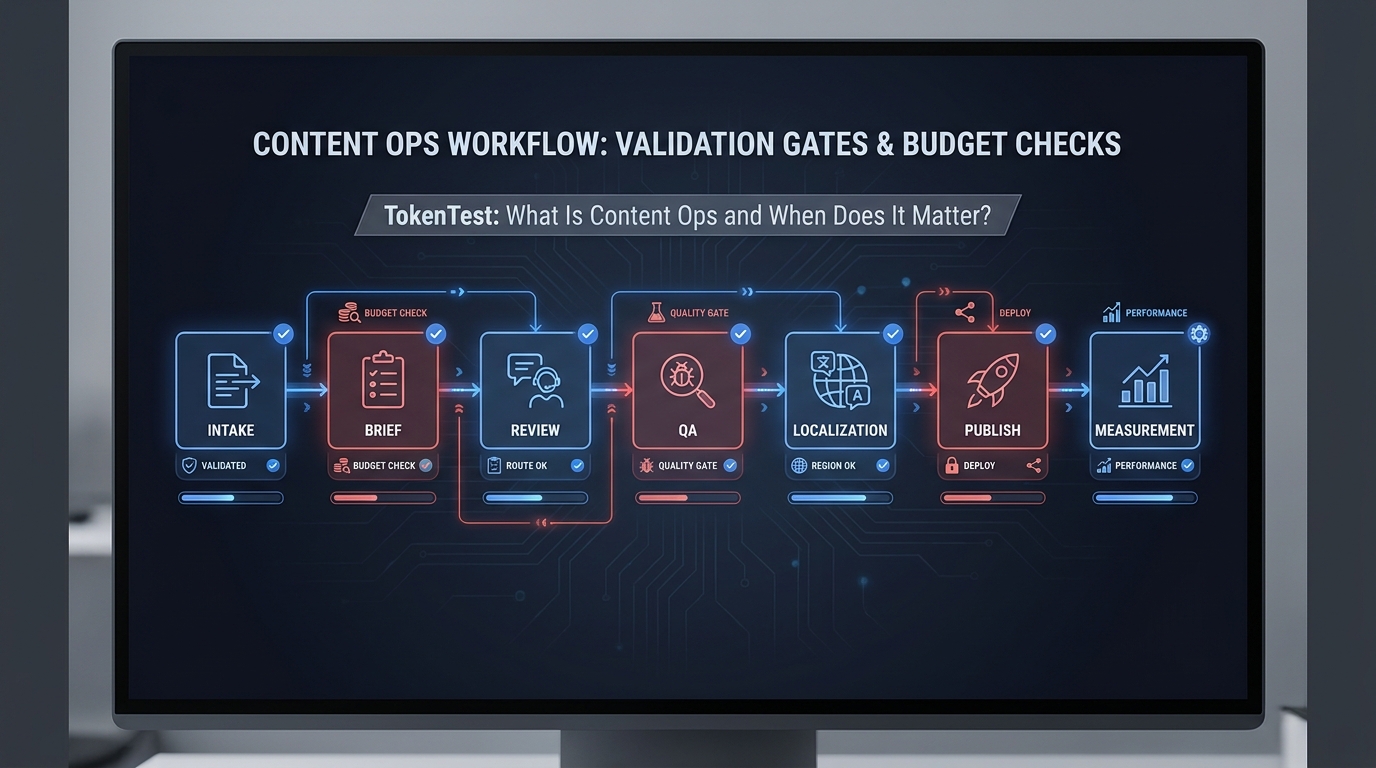
Content ops is the system behind consistent publishing
Content ops is the operating system for how a team turns ideas into published, measured, reusable content. It includes the intake rules, brief format, source checks, approvals, production workflow, localization process, publishing QA, and reporting loop that sit behind the visible editorial calendar.
That matters because most content problems do not start in the CMS. They start earlier, when a request arrives without an owner, a brief has no source evidence, a review step happens too late, a translation ships without route checks, or the team cannot prove which URLs helped pipeline.
For a small team publishing one or two low-risk assets a month, content ops can stay lightweight. For a team using AI drafts, multiple channels, translations, paid campaigns, partner reviews, or compliance approval, content ops becomes the difference between a repeatable system and a pile of one-off heroics.
This content ops guide gives you the practical version: what content ops includes, when it matters, which signals mean you need it, and how to build a workflow without buying a heavy platform too early.
What content ops includes
Content ops is not just content strategy, project management, or content marketing operations. It is the connective tissue across all of them.
A useful content ops system usually covers seven jobs:
| Job | What it controls | Failure mode when missing |
|---|---|---|
| Intake | Who can request content, what they must provide, and how work is prioritized | Random requests crowd out high-intent work |
| Briefing | Audience, search intent, proof needs, sources, examples, CTA, and reviewer | Drafts sound plausible but cannot be verified |
| Production | Drafting, editing, design, SME review, localization, and CMS prep | Work stalls in invisible handoffs |
| Governance | Brand rules, source rules, legal/compliance gates, AI usage boundaries | Risky claims reach public pages |
| Publishing QA | Metadata, canonical URL, schema, indexability, redirects, translation routes, and live readback | Published URLs have preventable technical defects |
| Measurement | URL-level traffic, clicks, conversions, assisted pipeline, and refresh triggers | The team publishes but does not learn |
| Reuse | Approved snippets, templates, product facts, internal links, and asset metadata | Each team recreates the same explanation |
If your team only has a calendar, you have scheduling. If your team also has the controls above, you have content ops.
When content ops matters
Content ops matters when content volume, risk, or dependency count rises faster than informal coordination can handle.
The simplest test is this: if a content mistake can waste budget, create compliance exposure, delay a launch, break an SEO route, or mislead a buyer, it deserves an operational gate.
Here are the common moments when content ops becomes worth the effort.
1. Multiple teams request content from the same production group
Content ops starts to matter when sales, product marketing, SEO, lifecycle, customer success, and leadership all want content from the same people. Without intake rules, the loudest request wins. With intake rules, each request carries the same minimum evidence: audience, goal, source material, priority, deadline, owner, and success metric.
For SEO work, this prevents duplicate pages and weak briefs. A request for "write about content ops tools" should include the target keyword cluster, search intent, internal-link targets, proof needs, and the conversion path. Without that, the writer is forced to guess.
2. AI enters the workflow
AI does not remove content ops. It increases the need for it.
AI can help draft briefs, outlines, variants, translations, metadata, and refresh candidates. But AI also makes it easier to produce unsupported claims, duplicate angles, mismatched CTAs, and localized pages that nobody checked. Content ops gives AI-generated work a release path: source pack, prompt budget, reviewer, factual QA, publishing QA, and readback.
For TokenTest, that is the natural bridge. TokenTest is not a general content ops platform. It is a production-reference evaluation console for AI middle-layer buyers and model-access workflows. Its public product checks model identity, usage integrity, protocol behavior, safety boundaries, token evidence, and exportable reports before production. The content ops lesson is the same: AI work needs evidence before release, not just a dashboard after something goes wrong.
3. Publishing spans more than one channel or market
Content ops matters when the same idea must become a blog post, landing page, email, social thread, help-center article, ad asset, and localized page. At that point, a single draft is not the unit of work. The unit of work is a content package with source truth, channel variants, asset metadata, route rules, and measurement tags.
This is where many teams discover the limits of a simple task board. A task can say "publish the article," but it rarely proves that the canonical is correct, the Chinese route is live, the hero image loaded, the CTA points to the right destination, and analytics will attribute the page.
4. Review has real consequences
Content ops becomes necessary when content needs subject-matter, brand, legal, compliance, security, localization, or executive review. The goal is not to add bureaucracy. The goal is to place the right review at the right moment.
Late review is expensive. If legal sees a claim after design and localization, the team may redo the entire package. If an engineer sees a technical error after publication, the team may need to patch the article, update translations, and revalidate live URLs. Good content ops moves risky checks earlier.
5. The team needs to prove what content is worth
Content ops also matters when leadership asks which content should keep getting funded. A calendar cannot answer that. A workflow with URL-level measurement can.
For SEO articles, the minimum measurement loop should track indexed URL count, organic clicks, qualified signups, assisted conversions, and refresh triggers. If a page targets buyers, the workflow should also record the intended funnel stage, CTA, internal links, and proof sources. That gives future operators enough context to improve the page instead of starting over.
A practical content ops workflow
You do not need a large platform to start. You need a workflow that makes the next handoff unambiguous.
Use this seven-step content ops workflow for articles, guides, and campaign content:
- Intake: capture request owner, audience, business goal, due date, channel, keyword or campaign target, source material, and decision deadline.
- Triage: approve, defer, combine, or reject the request based on priority, opportunity, capacity, and duplication risk.
- Brief: define search intent, title, outline, proof needs, internal links, CTA, reviewer, schema, media role, and measurement plan.
- Draft: write from the brief, keep unsupported claims out, and label anything that needs confirmation before publishing.
- Review: route to the right reviewer based on risk: SME for technical claims, legal for regulated claims, brand for messaging, localization for market-specific changes.
- Publish QA: check slug, metadata, canonical, schema, image, links, indexability, localized routes, mobile rendering, and analytics tags.
- Measure and refresh: record launch evidence, watch early indexing and click data, and schedule refreshes when search intent, product facts, or internal links change.
The important part is not the software. The important part is that every step leaves enough evidence for the next operator.
Content ops tools: what to use when
Content ops tools range from simple databases to enterprise content supply-chain platforms. The right choice depends on complexity.
| Team state | Tooling that usually works | Watch-outs |
|---|---|---|
| Early team, low volume | Spreadsheet, Notion, Airtable, Linear, GitHub Issues, CMS checklist | Easy to skip evidence and QA because the system is too informal |
| Growing SEO or lifecycle team | Airtable-style relational content database, workflow automation, CMS integration, analytics dashboards | Needs clear ownership or it becomes a larger calendar |
| Multi-market content team | DAM, localization workflow, review routing, translation memory, route readback | Localized URLs need QA, not just translated copy |
| Enterprise brand or regulated team | Content operations platform, DAM, MRM, approval audit trail, rights management, compliance review | Heavy tools still fail if intake and measurement rules are weak |
| AI-assisted publishing team | Source packs, prompt/version logs, token budgets, factual QA, publishing readbacks, model-output checks | Faster drafting can create faster mistakes without release gates |
Use the lightest tool that can enforce the workflow you actually need. A spreadsheet is fine if it records sources, owners, status, URL, and measurement. An enterprise platform is wasteful if the team has not agreed what "ready to publish" means.
Signals that your team needs stronger content ops
You probably need stronger content ops if three or more of these are true:
- Writers regularly ask, "Who owns this?"
- Content requests arrive without audience, proof, or source material.
- The same topic gets briefed more than once.
- Published articles need avoidable fixes to titles, canonicals, links, schema, or images.
- Localized pages go live without route validation.
- AI drafts are reviewed only for style, not factual support.
- Legal or technical reviewers see content after most production work is already done.
- The CMS contains old product claims nobody owns.
- Reporting is based on total traffic, not URL-level outcomes.
- The team cannot explain why a published page should be refreshed, merged, or retired.
The most expensive content ops failures are usually invisible until late: duplicated work, review rework, broken routes, unsupported claims, and pages that never connect to pipeline.
What to keep manual
Good content ops does not automate everything.
Keep these steps human-owned:
- Final judgment on positioning, legal risk, regulated claims, and product promises.
- Technical review when the article describes APIs, model behavior, security, or implementation.
- Editorial judgment on whether the search intent deserves a new page or should update an existing one.
- CTA choice for bottom-funnel or revenue-sensitive pages.
- Postmortems when a page creates confusion, attracts the wrong audience, or underperforms despite indexing.
Automate the repetitive checks: metadata presence, link status, route availability, canonical, schema validation, translation route readback, image presence, and analytics tagging. Keep judgment where judgment matters.
How TokenTest teams should think about content ops
For TokenTest, content ops should stay proof-led. The site’s public positioning is about evaluating model access risk before production, including usage integrity, token evidence, protocol behavior, safety boundaries, and reports. The blog should mirror that discipline.
That means every SEO article package should preserve:
- The keyword cluster and search intent.
- The approved product claims and source URLs.
- The internal links and expected conversion path.
- The publishing QA evidence for source and localized routes.
- The token, AI, or model-evaluation angle when it is genuinely relevant.
- The measurement plan: indexed URL count, organic clicks, qualified signups, and assisted conversions.
Content ops is valuable when it prevents the team from shipping content that cannot be traced, verified, localized, measured, or improved.
Content ops checklist
Before you call a content ops workflow "ready," check these items:
- Request: Every content request has an owner, goal, audience, channel, due date, and priority.
- Brief: Every brief names search intent, proof needs, reviewer, CTA, internal links, and source URLs.
- Evidence: Every product, competitor, pricing, legal, or technical claim has a source or is removed.
- Workflow: Every status change has a next owner and exit criteria.
- AI controls: AI-assisted drafts have source checks, prompt/token boundaries, and human review.
- Publishing: Every URL gets metadata, canonical, schema, image, link, indexability, and route checks.
- Localization: Every translation gets localized metadata and public route readback.
- Measurement: Every published asset has a URL, analytics path, KPI, and refresh trigger.
- Reuse: Approved facts, snippets, images, and templates are stored where future work can find them.
Source references for further reading
For broader content operations framing, compare Aprimo's content operations strategy guide, Airtable's guide to using Airtable for content operations, and Screendragon's content operations platform overview. For TokenTest-specific context, see the TokenTest product manual and the current TokenTest Blog.
Bottom line
Content ops matters when publishing becomes risky enough, frequent enough, or cross-functional enough that memory and goodwill are no longer reliable controls.
Start with the workflow before the tool. Define intake, brief quality, source evidence, review gates, publishing QA, localization checks, and measurement. Then choose content ops tools that enforce those decisions.
For teams using AI in production content workflows, the rule is even simpler: if AI helps create the asset, content ops should prove the asset is safe to publish. That is how content ops turns speed into a repeatable system instead of another source of rework.
Explore more TokenTest workflow articles on the TokenTest Blog, and compare the buyer checklist in Content Ops Comparison: What Buyers Should Check.