How Model Fingerprint Checks Prevent Watered-Down AI Routes
How Model Fingerprint Checks Prevent Watered-Down AI Routes: A kimi-k3 Case Study
If your team buys model access through an AI gateway, reseller, or routing layer, do not stop at asking whether the model can answer a prompt.
The first question is more basic:
Did the endpoint actually serve the model you requested?
That is the job of model fingerprint verification. It is not a benchmark score and it is not a subjective quality review. It is a runtime evidence check: does the raw request and raw response prove that the selected model, protocol shape, usage metadata, and response identity match what was promised?
In a recent TokenTest run, the requested model was kimi-k3, but successful chat completion responses repeatedly reported kimi-k2.7-code as the returned model. That makes the case useful beyond one vendor or one model family: it shows why channel verification cannot rely on model lists, dropdowns, or sales claims alone.
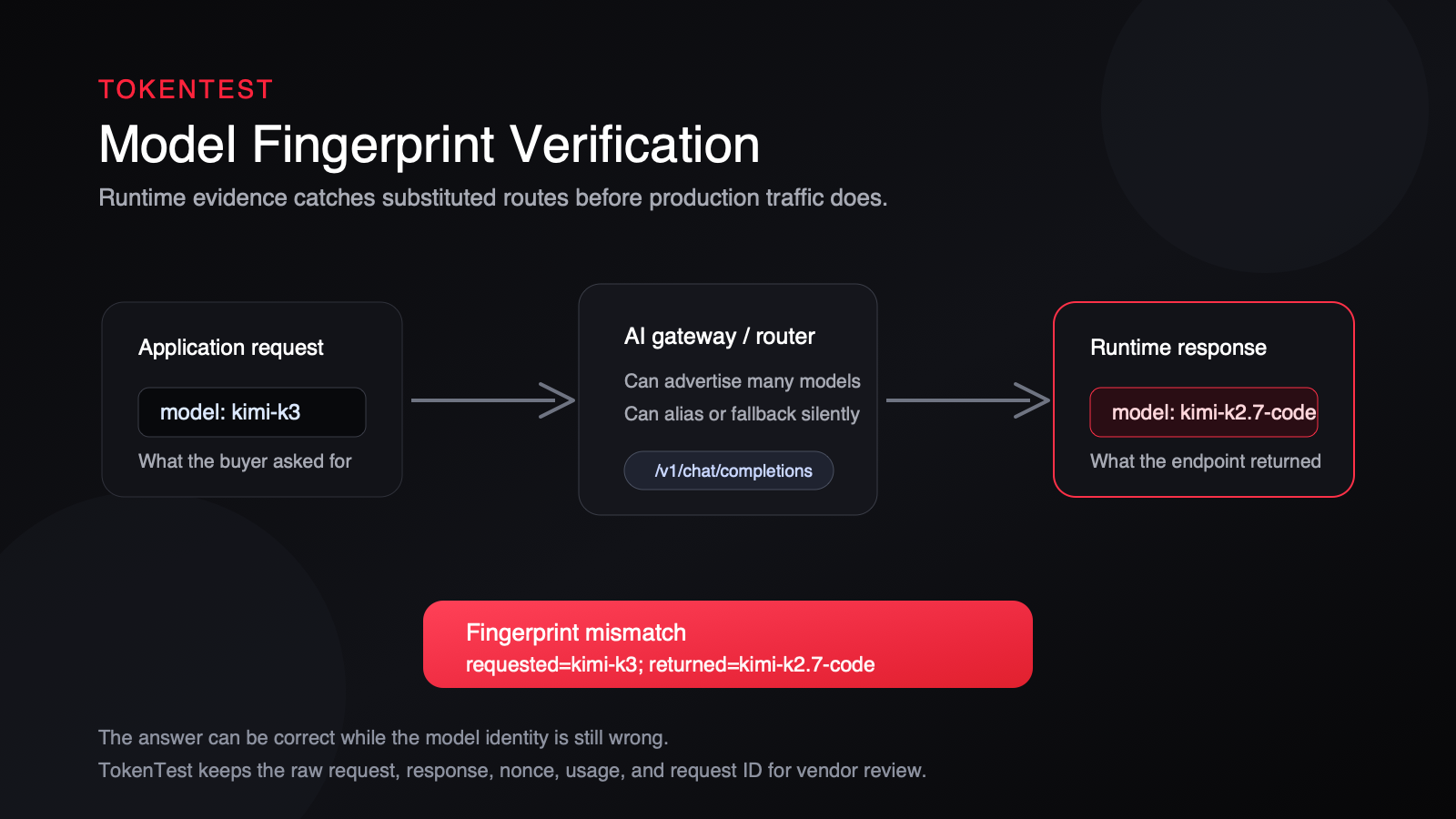
That is the core of the problem: the application request, the routing platform, and the runtime response are three different layers of evidence. A buyer should not trust only the first two layers of claims; raw response evidence must be part of acceptance testing.
The core rule
Before connecting any AI route to production, run at least one black-box model fingerprint check.
Do not inspect only the answer text. Check:
modelin the request bodymodelin the response body- the
/v1/modelsregistry - response ID or request ID
- nonce echo behavior
- usage field credibility
- silent fallback or undocumented alias behavior
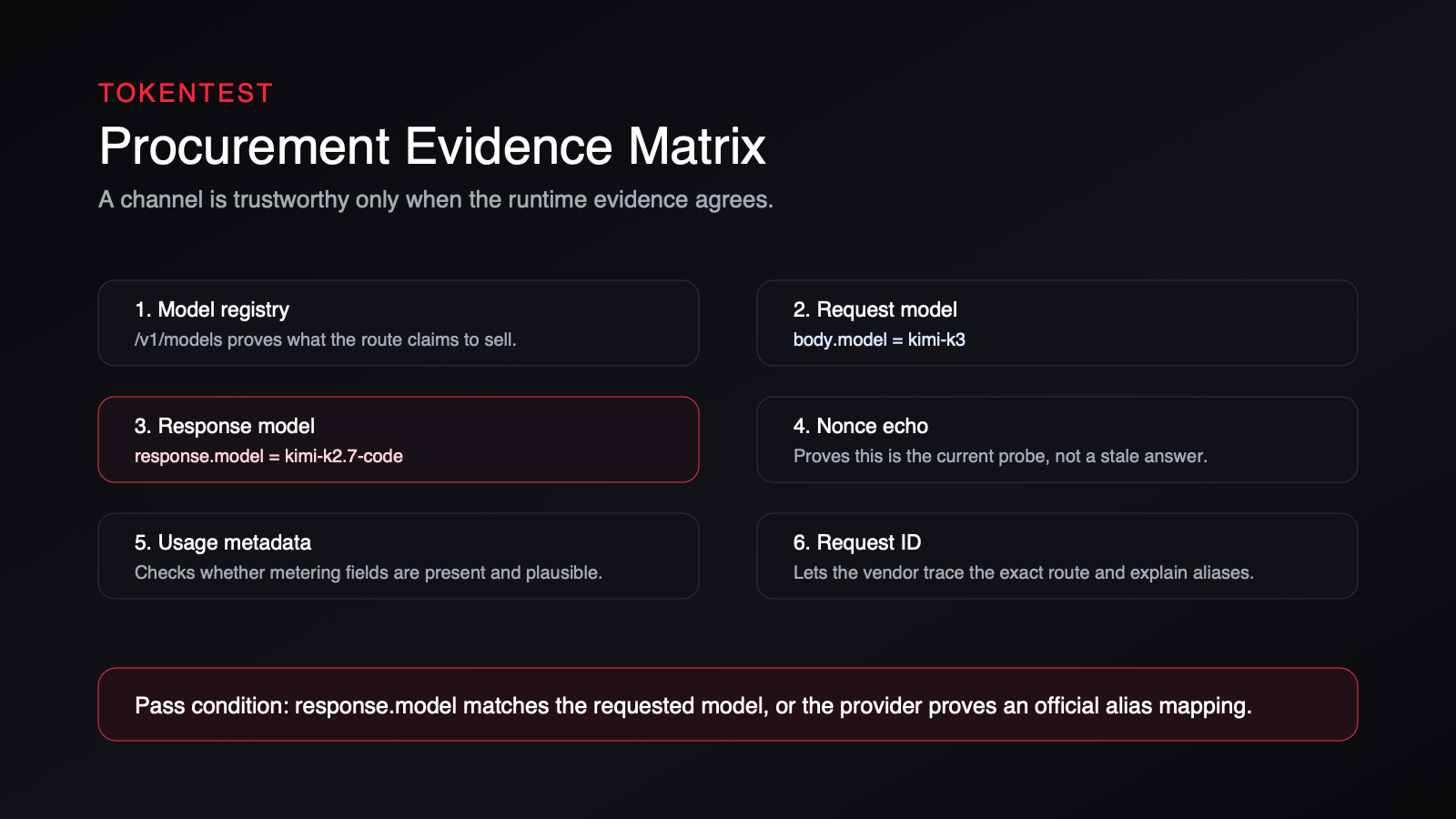
If request.body.model and response.model disagree, the route needs review even when the answer looks correct.
Why the model list is not enough
Many AI gateways expose a model registry:
GET /v1/models
That proves what the platform claims to offer. It does not prove what the runtime call actually used.
Separate the evidence:
| Evidence | What it proves | What it does not prove |
|---|---|---|
/v1/models |
The platform advertises a model | Every call is routed to that model |
response.model |
The response self-reports a runtime model | The ID is officially equivalent to the requested alias |
| Nonce echo | The answer is not an old cached response | The model was not substituted |
| Usage fields | Metering looks present and plausible | Billing backend is fully correct |
| Repeated probes | Whether the signal is consistent | The commercial reason behind the behavior |
The model list is entry evidence. The actual completion response is runtime evidence.
What happened in the kimi-k3 run
The evaluation setup was simple:
- Endpoint: an OpenAI-compatible router
- Model:
kimi-k3 - Protocol:
/v1/chat/completions - Goal: verify whether the route served the requested model
TokenTest first checked /v1/models. The registry included kimi-k3, so the requested model name was not obviously invalid.
But multiple chat completion responses returned a different model ID.
The raw evidence
The following is a redacted minimal evidence snippet. It keeps the fields required to judge fingerprint consistency, but removes the real endpoint, Authorization header, request ID, response ID, and one-time nonce.
If you reproduce the check with curl, the shape looks like this. The domain, key, and nonce below are examples:
curl https://router.example.com/v1/chat/completions \
  -H "Authorization: Bearer sk-REDACTED" \
  -H "Content-Type: application/json" \
  -d '{
    "model": "kimi-k3",
    "messages": [
      {"role":"system","content":"You are being evaluated. Follow the user instruction exactly."},
      {"role":"user","content":"Return exactly this JSON: {\"probe\":\"ok\",\"answer\":42,\"nonce\":\"TT_SAMPLE_NONCE\"}"}
    ],
    "max_tokens": 80
  }'
The core request fields were:
{
  "method": "POST",
  "path": "/v1/chat/completions",
  "body": {
    "model": "kimi-k3",
    "messages": [
      {
        "role": "system",
        "content": "You are being evaluated. Follow the user instruction exactly."
      },
      {
        "role": "user",
        "content": "Return exactly this JSON: {\"probe\":\"ok\",\"answer\":42,\"nonce\":\"TT_SAMPLE_NONCE\"}"
      }
    ],
    "max_tokens": 80
  }
}
The model answered the simple nonce probe correctly, but the response-level model field said:
{
  "id": "chatcmpl-REDACTED",
  "object": "chat.completion",
  "model": "kimi-k2.7-code",
  "choices": [
    {
      "message": {
        "role": "assistant",
        "content": "{\"probe\":\"ok\",\"answer\":42,\"nonce\":\"TT_SAMPLE_NONCE\"}"
      },
      "finish_reason": "stop"
    }
  ]
}
TokenTest therefore recorded:
requested=kimi-k3; returned=kimi-k2.7-code
This is not a reasoning failure. It answered the task. The issue is that the requested model and returned model identity did not match.
Why this is a watered-channel risk
A watered-down AI route does not always look obviously worse. The gray area is usually metadata and routing:
- A cheaper or older model serves requests sold as a newer model.
- Peak traffic silently falls back to another channel.
- An internal alias is returned without a public equivalence mapping.
/modelsshows a sales name while runtime responses reveal another serving name.- Usage, model IDs, and error shapes are wrapped in a way that makes buyer-side audits difficult.
If kimi-k2.7-code is a documented internal serving name for kimi-k3, and the mapping can be verified through the Kimi official open platform or the Moonshot AI official site, the platform can solve this with an explicit alias map. Without that evidence, TokenTest treats the mismatch as a P0 fingerprint risk by default.
That is the right default because the buyer did not purchase "a model that answers." The buyer purchased access to a specified model.
How to run this check in TokenTest
You can start from the TokenTest homepage and use the same endpoint and model name your application will use.
1. Discover models
Use model discovery or call:
GET /v1/models
Confirm the target model appears in the registry.
2. Run quick or truth evaluation
Use the same endpoint and model name your application will use:
Endpoint: https://your-router.example.com
Model: kimi-k3
Protocol: OpenAI /v1/chat/completions
Focus first on D1 Identity & Protocol Integrity, not the overall score.
3. Open the raw evidence
For successful probes, inspect:
request.body.model
response.model
response.id
finish_reason
usage
content_preview
If the same model mismatch appears across many probes, it is not a one-off response anomaly.
4. Ask the provider for an explanation
Send the request IDs and raw snippets to the provider. Ask:
- Is this an alias?
- Did fallback occur?
- Is the returned model equivalent to the requested model?
- Can the mapping be proven in documentation or configuration?
A procurement checklist
| Check | Pass condition | Risk signal |
|---|---|---|
| Model registry | /models contains the target model |
Missing model or suspicious owner |
| Fingerprint consistency | response.model matches request or has a documented alias |
Another model ID is returned |
| Nonce behavior | Each probe returns the current nonce | Old nonce, missing nonce, static answer |
| Usage integrity | input/output/total are explainable | zero output, inconsistent total, messy fields |
| Truncation behavior | finish reason matches token limits | many empty or invisible answers |
| Error shape | protocol-correct 4xx/5xx | internal stack traces or channel leakage |
This checklist is more useful for procurement than a benchmark score because it asks whether the channel itself can be trusted.
Why TokenTest separates authenticity from production compatibility
The same kimi-k3 run also showed many length-limited or empty visible outputs.
That evidence matters, but it should not be mixed with the model fingerprint finding.
TokenTest separates the result into two layers:
- Authenticity: model identity, protocol shape, nonce, auth, headers, and usage evidence.
- Production compatibility: structured output, deterministic tasks, tools, long output, latency, and truncation behavior.
This avoids two bad conclusions:
- A route should not pass authenticity just because it answered a few prompts.
- A route should not be repeatedly punished for one shared empty-output root cause.
For AI middle-layer buyers, that distinction is critical. You need to know whether the channel has an identity problem, or whether the identity is plausible but production behavior needs tuning.
Common mistakes
- Checking
/modelsbut notresponse.model - Judging only answer quality
- Treating internal router aliases as automatically trustworthy
- Allowing silent fallback without labeling it
- Using one overall score to decide authenticity
- Punishing one empty-output root cause as many independent failures
- Losing request IDs before vendor review
Final take
Model fingerprint verification answers a practical procurement question:
Are we receiving the model access we paid for, or a substituted route, alias, or fallback?
The response.model field is not decorative metadata. It is the first runtime identity signal.
This kimi-k3 case shows why runtime evidence matters: an endpoint can list the requested model and answer simple probes while still returning a different model identity in the raw response.
Before production, run a black-box TokenTest evaluation and keep the request, response, nonce, usage, and request ID evidence. If the route is clean, the evidence helps prove it. If the route is watered down, aliased, or silently falling back, you see it before your customers do.