Token Budget Templates for Product Managers Shipping AI Features
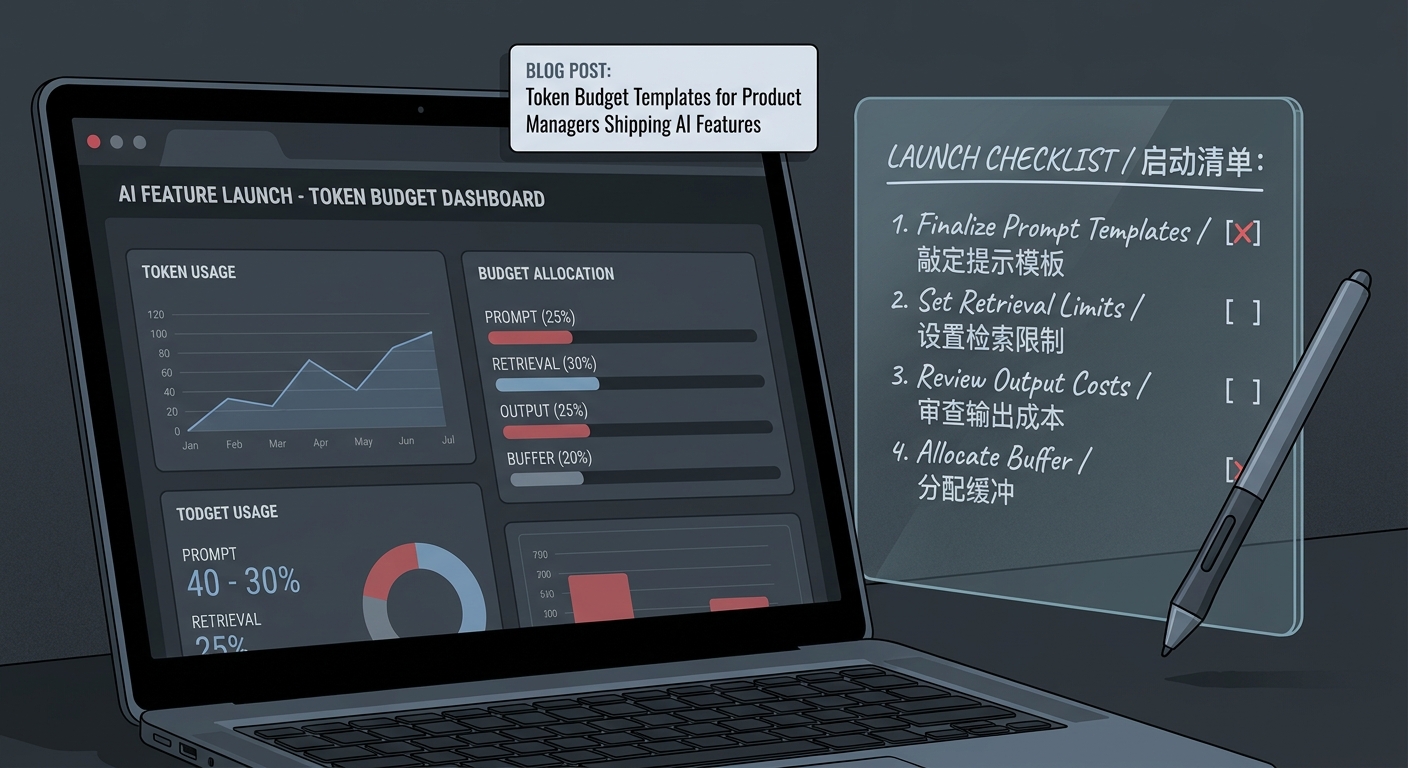
Token Budget Templates for Product Managers Shipping AI Features
Product managers usually do not need one more abstract explainer about tokens. They need a repeatable way to answer a harder launch question:
Will this AI feature still fit its cost, latency, and quality guardrails after prompts get longer, retrieval grows, and localization ships?
That is where token budget templates for product managers shipping AI features are useful. They turn token counting from a developer-side estimate into a launch artifact a PM can review, challenge, and approve.
As of July 21, 2026, OpenAI's current token-counting guide gives teams two concrete planning facts:
- You can count request input tokens before send through
POST /v1/responses/input_tokens. - Reported output usage includes all generated tokens, not only visible answer text, so
max_output_tokensneeds real headroom.
Those two facts matter because a feature budget is rarely just prompt text. It also includes retrieval, tool scaffolding, response formatting, and whatever output reserve your UX depends on.
TokenTest is useful in that workflow because the live product is not positioned as a toy counter. The homepage describes TokenTest as a production-reference evaluation console that batch-tests token usage, model capability, route protocol, safety boundaries, and channel reliability, while explicitly stating that your API key is never stored. The visible checks include Usage integrity, cache token evidence, thinking / reasoning tokens, token total consistency, input monotonicity, and stop/token limit linkage. The product manual's D4 token dimension defines the review scope around usage presence, total consistency, input monotonicity, output reasonableness, stop-limit linkage, stream usage, and cache evidence.
That combination makes TokenTest a practical review surface for token budget templates for product managers shipping AI features.
Why token budget templates for product managers shipping AI features matter
Most launch reviews still break token planning into two weak questions:
- What did the engineering team measure in staging?
- What is the model's maximum context window?
Neither question is enough on its own.
The first one is often based on a short English happy-path prompt. The second one is a ceiling, not a launch budget. Between those two numbers sits the real product decision:
- How much budget belongs to instructions?
- How much belongs to user input?
- How much belongs to retrieval or attached files?
- How much belongs to output reserve?
- How much uncertainty do you want to carry into production?
If the PM cannot review those splits, the feature is being approved on incomplete evidence.
The token budget formula PMs can actually use
Start every feature review with one shared formula:
total_request_budget
= system_tokens
+ user_input_tokens
+ retrieval_tokens
+ tool_and_format_tokens
+ reserved_output_tokens
+ safety_buffer
For reasoning-heavy workflows, keep an extra note beside the template:
launch_buffer
= safety_buffer
+ non_visible_output_allowance
The point is not to pretend the template is mathematically perfect. The point is to force every team to budget the same six buckets before launch.
Token budget templates for product managers shipping AI features: three working patterns
Template 1: Single-turn support classifier
Use this when the feature reads one customer message and returns a structured answer.
| Budget area | Starting rule | PM review question |
|---|---|---|
| System instructions | Keep under one short policy block | Is any instruction repeated elsewhere in the stack? |
| User input | Size from the 95th percentile message | What happens for the longest real tickets? |
| Retrieval | Usually 0 |
Is retrieval truly unnecessary? |
| Tools and format | Include JSON schema and routing labels | Are we paying for structure the UI does not need? |
| Reserved output | Small and fixed | Does the feature need explanation or just classification? |
| Safety buffer | Keep a small fixed reserve | Is there enough room for non-visible formatting tokens? |
Best use case: triage, intent classification, refund risk, escalation routing.
Template 2: Multilingual support copilot
This is the first template where token budget templates for product managers shipping AI features usually pay off.
| Budget area | Starting rule | PM review question |
|---|---|---|
| System instructions | One source prompt, localized only when needed | Which policy text must be translated versus reused? |
| User input | Measure each production language separately | Are we budgeting from English only? |
| Retrieval | Cap the support article block | Can we trim retrieved passages before send? |
| Tools and format | Include tool schemas and citation format | Which parts are required for the user-visible answer? |
| Reserved output | Set by the longest supported language flow | Does Chinese, Japanese, or German need a larger reserve? |
| Safety buffer | Larger than classifier template | Do we still have room if localized prompts expand? |
Best use case: bilingual helpdesk assistant, multilingual onboarding guide, internal support copilot.
Template 3: Retrieval-heavy product assistant
Use this for features that compare docs, summarize long context, or call tools.
| Budget area | Starting rule | PM review question |
|---|---|---|
| System instructions | Keep one concise policy layer | Which policy lines are historical baggage? |
| User input | Measure task prompts, not toy examples | What is the largest real task users submit? |
| Retrieval | Treat this as the biggest controllable cost bucket | Which retrieval chunks are actually used? |
| Tools and format | Count every schema and response wrapper | Which tools are loaded but rarely called? |
| Reserved output | Set from UX expectation, not optimism | What is the minimum acceptable answer length? |
| Safety buffer | Highest of the three templates | How much room is left for formatting drift and truncation risk? |
Best use case: PRD copilot, policy comparison, contract summary, long-form internal search assistant.
How product managers should score the template
For each feature, require four outputs in the review doc:
- Base budget: the canonical request shape that engineering plans to ship.
- Stress budget: the same task with longer context, stricter formatting, or larger retrieval.
- Localized budget: the same workflow in every launch language.
- Live validation note: whether runtime usage fields behaved credibly when the workflow was tested.
That last line is why token budget templates for product managers shipping AI features should not stop at preflight counting.
What the official docs tell you, and what they do not
OpenAI's current guide is strong on the preflight question: how many input tokens the exact request shape will consume before you send it.
It is also explicit about the output caveat. Reported output usage includes non-visible generated tokens, and those tokens still count against max_output_tokens. That means a PM can approve a feature with a prompt that fits, but still miss a launch risk if the output reserve is too optimistic.
What the guide does not do is validate whether your endpoint, router, or proxy reports usage fields in a way you can trust. That is the runtime problem, not the preflight problem.
Where TokenTest fits into the PM workflow
TokenTest helps bridge that gap.
A PM does not need to inspect every raw response. They need to know whether the system behaves plausibly under change. The visible TokenTest checks map cleanly to launch review questions:
| TokenTest signal | PM question it answers |
|---|---|
| Usage integrity | Did the endpoint return auditable usage fields at all? |
| Token total consistency | Do the totals reconcile when prompt size changes? |
| Input monotonicity | Does a larger prompt produce a clearly larger input count? |
| Stop/token limit linkage | Does a tighter cap change behavior in a believable way? |
| Cache token evidence | Are repeated runs actually showing cache behavior when expected? |
| Thinking / reasoning tokens | Is hidden compute pressure visible in the usage evidence? |
That is a more reviewable workflow than asking the PM to trust a spreadsheet exported from one staging call.
A rollout workflow for token budget templates for product managers shipping AI features
Use this sequence before launch:
- Freeze one production-like task for the feature.
- Count the exact request shape before send.
- Repeat the count with the longest realistic input.
- Repeat the count for every launch language.
- Run the same cases in TokenTest against the live endpoint.
- Record the pass or fail result in the feature review.
If a team skips steps 4 or 5, the template is incomplete.
Examples you can paste into TokenTest
Example 1: Baseline support classification
You are a support operations assistant.

Return strict JSON with:
- issue_type
- urgency
- summary

Customer message:
"I was billed twice after checkout failed and I still cannot access the premium feature."
Use this to establish the lowest-cost version of the workflow.
Example 2: Policy-heavy variant
You are a support operations assistant for a subscription SaaS product.

Rules:
1. Return strict JSON only.
2. Never provide legal, financial, or medical advice.
3. If the customer mentions duplicate charges, set issue_type to billing_issue.
4. If the customer lost access after payment, set urgency to high.
5. Add a summary under 25 words.

Customer message:
"I was billed twice after checkout failed and I still cannot access the premium feature."
Run this against Example 1 to confirm input monotonicity and larger structure overhead.
Example 3: Chinese localized check
你是一名客服运营助手。

请返回严格的 JSON,包含:
- issue_type
- urgency
- summary

客户消息:
"结账失败后我被重复扣费,而且仍然无法使用高级功能。"
Use this to validate that the multilingual template is measured directly instead of inferred from English.
What to watch for in multilingual launches
Multilingual release work is where token budget templates for product managers shipping AI features stop being optional.
Do not assume:
- the English prompt and Chinese prompt cost the same
- the same output cap is safe in every language
- retrieval snippets stay the same length after localization
- one staging run is enough to approve the rollout
Instead, require a localized budget row for every language in scope. If the feature launches in English and Chinese on July 21, 2026, both rows should exist before approval on that date.
A compact launch checklist
| Check | Pass condition |
|---|---|
| Exact request counted | Team measured the real prompt, tools, and retrieval shape |
| Long-input scenario counted | Team measured the longer realistic case |
| Localized requests counted | Every launch language has its own row |
| Output reserve defined | max_output_tokens reflects UX need plus headroom |
| Runtime usage validated | TokenTest checks remained believable under change |
| PM sign-off note written | Budget decision is visible in the launch record |
What not to do
Avoid these anti-patterns:
- Do not approve from a single English happy-path prompt.
- Do not use the model's maximum context number as the product budget.
- Do not ignore non-visible output when setting
max_output_tokens. - Do not approve a multilingual feature without localized counts.
- Do not trust runtime usage fields that stay flat across clearly different prompt sizes.
Final take
Good token budget templates for product managers shipping AI features do not try to replace engineering judgment. They make engineering judgment reviewable.
That is the real value: one template, one formula, one multilingual check, and one live validation pass before a feature ships.
If you want a stronger launch rule, use this:
Do not ship an AI feature until the team has counted the exact request, measured the largest realistic variant, reviewed every launch language, and validated live usage integrity.
That is a standard a PM can defend, and TokenTest is well positioned to support it.
Sources
- OpenAI token counting guide: https://developers.openai.com/api/docs/guides/token-counting
- TokenTest homepage: https://tokentest.io/
- TokenTest product manual: https://tokentest.io/manual