How to Reserve Output Tokens Without Undercutting Answer Quality
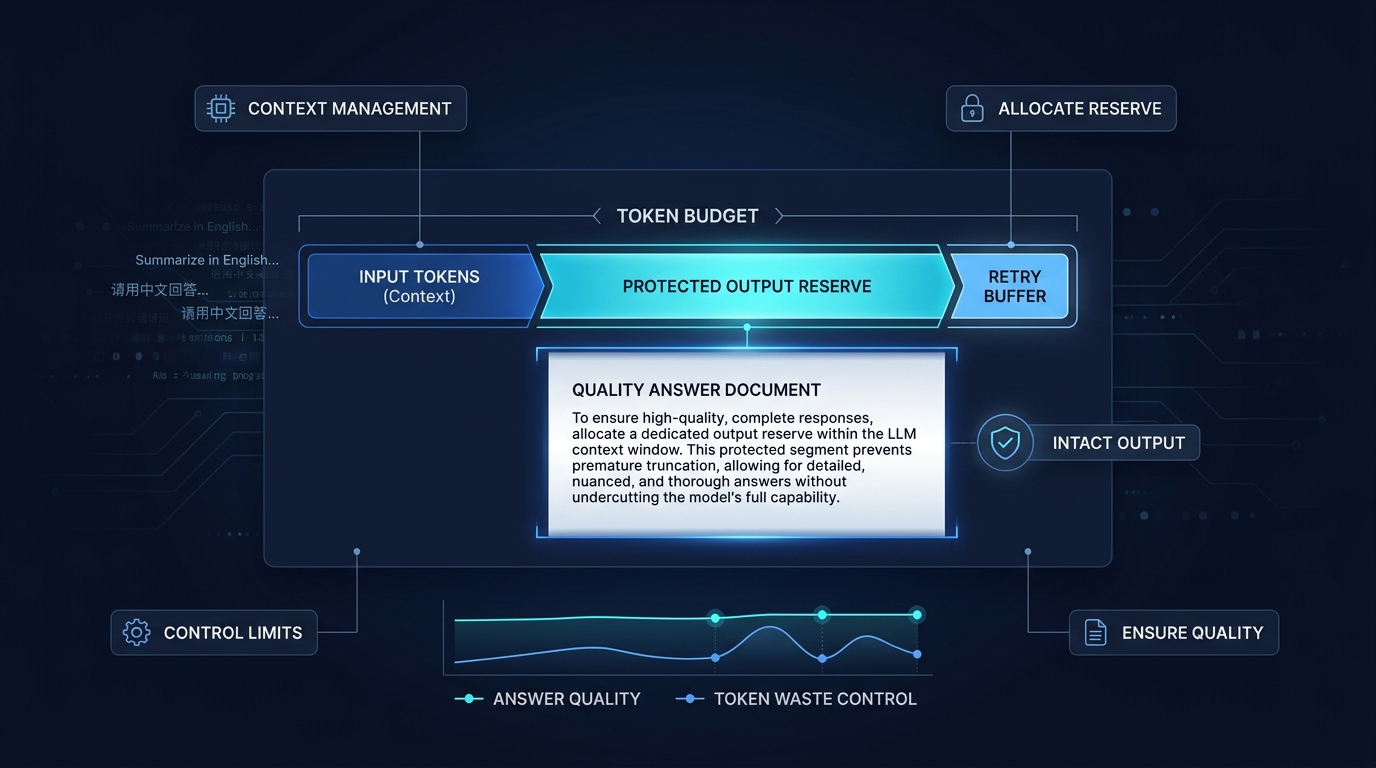
Output-token limits are useful until they make the model stop halfway through the answer you actually needed. A cap that is too loose wastes budget and leaves less room for input. A cap that is too tight can remove the conclusion, truncate JSON, skip required sections, or force a second call that costs more than the tokens you tried to save.
The practical answer is not to reserve a fixed percentage of every context window. Reserve a minimum viable answer first, add task-specific headroom, and then fit the input around that protected output budget.
This guide shows how to reserve output tokens without undercutting answer quality, with formulas, examples, paste-ready test prompts, and a workflow you can run in TokenTest.
What “reserving output tokens” really means
Every model request must fit within the limits of the route you use. At a planning level, think of the request as:
usable context >= input tokens + reserved output tokens + safety margin
The exact accounting differs by provider and model. Chat wrappers, tools, images, schemas, cached content, and internal reasoning can change what is counted or reported. That is why a planning estimate should not be treated as the final source of truth.
An output reserve is therefore a pre-call capacity decision, not a prediction that the model will consume every reserved token. You are protecting enough space for a valid answer while allowing the generation to stop naturally when it is complete.
Why small output caps can reduce answer quality
An output limit does not tell the model which parts of the answer are expendable. If the generation reaches the cap, the result may stop at an arbitrary point.
That creates four common failure modes:
- Structural truncation: a JSON object, code block, table, or numbered workflow ends before it closes.
- Priority inversion: the model spends tokens on context-setting and loses the recommendation or conclusion.
- Requirement loss: later sections in a multi-part instruction disappear even though the beginning looks polished.
- False savings: the incomplete answer triggers a continuation, repair, or full retry.
A concise complete answer is efficient. An incomplete answer is not.
The protected-output formula
Use this starting formula for each request:
protected output reserve = minimum viable answer
                         + format overhead
                         + uncertainty allowance
                         + optional reasoning allowance
1. Minimum viable answer
Define the shortest response that can still pass the task. Count required sections, fields, examples, citations, code blocks, or steps.
For example, a support classification that returns five JSON fields needs far less output room than a technical migration plan with risks, commands, and rollback steps.
2. Format overhead
Structured formats consume tokens that are not part of the prose itself. Budget for keys, braces, Markdown syntax, code fences, table separators, citations, and repeated labels.
3. Uncertainty allowance
Add room when the answer length varies with the evidence. Retrieval results, tool output, source count, input language, and the number of detected issues can all expand the response.
4. Reasoning allowance
Some APIs report internal or non-visible reasoning tokens as output usage, and an output cap can constrain that usage along with visible text. OpenAI's current token-counting guide explicitly warns that output usage may include tokens you do not see. Do not size a reasoning-model response from visible word count alone.
A practical reserve table
Use task shape—not model context size—as the first sizing signal.
| Task | Minimum viable answer | Suggested initial reserve | Quality check |
|---|---|---|---|
| Classification with compact JSON | 30–80 tokens | 100–250 tokens | All fields parse and use allowed values |
| Short support answer | 100–250 tokens | 250–500 tokens | Direct answer, key caveat, next step |
| Extraction from one document | Schema-dependent | 1.5–2.5× a filled sample | Valid structure; no missing required fields |
| Code fix with explanation | 300–800 tokens | 700–1,500 tokens | Complete patch, assumptions, verification |
| Source-backed analysis | 600–1,500 tokens | 1,200–3,000 tokens | Recommendation, evidence, caveats, sources |
| Long-form article draft | 1,200–2,500 tokens | 2,000–4,000 tokens | All planned sections and CTA are present |
These are test ranges, not universal model limits. Replace them with observed percentiles from your own prompts and route.
How to reserve output tokens without undercutting answer quality
Step 1: Write a completion contract
Before choosing a cap, define what “complete” means.
The answer must contain:
- one direct recommendation;
- three implementation steps;
- one risk or caveat;
- one verification check;
- no introduction longer than two sentences.
This makes the quality floor testable. It also tells the model to prioritize valuable content before optional detail.
Step 2: Create a representative answer skeleton
Draft the shortest acceptable structure with placeholders:
Recommendation: [1-2 sentences]

Steps:
1. [action]
2. [action]
3. [action]

Risk: [one caveat]
Check: [one verification]
Count or estimate this skeleton, fill it with realistic content, and use it as the minimum viable answer. Do not estimate from the prompt alone.
Step 3: Add format and variance headroom
For tightly bounded JSON, a small absolute buffer may be enough. For source-backed analysis or multilingual content, use a larger allowance because the number and length of valid points vary.
A simple starting rule is:
initial output cap = representative valid answer × 1.3 to 1.8
Use the lower end for fixed schemas and the higher end for open-ended synthesis. This multiplier is a testing heuristic, not a provider guarantee.
Step 4: Protect the reserve before adding more input
If a request approaches the route's usable context, reduce or summarize input before shrinking the protected answer.
Prioritize input in this order:
- system and safety instructions;
- the user's current request;
- required evidence and tool results;
- recent relevant conversation;
- optional examples and historical context.
Dropping low-value history is usually safer than forcing a 1,000-token deliverable into 300 output tokens.
Step 5: Make the prompt quality-aware
Ask for prioritization, not merely brevity.
Answer within the available budget. Preserve the final recommendation,
required fields, and verification steps. Compress background explanation
first. Do not leave code, JSON, tables, or numbered steps incomplete.
Avoid asking the model to “use every token.” A maximum is a ceiling, not a target.
Step 6: Validate the stop condition
After the call, inspect the provider's finish or stop reason and reported usage. A response that stopped because it reached a token limit should not automatically pass just because it contains fluent text.
For structured output, parse it. For code, run the narrowest relevant check. For a report, verify that every required section exists.
Step 7: Tune from valid production samples
Track output usage only for responses that passed the task. Then choose a cap from the upper range of valid outputs rather than from the overall average.
Useful fields include:
route
task_type
input_tokens
output_tokens
output_cap
finish_reason
task_valid
repair_required
language
If many valid answers use less than half the cap, lower it gradually. If truncation or repair rates rise, increase the reserve or tighten the requested structure.
Paste-ready experiments for TokenTest
Open TokenTest, choose the model or tokenizer relevant to your route, and compare these prompts before you send them to production.
Experiment 1: Short but complete support answer
You are a technical support engineer. Explain why an API request may hit a
context limit even when the visible user message is short.

Completion contract:
- answer in no more than 180 words;
- include one direct explanation;
- include three likely hidden contributors;
- include one diagnostic next step;
- preserve the diagnostic step if you need to compress.
Experiment 2: Fixed JSON reserve
Classify the following product feedback. Return valid JSON only with these
keys: sentiment, topic, urgency, summary, needs_human_review.

Allowed sentiment: positive, neutral, negative.
Allowed urgency: low, medium, high.
Keep summary under 30 words.

Feedback:
“The export works, but yesterday's usage total is missing and our finance
team needs the report before noon.”
Experiment 3: Bilingual variance
Paste the completion contract once in English and once in Chinese. Keep the meaning and required fields equivalent, then compare input estimates and leave separate output headroom for each language. Token counts are model- and tokenizer-specific; equivalent meaning does not imply identical token usage.
Better ways to save tokens than cutting the answer
If the output reserve does not fit, reduce waste elsewhere first:
- summarize old conversation turns;
- cap retrieval results by relevance and size;
- remove duplicate tool output;
- request a bounded number of examples;
- use a compact schema;
- ask the reviewer for a patch list instead of a full rewrite;
- split discovery from final synthesis;
- store large artifacts outside the conversation and pass only required excerpts.
These changes preserve the answer's quality floor while reducing the input or repeated-generation cost.
Adaptive output caps work better than one global limit
A production system should classify the task before assigning an output cap.
if task is fixed-schema extraction:
    cap = filled_schema_estimate + small_buffer
elif task is short answer:
    cap = contract_estimate * 1.3
elif task is source-backed synthesis:
    cap = contract_estimate * 1.6
else:
    use a conservative default and collect evidence
You can also increase the cap when the request contains more required sections, more sources, more code files, or a language pair that has shown higher usage on the selected route.
Common mistakes
Reserving a fixed percentage of the context window
Ten percent may be excessive for a classifier and inadequate for a report. Reserve by deliverable shape.
Measuring only visible words
Tokens do not map one-to-one to words, and some routes report non-visible output usage. Use route-native usage data for final tuning.
Treating truncation as a prompt problem only
A better prompt helps, but it cannot fit an answer into a cap smaller than the required structure.
Increasing the cap without controlling scope
A loose prompt can expand to fill available space. Pair the cap with a completion contract, section limits, and a clear priority order.
Using one budget for every language
Tokenization varies by text, language, model, and tokenizer. Test each important locale rather than copying the English budget.
Final checklist
Before shipping a token limit, confirm that you have:
- defined the minimum viable answer;
- budgeted structural overhead;
- allowed for task and language variance;
- protected output room before optional input;
- instructed the model what to compress first;
- checked finish reasons and validity;
- tracked repair and retry rates;
- and tuned the cap only from valid answers.
That is how to reserve output tokens without undercutting answer quality: protect completeness first, constrain optional detail second, and replace estimates with observed evidence.
Use TokenTest to check prompt size, compare languages and models, and make the reserve visible before the request reaches production.
For more practical prompt-budgeting workflows, browse the TokenTest blog.
FAQ
Should I reserve the model's full maximum output?
Usually no. Reserve enough for a valid response plus measured headroom. A very high cap can reduce available input capacity and weaken cost controls, even if the model stops before using it.
Is a 20% output reserve a good rule?
It is too broad to be a reliable rule. Fixed-schema extraction may need much less, while long-form synthesis may need more. Estimate the required deliverable first.
What should I do when the answer hits the output cap?
Treat it as incomplete until validated. Increase the cap, reduce low-value input, tighten the structure, or request a bounded continuation that starts from the missing section rather than regenerating everything.
Do reasoning tokens reduce room for the visible answer?
They can on routes where reasoning tokens are counted within output usage or controlled by the output-token cap. Check the official documentation and usage fields for the specific model and API route.
How should I budget output tokens for Chinese and English?
Test both versions with the actual tokenizer or route. Do not convert from word count or assume equivalent prompts have equal token counts.